Enos Arielle N, Kozak Genevieve M
Department of Biology University of Massachusetts-Dartmouth Dartmouth Massachusetts USA.
Ecol Evol. 2021 Aug 4;11(17):12064-12074. doi: 10.1002/ece3.7972. eCollection 2021 Sep.
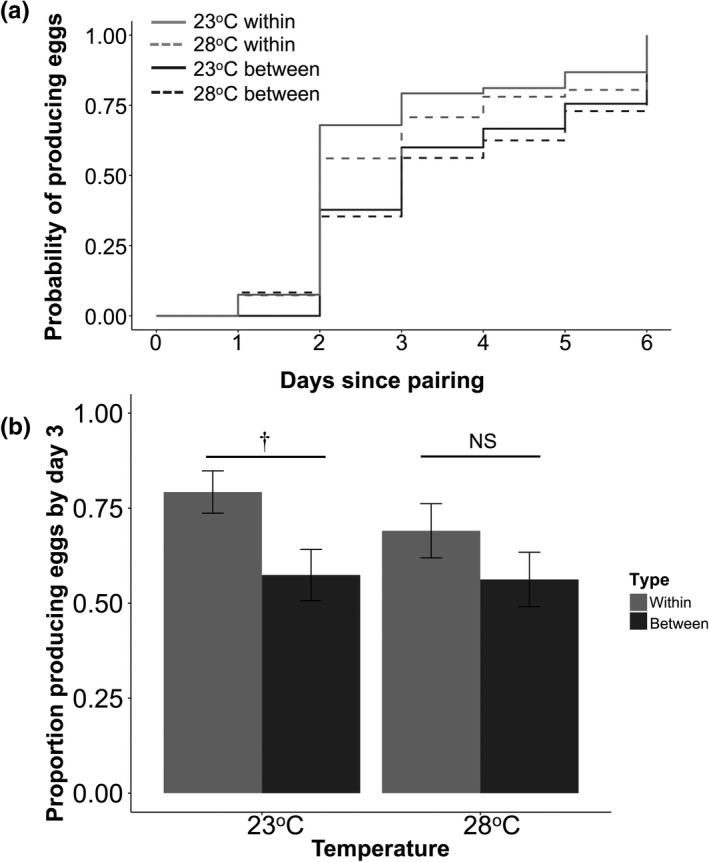
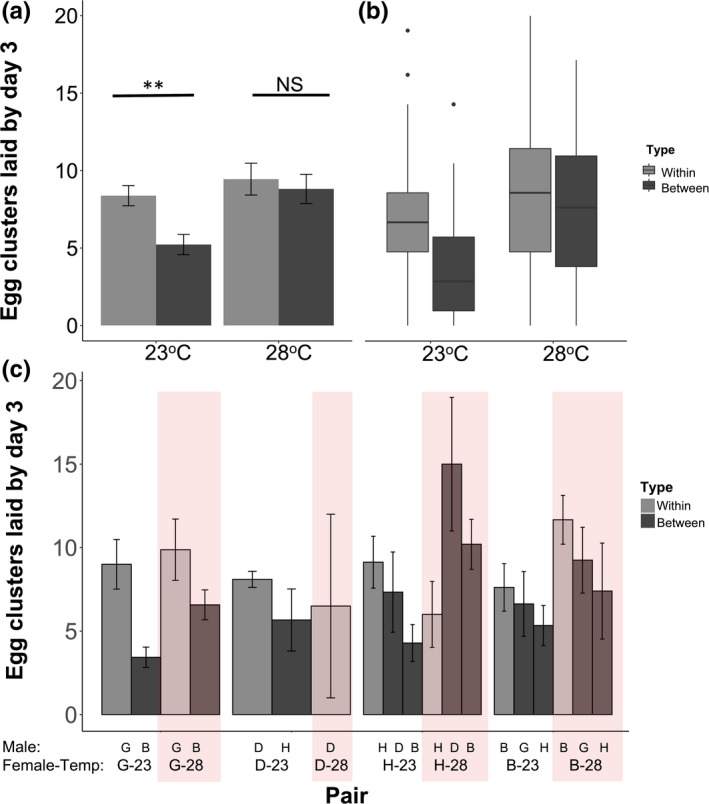
Rapidly changing environments may weaken sexual selection and lead to indiscriminate mating by interfering with the reception of mating signals or by increasing the costs associated with mate choice. If temperature alters sexual selection, it may impact population response and adaptation to climate change. Here, we examine how differences in temperature of the mating environment influence reproductive investment in the European corn borer moth (). Mate preference in this species is known to be related to pheromone usage, with assortative mating occurring between genetically distinct E and Z strains that differ in the composition of female and male pheromones. We compared egg production within and between corn borer lines derived from four different populations that vary in pheromone composition and other traits. Pairs of adults were placed in a mating environment that matched the pupal environment (ambient temperature) or at elevated temperature (5°C above the pupal environment). At ambient temperature, we found that within-line pairs produced eggs sooner and produced more egg clusters than between-line pairs. However, at elevated temperature, between-line pairs produced the same number of egg clusters as within-line pairs. These results suggest that elevated temperature increased investment in matings with typically less preferred, between-line mates. This increased investment could result in changes in gene flow among corn borer populations in warming environments.
快速变化的环境可能会削弱性选择,并通过干扰交配信号的接收或增加与配偶选择相关的成本导致随意交配。如果温度改变性选择,可能会影响种群对气候变化的反应和适应。在此,我们研究交配环境温度的差异如何影响欧洲玉米螟蛾()的生殖投入。已知该物种的配偶偏好与性信息素的使用有关,在遗传上不同的E型和Z型品系之间会发生选型交配,这两种品系的雌雄性信息素组成不同。我们比较了来自四个不同种群的玉米螟品系内部和之间的产卵情况,这些种群在性信息素组成和其他特征方面存在差异。将成对的成虫置于与蛹环境匹配的交配环境(环境温度)或高温环境(比蛹环境高5°C)中。在环境温度下,我们发现品系内的成对个体比品系间的成对个体产卵更早且产卵团更多。然而,在高温环境下,品系间的成对个体产卵团数量与品系内的成对个体相同。这些结果表明,高温增加了与通常不太受青睐的品系间配偶交配的投入。这种增加的投入可能会导致变暖环境中玉米螟种群之间基因流动的变化。