Department of Biology, Tufts University, 200 Boston Ave, Suite 4700, Medford, MA, 02155, USA.
Current Affiliation: Rochester Institute of Technology, Thomas H. Gosnell School of Life Sciences, 85 Lomb Memorial Drive, Rochester, NY, 14623, USA.
BMC Evol Biol. 2020 Mar 6;20(1):34. doi: 10.1186/s12862-020-1598-6.
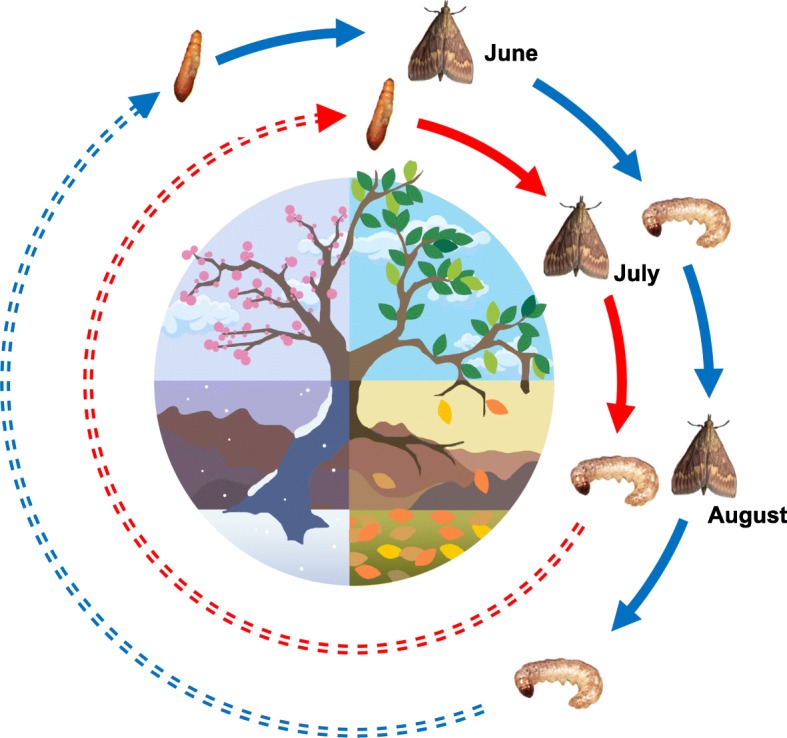
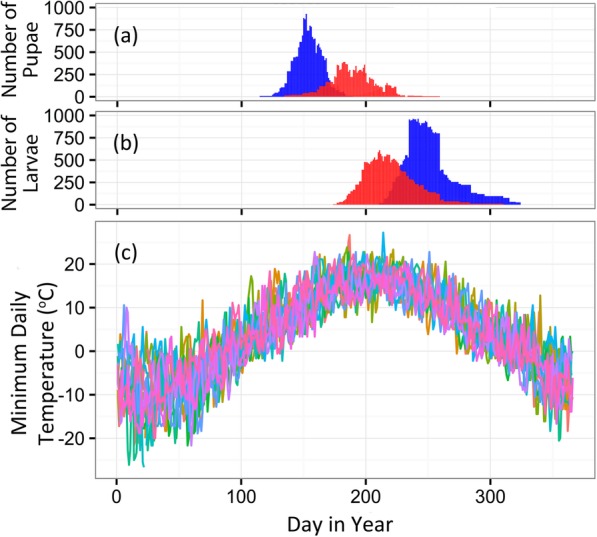
Understanding adaptation involves establishing connections between selective agents and beneficial population responses. However, relatively little attention has been paid to seasonal adaptation, in part, because it requires complex and integrative knowledge about seasonally fluctuating environmental factors, the effects of variable phenology on exposure to those factors, and evidence for temporal specialization. In the European corn borer moth, Ostrinia nubilalis, sympatric pheromone strains exploit the same host plant (Zea mays) but may genetically differ in phenology and be reproductively "isolated by time." Z strain populations in eastern North America have been shown to have a prolonged larval diapause and produce one annual mating flight (July), whereas E strain populations complete an earlier (June) and a later (August) mating flight by shortening diapause duration. Here, we find evidence consistent with seasonal "adaptation by time" between these ecotypes.
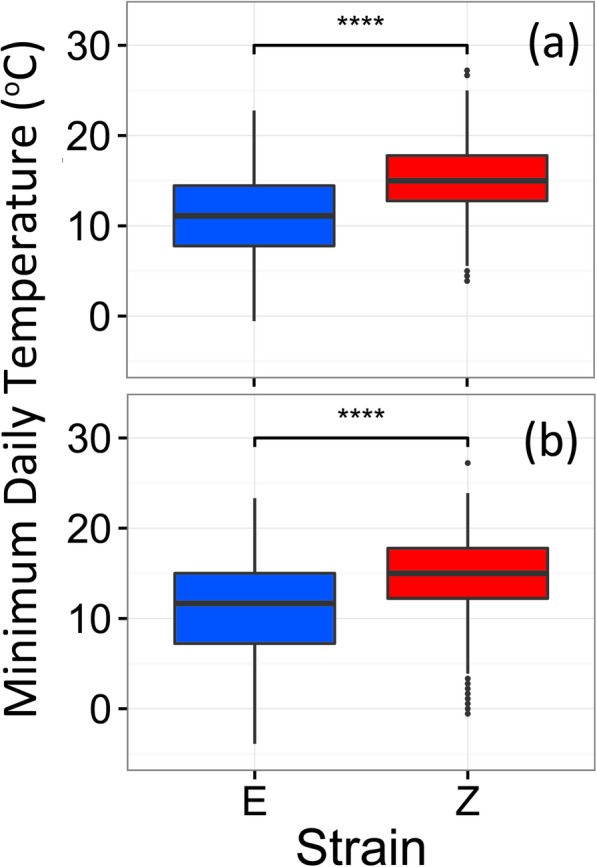
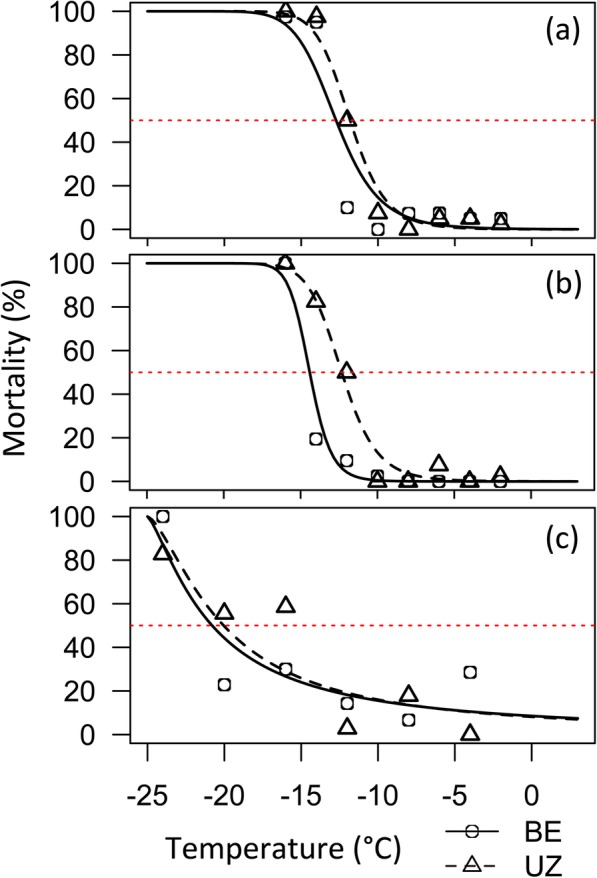
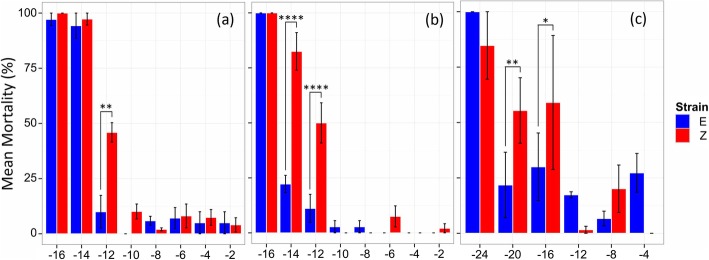
We use 12 years of field observation of adult seasonal abundance to estimate phenology of ecotype life cycles and to quantify life-stage specific climatic conditions. We find that the observed reduction of diapause duration in the E strain leads their non-diapausing, active life stages to experience a ~ 4 °C colder environment compared to the equivalent life stages in the Z strain. For a representative pair of populations under controlled laboratory conditions, we compare life-stage specific cold tolerance and find non-diapausing, active life stages in the E strain have as much as a 60% greater capacity to survive rapid cold shock. Enhanced cold hardiness appears unrelated to life-stage specific changes in the temperature at which tissues freeze.
Our results suggest that isolation by time and adaptation by time may both contribute to population divergence, and they argue for expanded study in this species of allochronic populations in nature experiencing the full spectrum of seasonal environments. Cyclical selective pressures are inherent properties of seasonal habitats. Diverse fluctuating selective agents across each year (temperature, predation, competition, precipitation, etc.) may therefore be underappreciated drivers of biological diversity.
理解适应需要建立选择性因素与有益种群反应之间的联系。然而,季节性适应相对较少受到关注,部分原因是它需要关于季节性波动的环境因素、变异性期对暴露于这些因素的影响以及时间特化的证据的复杂综合知识。在欧洲玉米螟蛾中,同域化信息素株系利用相同的宿主植物(玉米),但在物候学上可能存在遗传差异,并且在繁殖上“因时间而隔离”。已表明,北美东部的 Z 株系种群的幼虫滞育期延长,并产生一次年度交配飞行(7 月),而 E 株系种群通过缩短滞育期来完成更早(6 月)和更晚(8 月)的交配飞行。在这里,我们发现这些生态型之间存在季节性“时间适应”的证据。
我们使用 12 年的野外成虫季节性丰度观测来估计生态型生命周期的物候,并量化特定生命阶段的气候条件。我们发现,E 株系滞育期的缩短导致其非滞育、活跃的生命阶段经历比 Z 株系同等生命阶段低约 4°C 的环境。对于控制实验室条件下的一对代表性种群,我们比较了特定生命阶段的耐寒性,发现 E 株系的非滞育、活跃的生命阶段对快速冷休克的存活能力提高了约 60%。增强的耐寒性似乎与组织冻结温度的特定生命阶段变化无关。
我们的结果表明,时间隔离和时间适应都可能导致种群分化,并且它们呼吁在这个经历完整季节性环境的异时种群的物种中扩大对时间隔离和时间适应的研究。周期性的选择压力是季节性栖息地的固有特性。因此,每年多样化的波动选择因素(温度、捕食、竞争、降水等)可能是生物多样性的被低估的驱动因素。