Westhof Andreas, Kleinschmidt-Doerr Kerstin, Michaelis Martin, Brenneis Christian
TIP Immunology, Innovation Cluster Osteoarthritis, Merck Healthcare KGaA, Darmstadt, Germany.
Heliyon. 2021 Sep 2;7(9):e07906. doi: 10.1016/j.heliyon.2021.e07906. eCollection 2021 Sep.
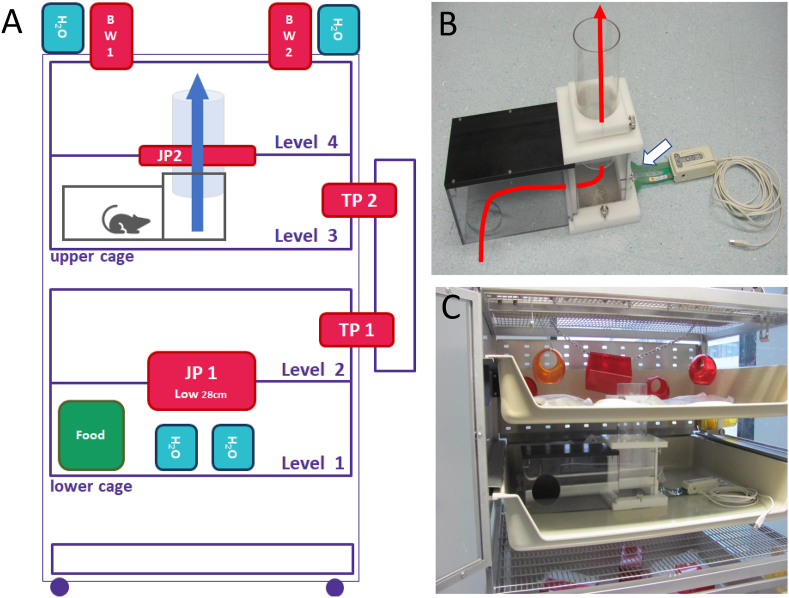
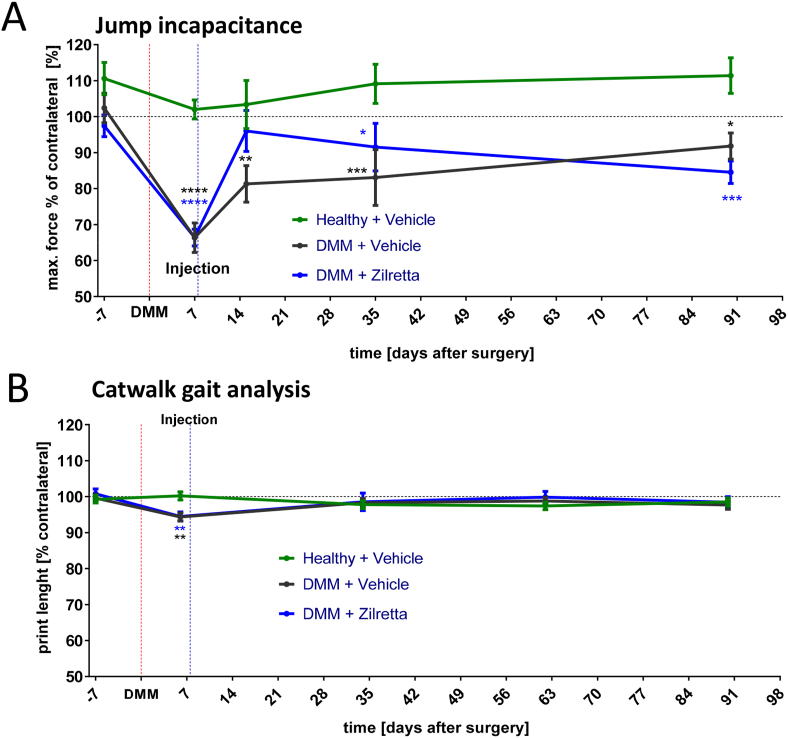
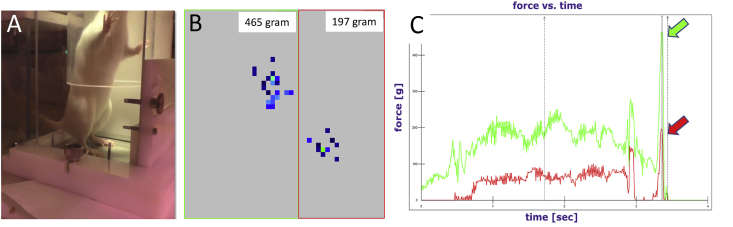
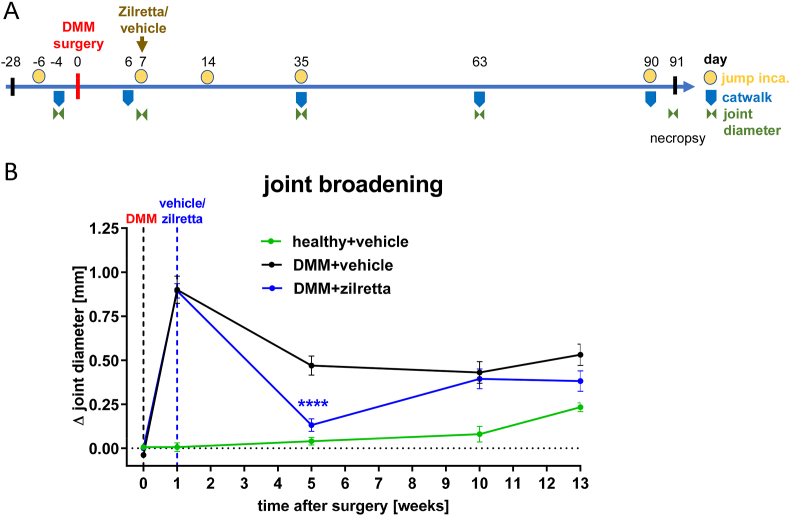
Pain due to osteoarthritis (OA) often occurs during locomotion in the vertical direction when joints are subjected to high mechanical load, e.g. during standing up from a chair or using stairs. To investigate joint pain in OA rat models, dynamic weight-bearing or gait analysis is traditionally conducted during horizontal walking on a flat surface. However, in chronic models of OA, which are of particular translational relevance for the disease, differences in the readouts between OA and control rats are often weak and of high variability leading to an insufficient assay window for drug profiling. To measure pain-related symptoms more sensitively, we conducted a dynamic weight-bearing test in the moment of a strong voluntary mechanical load. For that, we permanently housed rats in a four-story rat colony cage (RCC) and determined hind paw forces during voluntary jumping from one level to the next. This outcome measure was named jump incapacitance. After inducing OA by destabilizing the medial meniscus (DMM), we found that during jumps the average ipsilateral over contralateral hind paw forces were significantly reduced compared with healthy controls (jump incapacitance) from early- (day 7) to late-stage disease (day 90). An intra-articular injection of Zilretta (triamcinolone acetonide extended-release injectable suspension) attenuated OA-induced jump incapacitance after 8 days compared with DMM rats receiving vehicle (p = 0.069). In contrast, a CatWalk test for gait disturbance failed to detect any significant alterations in the chronic course of the DMM model. In conclusion, the dynamic weight-bearing test during jumping represents a novel method to characterize joint pain symptoms even in a slowly progressive OA rat model. It is sensitive, observer independent, relates to clinically relevant endpoints and demonstrates backtranslation of a drug that is approved for the treatment of OA knee pain.
骨关节炎(OA)引起的疼痛通常在关节承受高机械负荷的垂直方向运动时出现,例如从椅子上站起来或使用楼梯时。为了研究OA大鼠模型中的关节疼痛,传统上是在平坦表面上水平行走时进行动态负重或步态分析。然而,在与该疾病具有特殊转化相关性的OA慢性模型中,OA大鼠和对照大鼠之间的读数差异通常很微弱且变异性很大,导致药物分析的检测窗口不足。为了更敏感地测量与疼痛相关的症状,我们在强烈的自愿机械负荷时刻进行了动态负重测试。为此,我们将大鼠长期饲养在一个四层大鼠群落笼(RCC)中,并在它们自愿从一层跳到另一层时测定后爪力量。这个结果指标被命名为跳跃无能。通过破坏内侧半月板(DMM)诱导OA后,我们发现从疾病早期(第7天)到晚期(第90天),与健康对照相比,跳跃过程中患侧后爪与对侧后爪的平均力量显著降低(跳跃无能)。与接受载体的DMM大鼠相比,关节内注射Zilretta(曲安奈德缓释注射混悬液)8天后减轻了OA诱导的跳跃无能(p = 0.069)。相比之下,用于步态障碍的CatWalk测试未能检测到DMM模型慢性病程中的任何显著变化。总之,跳跃过程中的动态负重测试代表了一种即使在缓慢进展的OA大鼠模型中也能表征关节疼痛症状的新方法。它敏感、独立于观察者、与临床相关终点相关,并证明了一种被批准用于治疗OA膝关节疼痛的药物的逆向转化。