High-Throughput Biology Center, Department of Biomedical Engineering, Johns Hopkins University School of Medicinegrid.471401.7, Baltimore, Maryland, USA.
Center for Systems Approaches to Infectious Diseases (C-SAID), Johns Hopkins University School of Medicinegrid.471401.7, Baltimore, Maryland, USA.
Microbiol Spectr. 2021 Oct 31;9(2):e0024621. doi: 10.1128/Spectrum.00246-21. Epub 2021 Sep 15.
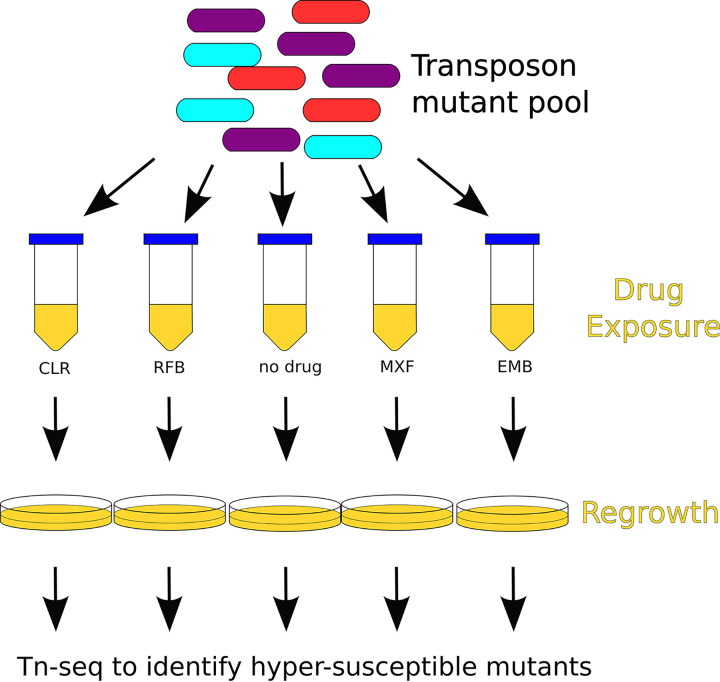
The Mycobacterium avium complex (MAC) is one of the most prevalent causes of nontuberculous mycobacteria pulmonary infection in the United States, and yet it remains understudied. Current MAC treatment requires more than a year of intermittent to daily combination antibiotic therapy, depending on disease severity. In order to shorten and simplify curative regimens, it is important to identify the innate bacterial factors contributing to reduced antibiotic susceptibility, namely, antibiotic tolerance genes. In this study, we performed a genome-wide transposon screen to elucidate M. avium genes that play a role in the bacterium's tolerance to first- and second-line antibiotics. We identified a total of 193 unique M. avium mutants with significantly altered susceptibility to at least one of the four clinically used antibiotics we tested, including two mutants (in DFS55_00905 and DFS55_12730) with panhypersusceptibility. The products of the antibiotic tolerance genes we have identified may represent novel targets for future drug development studies aimed at shortening the duration of therapy for MAC infections. The prolonged treatment required to eradicate Mycobacterium avium complex (MAC) infection is likely due to the presence of subpopulations of antibiotic-tolerant bacteria with reduced susceptibility to currently available drugs. However, little is known about the genes and pathways responsible for antibiotic tolerance in MAC. In this study, we performed a forward genetic screen to identify M. avium antibiotic tolerance genes, whose products may represent attractive targets for the development of novel adjunctive drugs capable of shortening the curative treatment for MAC infections.
鸟分枝杆菌复合群(MAC)是美国最常见的非结核分枝杆菌肺部感染病原体之一,但目前对其研究仍不够充分。MAC 的现行治疗方案需要一年以上的间断或每日联合抗生素治疗,具体取决于疾病的严重程度。为了缩短和简化治疗方案,确定导致抗生素敏感性降低的固有细菌因素(即抗生素耐受基因)非常重要。在这项研究中,我们进行了全基因组转座子筛选,以阐明在细菌对抗生素的耐受性中起作用的鸟分枝杆菌基因。我们总共鉴定了 193 个独特的鸟分枝杆菌突变体,它们对我们测试的四种临床使用抗生素中的至少一种的敏感性显著改变,包括两个具有泛耐药性的突变体(在 DFS55_00905 和 DFS55_12730 中)。我们鉴定的抗生素耐受基因的产物可能代表未来药物开发研究的新靶点,旨在缩短 MAC 感染的治疗持续时间。 消除鸟分枝杆菌复合群(MAC)感染所需的长期治疗可能是由于存在对现有药物敏感性降低的抗生素耐受亚群细菌。然而,对于 MAC 中抗生素耐受的基因和途径知之甚少。在这项研究中,我们进行了正向遗传筛选,以鉴定鸟分枝杆菌抗生素耐受基因,其产物可能成为开发新的辅助药物的有吸引力的靶点,这些药物能够缩短 MAC 感染的治疗时间。