Endocrinology & Diabetes Specialists of Northwest Ohio, Findlay, Ohio, USA.
Diabetes Technol Ther. 2022 Jan;24(1):26-31. doi: 10.1089/dia.2021.0212.
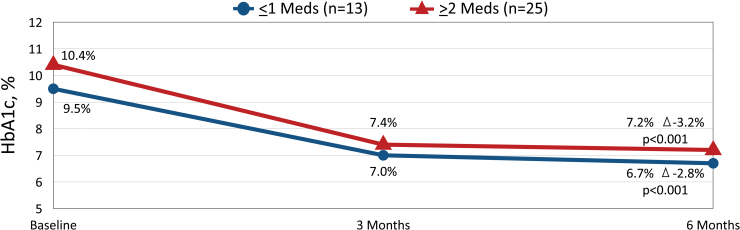
Use of real-time continuous glucose monitoring (rtCGM) has been shown to improve glycemic control in patients with type 2 diabetes (T2D) who are treated with intensive insulin therapy. However, most T2D patients are denied coverage for rtCGM due to failure to meet payer eligibility requirements: treatment with ≥3 insulin injections (or pump) and history of 4 × /day blood glucose testing. We investigated the relevance of these criteria to successful rtCGM use. This 6-month, prospective, interventional, single-arm study assessed the clinical effects of use rtCGM in patients with T2D treated with basal insulin only or noninsulin therapy. Primary outcomes were changes in HbA1c, average glucose, glycemic variability (% coefficient of variation), and percent of time in range (%TIR), below range (%TBR) and above range (%TAR). Thirty-eight patients were included in the analysis (10.1% ± 1.8% HbA1c, 54.7 ± 10.2 years, 35.6 ± 6.4 body mass index). At 6 months, we observed reductions in HbA1c (-3.0% ± 1.3%, < 0.001) and average glucose (-23.6 ± 38.8, < 0.001). %TIR increased 15.2 ± 22.3, from 57.0 ± 29.9 to 72.2 ± 23.6, < 0.001, with all patients maintaining %TBR targets (<4% at 70 mg/dL, <1% at <54 mg/dL). No changes in glycemic variability were observed. The greatest improvements in %TIR and %TAR were seen in patients treated with ≤1 medication. rtCGM use was associated with significant glycemic improvements in T2D patients treated with basal insulin only or noninsulin therapy. Given the growing body of evidence supporting rtCGM use in this population, insurance eligibility criteria should be modified to expand rtCGM use by T2D patients treated with less intensive therapies.
实时连续血糖监测(rtCGM)的使用已被证明可以改善接受强化胰岛素治疗的 2 型糖尿病(T2D)患者的血糖控制。然而,由于未能满足支付方资格要求,大多数 T2D 患者无法获得 rtCGM 的覆盖:接受≥3 次胰岛素注射(或泵)治疗和 4 次/天血糖检测史。我们研究了这些标准与成功使用 rtCGM 的相关性。这项为期 6 个月的前瞻性、干预性、单臂研究评估了仅接受基础胰岛素或非胰岛素治疗的 T2D 患者使用 rtCGM 的临床效果。主要结局是 HbA1c、平均血糖、血糖变异性(%变异系数)和达标时间百分比(%TIR)、达标时间以下百分比(%TBR)和达标时间以上百分比(%TAR)的变化。38 例患者纳入分析(HbA1c 为 10.1%±1.8%,年龄 54.7±10.2 岁,体重指数 35.6±6.4)。6 个月时,我们观察到 HbA1c 降低(-3.0%±1.3%, <0.001)和平均血糖降低(-23.6±38.8, <0.001)。%TIR 增加了 15.2±22.3,从 57.0±29.9 增加到 72.2±23.6, <0.001,所有患者均保持了%TBR 目标(70mg/dL 时<4%,54mg/dL 时<1%)。血糖变异性无变化。在接受≤1 种药物治疗的患者中,%TIR 和%TAR 的改善最大。仅接受基础胰岛素或非胰岛素治疗的 T2D 患者使用 rtCGM 与显著的血糖改善相关。鉴于越来越多的证据支持在该人群中使用 rtCGM,应修改保险资格标准,以扩大接受较不强化治疗的 T2D 患者使用 rtCGM。