Division of Bioengineering, Graduate School of Engineering Science, Osaka University, Osaka 560-8531, Japan.
Mol Biol Cell. 2021 Nov 1;32(21):ar28. doi: 10.1091/mbc.E21-01-0010. Epub 2021 Sep 15.
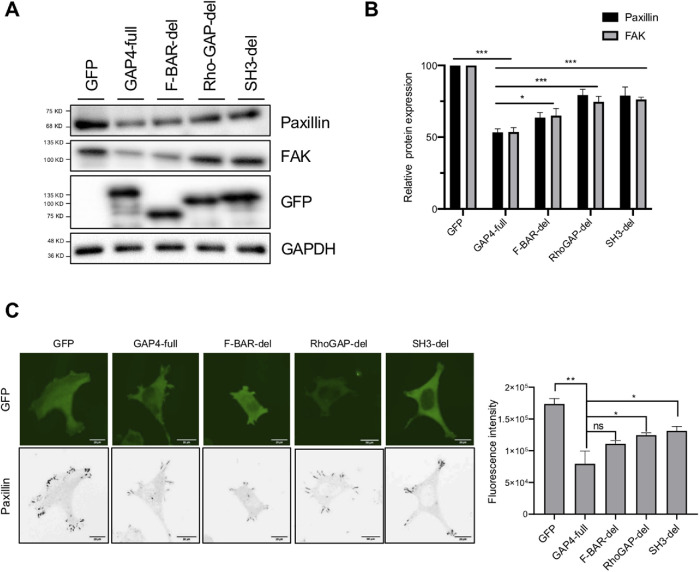
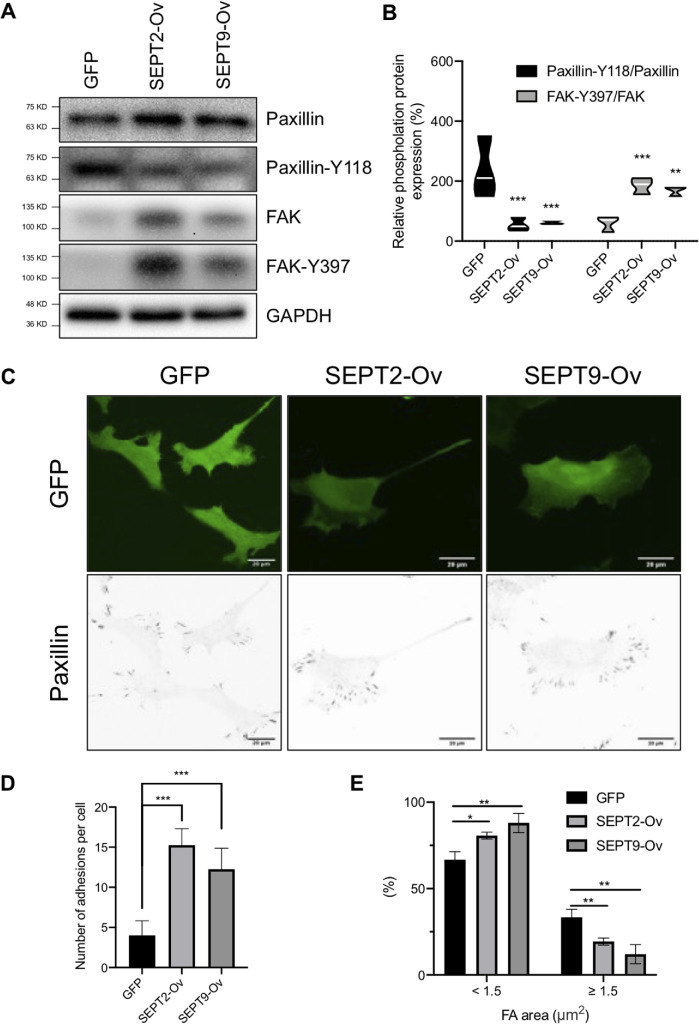
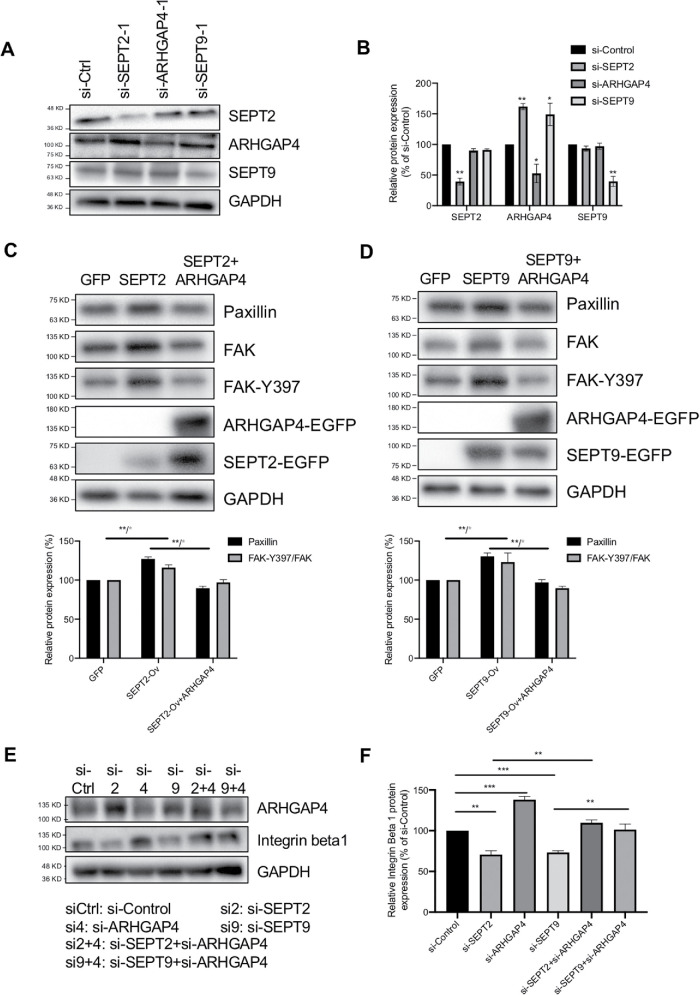
The Rho family of GTPases are inactivated in a cell context-dependent manner by Rho-GTPase-activating proteins (Rho-GAPs), but their signaling mechanisms are poorly understood. Here we demonstrate that ARHGAP4, one of the Rho-GAPs, forms a complex with SEPT2 and SEPT9 via its Rho-GAP domain and SH3 domain to enable both up- and down-modulation of integrin-mediated focal adhesions (FAs). We show that silencing ARHGAP4 and overexpressing its two mutually independent upstream regulators, SEPT2 and SEPT9, all induce reorganization of FAs to newly express Integrin Beta 1 and also enhance both cell migration and invasion. Interestingly, even if these cell migration/invasion-associated phenotypic changes are induced upon perturbations to the complex, it does not necessarily cause enhanced clustering of FAs. Instead, its extent depends on whether the microenvironment contains ligands suitable for the up-regulated Integrin Beta 1. These results provide novel insights into cell migration, invasion, and microenvironment-dependent phenotypic changes regulated by the newly identified complex.
Rho 家族的 GTPases 在细胞上下文依赖的方式下被 Rho-GTPase 激活蛋白(Rho-GAPs)失活,但它们的信号机制知之甚少。在这里,我们证明了 Rho-GAP 之一的 ARHGAP4 通过其 Rho-GAP 结构域和 SH3 结构域与 SEPT2 和 SEPT9 形成复合物,从而能够上调和下调整合素介导的焦点黏附(FA)。我们表明,沉默 ARHGAP4 并过表达其两个相互独立的上游调节因子 SEPT2 和 SEPT9,都会诱导 FA 的重新组织,以新表达整合素β 1,同时增强细胞迁移和侵袭。有趣的是,即使在对该复合物进行干扰时会引起与细胞迁移/侵袭相关的表型变化,但并不一定导致 FA 的聚集增强。相反,其程度取决于微环境中是否含有适合上调的整合素β 1 的配体。这些结果为新鉴定的复合物调控的细胞迁移、侵袭和微环境依赖性表型变化提供了新的见解。