University of Kansas, 1000 Sunnyside Drive, 3000 Dole, Lawrence, KS, 66045, USA.
J Neurodev Disord. 2021 Sep 15;13(1):36. doi: 10.1186/s11689-021-09386-x.
Approximately 30% of children diagnosed with autism remain minimally verbal past age 5. Interventions are often effective in increasing spoken communication for some of these children. Clinical and research decisions would be facilitated by identifying early indicators of progress in interventions. The purpose of this study was to investigate the relationship between speech sound measures obtained from the early phases of treatment and later treatment outcomes in children with autism and minimal verbal skills.
Twenty-three children (18 boys) between 5 and 9 years of age participated. We compared scores reflecting the phonemic features of word attempts produced during probes, and the number of correct words after 4 weeks of intervention to later word learning outcomes.
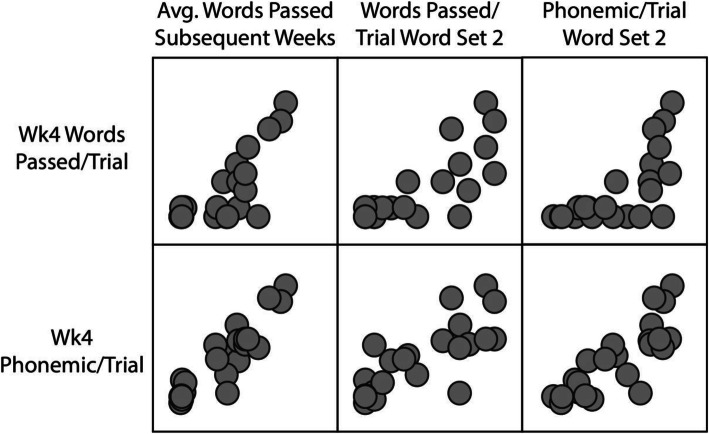
Correlational and hierarchical regression analyses showed that both predictors were positively correlated with outcomes, but the phonemic scores were more strongly related than number of correct words.
We conclude that phonemic scoring may be a useful measure to determine proximal gains in a spoken word learning intervention. Proximal measures are particularly helpful when trying to decide if the current course of intervention should be maintained or altered.
https://register.clinicaltrials.gov/prs/app/action/LoginUser?ts=2&cx=-jg9qo3 .
大约 30%被诊断为自闭症的儿童在 5 岁以后仍几乎不说话。对于其中一些儿童,干预措施通常可以有效地增加他们的口语交流能力。通过识别干预措施中进展的早期指标,可以方便临床和研究决策。本研究旨在探讨自闭症和语言能力极低的儿童在治疗早期获得的语音测量值与后期治疗结果之间的关系。
共有 23 名(18 名男孩)5 至 9 岁的儿童参与了研究。我们比较了在探针中反映单词尝试的音位特征的分数,以及在干预 4 周后正确单词的数量与后期单词学习结果之间的差异。
相关和层次回归分析表明,两个预测指标都与结果呈正相关,但音位得分与正确单词数量的相关性更强。
我们得出结论,音位评分可能是衡量口语单词学习干预中近期进展的有用指标。当试图决定是否应维持或改变当前的干预过程时,近期指标特别有帮助。
[临床试验注册网址]。