Qiao Tianci, Wu Hongyun, Peng Wei
Graduate School, Shandong University of Traditional Chinese Medicine, Jinan, China.
No.3 Neurology Department, Shandong University of Traditional Chinese Medicine Affiliated Hospital, Jinan, China.
Front Neurol. 2021 Aug 10;12:674398. doi: 10.3389/fneur.2021.674398. eCollection 2021.
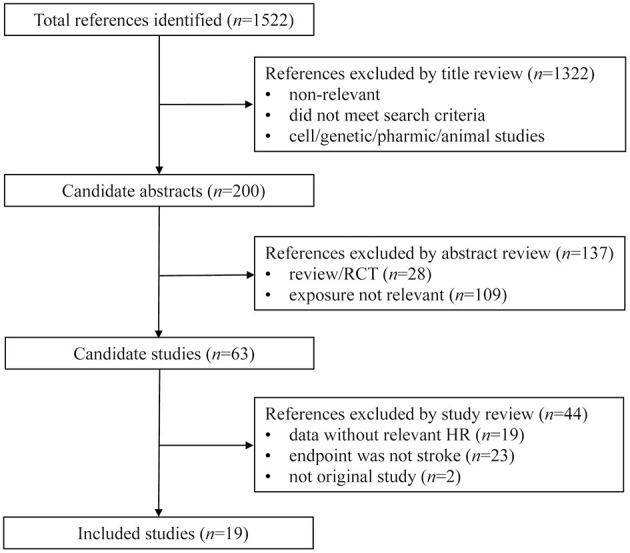
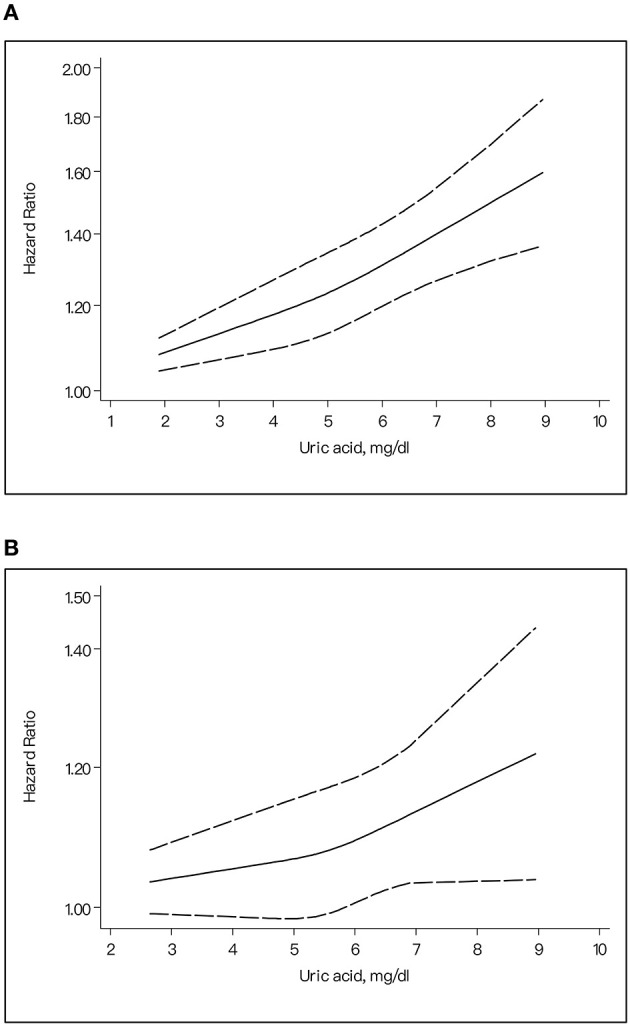
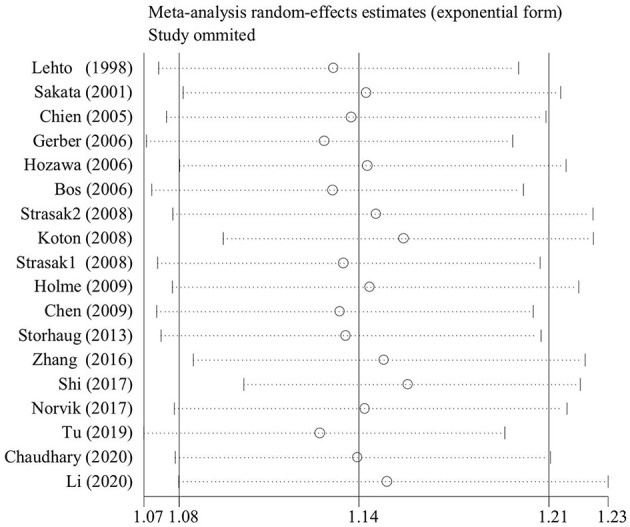
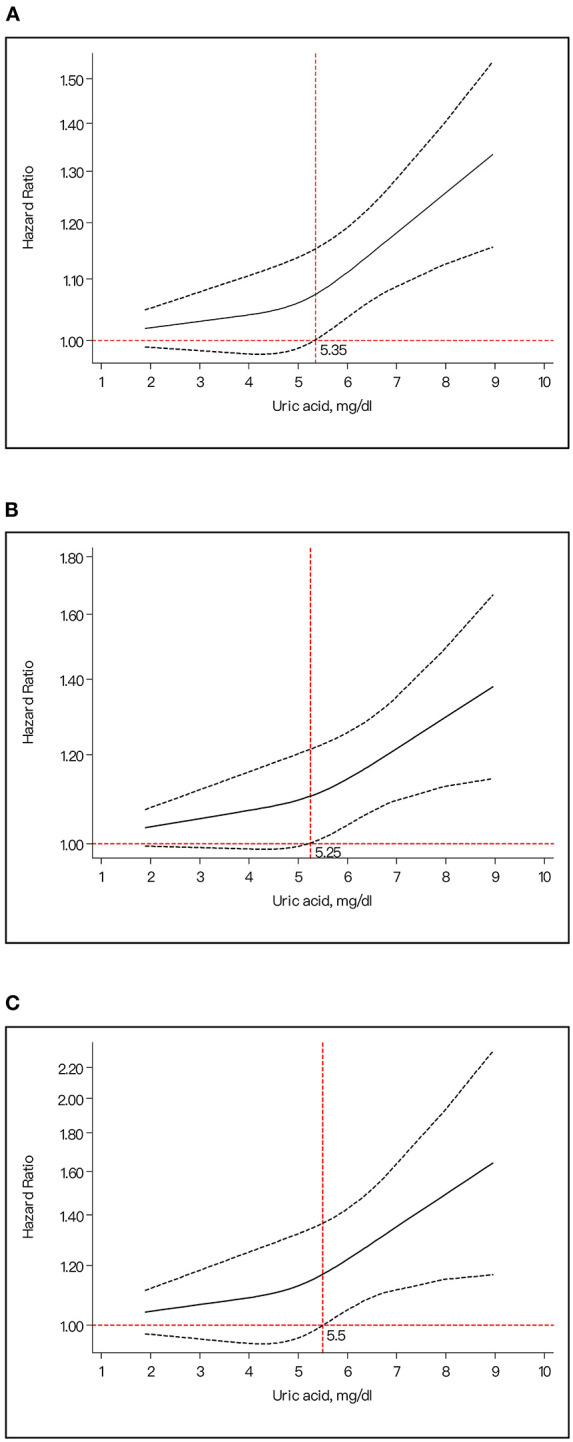
Uric acid (UA) is proposed as a potential risk factor for stroke in adult, yet the results from published studies are not generally accordant. We included prospective studies that explored the relationship between serum UA (SUA) and strokes. In this study, strokes include ischemic stroke and hemorrhagic stroke, which consists of intracerebral hemorrhage and subarachnoid hemorrhage. The effect-size estimates were expressed as hazard ratio (HR) and 95% confidence interval (CI). Sensitivity and subgroup analyses were performed to assess the robustness of the pooled estimation and potential sources of heterogeneity between studies. We meta-analyzed 19 prospective cohort articles, which involve 37,386 males and 31,163 females. Overall analyses results showed a significant association between a 1 mg/dl increase in high levels of SUA and the risk of total stroke (HR = 1.13; 95% CI: 1.09-1.18; < 0.001), ischemic stroke (HR = 1.15; 95% CI: 1.10-1.21; < 0.001), and hemorrhagic stroke (HR = 1.07; 95% CI: 1.00 to 1.15; = 0.046). No significant difference was found between ischemic stroke and hemorrhagic stroke. In the subgroup analyses, the association of high SUA levels and the risk of total stroke was statistically significant in females (HR = 1.19; 95% CI: 1.12-1.26; < 0.001) and males (HR = 1.11; 95% CI: 1.05-1.17; < 0.001). Coincidentally, the association was also statistically significant for ischemic stroke, both in females (HR = 1.26; 95% CI: 1.17-1.36; < 0.001) and in males (HR = 1.12; 95% CI: 1.06-1.19; < 0.001). However, for hemorrhagic stroke, it was only statistically significant in females (HR = 1.19; 95% CI: 1.04-1.35; = 0.01). Our dose-response research indicated the J-shaped trend between the ascending SUA levels and the higher risk of suffering from a stroke. Our findings indicate that elevated SUA is a significant risk factor for adult stroke, both for ischemic stroke and hemorrhagic stroke, and especially in females.
尿酸(UA)被认为是成年人中风的一个潜在风险因素,但已发表研究的结果并不普遍一致。我们纳入了探讨血清尿酸(SUA)与中风之间关系的前瞻性研究。在本研究中,中风包括缺血性中风和出血性中风,后者又由脑出血和蛛网膜下腔出血组成。效应量估计值以风险比(HR)和95%置信区间(CI)表示。进行了敏感性和亚组分析,以评估汇总估计的稳健性以及研究之间潜在的异质性来源。我们对19篇前瞻性队列文章进行了荟萃分析,这些文章涉及37386名男性和31163名女性。总体分析结果显示,高水平SUA每增加1mg/dl与总中风风险(HR = 1.13;95%CI:1.09 - 1.18;P < 0.001)、缺血性中风(HR = 1.15;95%CI:1.10 - 1.21;P < 0.001)和出血性中风(HR = 1.07;95%CI:1.00至1.15;P = 0.046)之间存在显著关联。缺血性中风和出血性中风之间未发现显著差异。在亚组分析中,高SUA水平与总中风风险的关联在女性(HR = 1.19;95%CI:1.12 - 1.26;P < 0.001)和男性(HR = 1.11;95%CI:1.05 - 1.17;P < 0.001)中均具有统计学意义。巧合的是,缺血性中风的关联在女性(HR = 1.26;95%CI:1.17 - 1.36;P < 0.001)和男性(HR = 1.12;95%CI:1.06 - 1.19;P < 0.001)中也具有统计学意义。然而,对于出血性中风,仅在女性中具有统计学意义(HR = 1.19;95%CI:1.04 - 1.35;P = 0.01)。我们的剂量反应研究表明,SUA水平升高与中风风险增加之间呈J形趋势。我们的研究结果表明,SUA升高是成年人中风的一个重要风险因素,无论是缺血性中风还是出血性中风,尤其是在女性中。