School of Health Management, Southern Medical University, Guangzhou, China.
Department of Health Management, Nanfang Hospital, Southern Medical University, Guangzhou, China.
Front Public Health. 2021 Aug 30;9:707062. doi: 10.3389/fpubh.2021.707062. eCollection 2021.
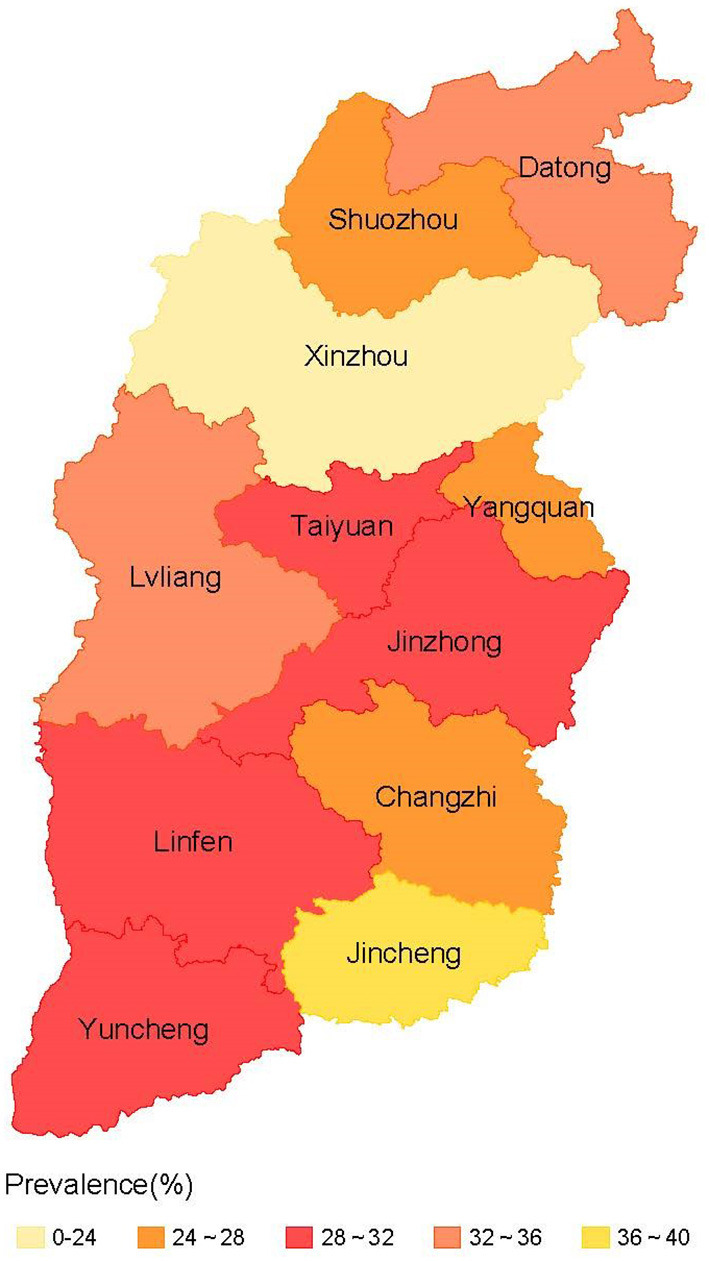
Multimorbidity has become one of the key issues in the public health sector. This study aimed to explore the urban-rural differences in patterns and associated factors of multimorbidity in China and to provide scientific reference for the development of health management strategies to reduce health inequality between urban and rural areas. A cross-sectional study, which used a multi-stage random sampling method, was conducted effectively among 3,250 participants in the Shanxi province of China. The chi-square test was used to compare the prevalence of chronic diseases among older adults with different demographic characteristics. The Apriori algorithm and multinomial logistic regression were used to explore the patterns and associated factors of multimorbidity among older adults, respectively. The findings showed that 30.3% of older adults reported multimorbidity, with significantly higher proportions in rural areas. Among urban older adults, 10 binary chronic disease combinations with strong association strength were obtained. In addition, 11 binary chronic disease combinations and three ternary chronic disease combinations with strong association strength were obtained among rural older adults. In rural and urban areas, there is a large gap in patterns and factors associated with multimorbidity. Multimorbidity was prevalent among older adults, which patterns mainly consisted of two or three chronic diseases. The patterns and associated factors of multimorbidity varied from urban to rural regions. Expanding the study of urban-rural differences in multimorbidity will help the country formulate more reasonable public health policies to maximize the benefits of medical services for all.
多病共存已成为公共卫生领域的重点问题之一。本研究旨在探讨中国城乡多病共存模式及相关因素的差异,为制定城乡卫生管理策略提供科学参考,以减少城乡健康不平等。
本研究采用多阶段随机抽样方法,对中国山西省的 3250 名参与者进行了有效的横断面研究。采用卡方检验比较了不同人口特征的老年人慢性病患病率。采用 Apriori 算法和多项逻辑回归分别探讨了老年人多病共存的模式和相关因素。
研究结果显示,30.3%的老年人报告患有多病共存,农村地区的比例明显更高。在城市老年人中,得到了 10 种具有较强关联强度的二元慢性疾病组合。此外,在农村老年人中还得到了 11 种具有较强关联强度的二元慢性疾病组合和 3 种三元慢性疾病组合。农村和城市地区在多病共存的模式和相关因素方面存在较大差距。
多病共存在老年人中较为普遍,其模式主要由两种或三种慢性病组成。城乡地区多病共存的模式和相关因素存在差异。扩大对城乡多病共存差异的研究将有助于国家制定更合理的公共卫生政策,使全体民众最大限度地受益于医疗服务。