Laird Pamela, Walker Roz, Gill Fenella J, Whitby Jack, Chang Anne B, Schultz André
Wal-yan Respiratory Research Centre, Telethon Kids Institute, University of Western Australia, Northern Entrance, Perth Children's Hospital, 15 Hospital Avenue Nedlands WA 6009, Australia.
Department of Physiotherapy, Perth Children's Hospital, 15 Hospital Avenue Nedlands WA 6009, Australia.
Lancet Reg Health West Pac. 2021 Aug 6;15:100239. doi: 10.1016/j.lanwpc.2021.100239. eCollection 2021 Oct.
Among Aboriginal children, the burden of acute respiratory tract infections (ALRIs) with consequent bronchiectasis post-hospitalisation is high. Clinical practice guidelines recommend medical follow-up one-month following discharge, which provides an opportunity to screen and manage persistent symptoms and may prevent bronchiectasis. Medical follow-up is not routinely undertaken in most centres. We aimed to identify barriers and facilitators and map steps required for medical follow-up of Aboriginal children hospitalised with ALRIs.
Our qualitative study used a knowledge translation and participatory action research approach, with semi-structured interviews and focus groups, followed by reflexive thematic grouping and process mapping.
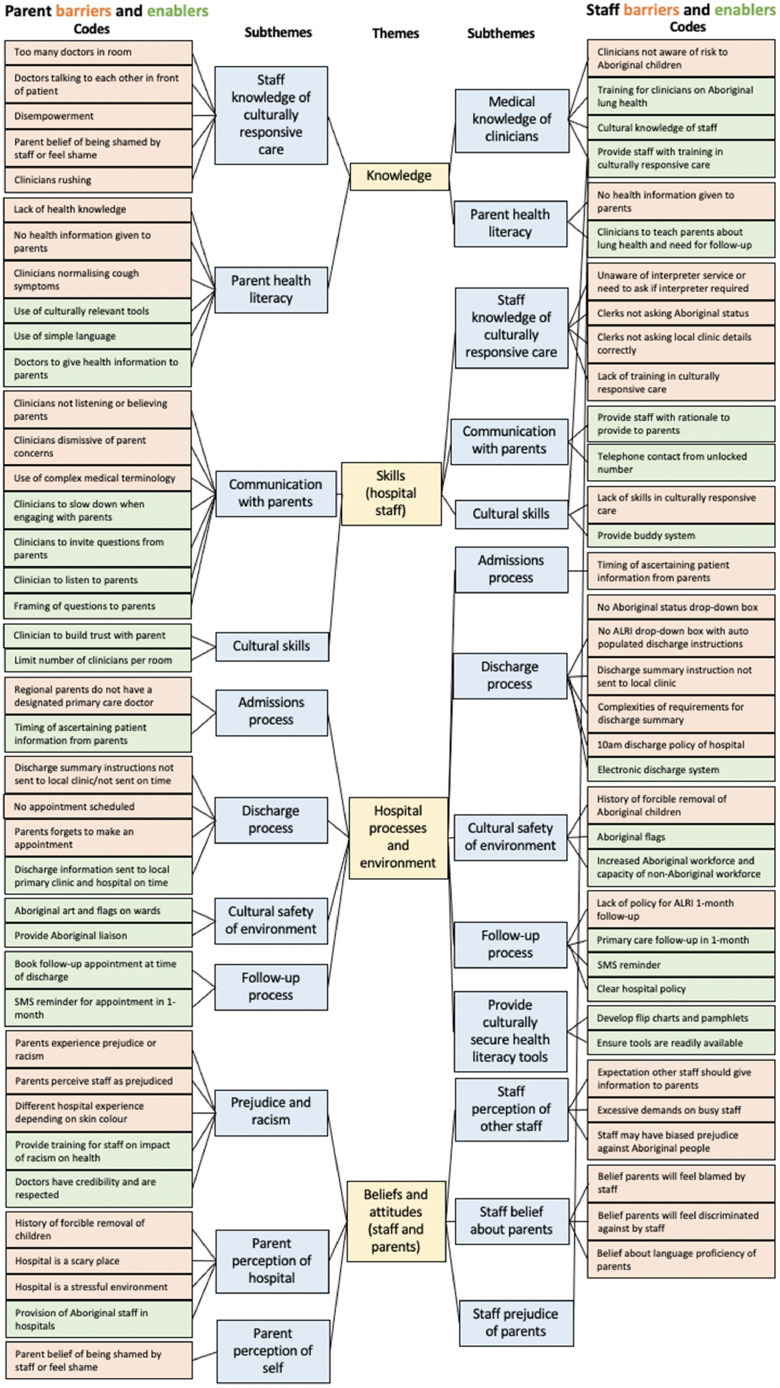
Eighteen parents of Aboriginal children hospitalised with ALRI and 144 Australian paediatric hospital staff participated. Barriers for parents were lack of information about their child's condition and need for medical follow-up. Facilitators for parents included doctors providing disease specific health information and follow-up instructions. Staff barriers included being unaware of the need for follow-up, skills in culturally responsive care and electronic discharge system limitations. Facilitators included training for clinicians in arranging follow-up and culturally secure engagement, with culturally responsive tools and improved discharge processes. Twelve-steps were identified to ensure medical follow-up.
We identified barriers and enablers for arranging effective medical follow-up for Aboriginal children hospitalised with ALRIs, summarised into four-themes, and mapped the steps required. Arranging effective follow-up is a complex process involving parents, hospital staff, hospital systems and primary healthcare services. A comprehensive knowledge translation approach may improve the follow-up process.
State and national grants and fellowships.
在原住民儿童中,急性呼吸道感染(ALRIs)及其住院后随之发生支气管扩张的负担很重。临床实践指南建议出院后一个月进行医学随访,这为筛查和处理持续症状提供了机会,并可能预防支气管扩张。大多数中心并未常规开展医学随访。我们旨在确定原住民儿童因ALRIs住院后进行医学随访的障碍和促进因素,并梳理所需步骤。
我们的定性研究采用知识转化和参与式行动研究方法,通过半结构化访谈和焦点小组讨论,随后进行反思性主题分组和流程梳理。
18名原住民儿童因ALRI住院的家长以及144名澳大利亚儿科医院工作人员参与了研究。家长面临的障碍包括对孩子病情及医学随访需求缺乏了解。家长的促进因素包括医生提供特定疾病的健康信息和随访指导。工作人员面临的障碍包括未意识到随访的必要性、文化敏感护理技能以及电子出院系统的局限性。促进因素包括为临床医生提供安排随访和文化安全参与方面的培训,配备文化敏感工具并改进出院流程。确定了12个步骤以确保医学随访。
我们确定了为因ALRIs住院的原住民儿童安排有效医学随访的障碍和促成因素,归纳为四个主题,并梳理了所需步骤。安排有效的随访是一个复杂的过程,涉及家长、医院工作人员、医院系统和基层医疗服务。全面的知识转化方法可能会改善随访流程。
州和国家拨款及奖学金。