Clinical Pharmacology & Safety Sciences, BioPharmaceuticals R&D, AstraZeneca, South San Francisco.
Department of Data Science, Fate Therapeutics Inc., San Diego, CA.
Rheumatology (Oxford). 2022 May 5;61(5):1900-1910. doi: 10.1093/rheumatology/keab704.
To characterize the relationship of anifrolumab pharmacokinetics with efficacy and safety in patients with moderate to severe SLE despite standard therapy, using pooled data from two phase 3 trials.
TULIP-1 and TULIP-2 were randomized, placebo-controlled, 52-week trials of intravenous anifrolumab (every 4 weeks for 48 weeks). For the exposure-response analysis, BILAG-based Composite Lupus Assessment (BICLA) or SLE Responder Index [SRI(4)] response rates at week 52 in each quartile/tertile of average anifrolumab serum concentration (Cave) were compared for anifrolumab and placebo in all-comers, patients who completed treatment, and IFN gene signature (IFNGS)-high patients who completed treatment, using average marginal effect logistic regression. Relationships between exposure and key safety events were assessed graphically.
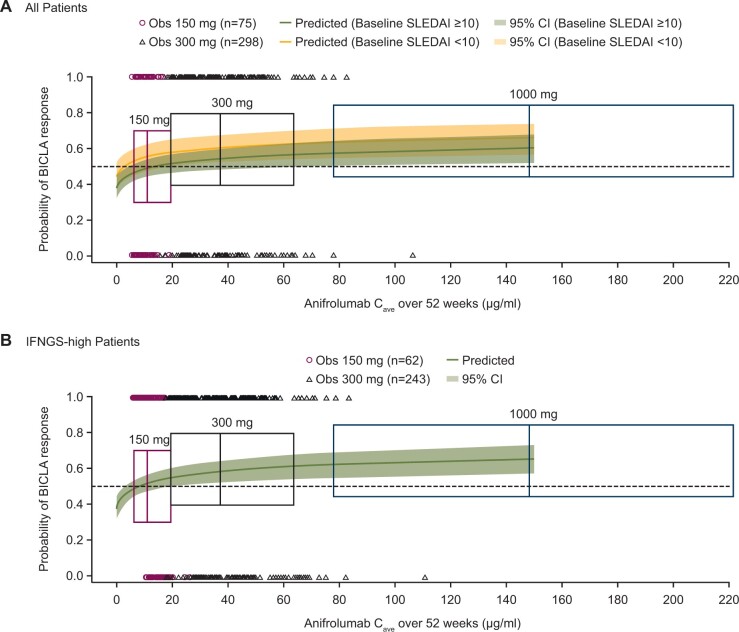
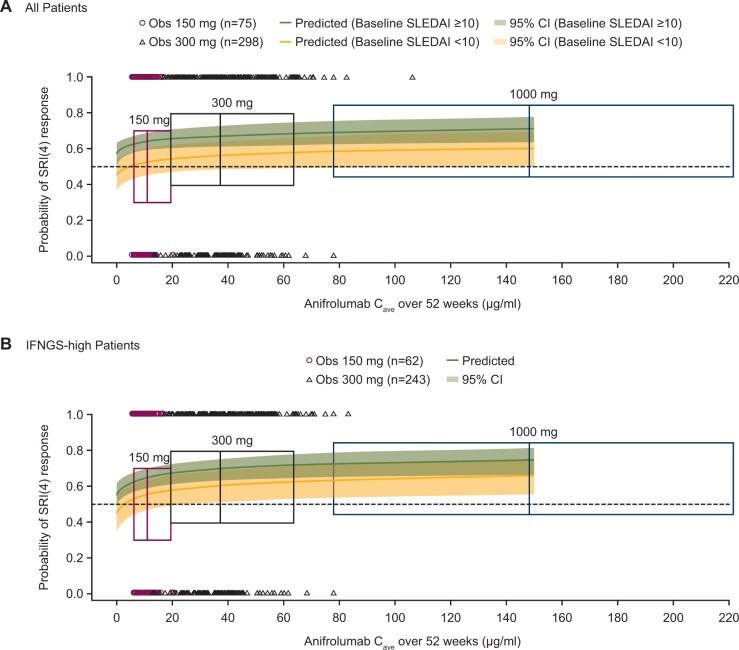
Of patients in TULIP-1/TULIP-2 who received anifrolumab (150 mg, n = 91; 300 mg, n = 356) or placebo (n = 366), 574 completed treatment, of whom 470 were IFNGS high. In the exposure-efficacy analyses, BICLA and SRI(4) treatment differences favouring anifrolumab 300 mg vs placebo were observed across Cave subgroups and all analysis populations. Logistic regression identified Cave as a significant covariate for predicted BICLA response, as higher anifrolumab Cave predicted greater efficacy. There was no evidence of exposure-driven incidence of key safety events through week 52 in patients receiving anifrolumab 150 or 300 mg.
While higher Cave predicted greater efficacy, consistent positive benefit favouring anifrolumab 300 mg vs placebo was observed in BICLA and SRI(4) responses across Cave subgroups in the TULIP trials. There was no evidence of exposure-driven safety events.
CLINICALTRIAL.GOV NUMBERS: NCT02446912, NCT02446899.
利用两项 3 期临床试验的汇总数据,描述阿尼鲁单抗的药代动力学与标准治疗下中重度系统性红斑狼疮(SLE)患者疗效和安全性之间的关系。
TULIP-1 和 TULIP-2 是两项随机、安慰剂对照、52 周的静脉注射阿尼鲁单抗(前 48 周每 4 周 1 次)试验。为进行暴露-反应分析,在所有患者、完成治疗的患者和完成治疗且干扰素基因特征(IFNGS)高的患者中,比较第 52 周时基于 BILAG 的综合狼疮评估(BICLA)或 SLE 应答指数 [SRI(4)] 应答率与阿尼鲁单抗和安慰剂在各浓度区间/浓度三分位的相关性,采用平均边缘效应逻辑回归。通过图形评估暴露与关键安全性事件之间的关系。
在 TULIP-1/TULIP-2 接受阿尼鲁单抗(150mg,n=91;300mg,n=356)或安慰剂(n=366)的患者中,有 574 例完成治疗,其中 470 例 IFNGS 高。在暴露-疗效分析中,在 Cave 各亚组和所有分析人群中,均观察到阿尼鲁单抗 300mg 与安慰剂相比的 BICLA 和 SRI(4)治疗差异有利。逻辑回归确定 Cave 是 BICLA 应答的显著协变量,因为较高的阿尼鲁单抗 Cave 预测疗效更高。在接受阿尼鲁单抗 150 或 300mg 的患者中,在第 52 周时未观察到与暴露相关的关键安全性事件的发生率。
虽然较高的 Cave 预测疗效更高,但在 TULIP 试验中,在 Cave 各亚组中,均观察到 BICLA 和 SRI(4)应答中,阿尼鲁单抗 300mg 与安慰剂相比具有一致的正获益。没有证据表明暴露驱动安全性事件。
NCT02446912、NCT02446899。