Centre for Inflammatory Diseases, Monash University, Melbourne, Victoria, Australia.
Biometrics, Late Respiratory & Immunology, BioPharmaceuticals R&D, AstraZeneca, Gothenburg, Sweden.
Ann Rheum Dis. 2023 May;82(5):639-645. doi: 10.1136/ard-2022-222748. Epub 2023 Jan 23.
In patients with systemic lupus erythematosus (SLE), lupus low disease activity state (LLDAS) attainment is associated with improved outcomes. We investigated LLDAS attainment in anifrolumab-treated patients.
We performed post hoc analysis of pooled Treatment of Uncontrolled Lupus via the Interferon Pathway (TULIP-1) (NCT02446912) and TULIP-2 (NCT02446899) anifrolumab phase 3 trial data in patients with moderate to severe SLE receiving standard therapy. LLDAS was defined as: SLE Disease Activity Index 2000 ≤4 without major organ activity, no new disease activity, Physician's Global Assessment ≤1, prednisone ≤7.5 mg/day and no non-standard immunosuppressant dosing. Time to first LLDAS attainment was compared between groups using Cox regression modelling; responses were compared using logistic regression.
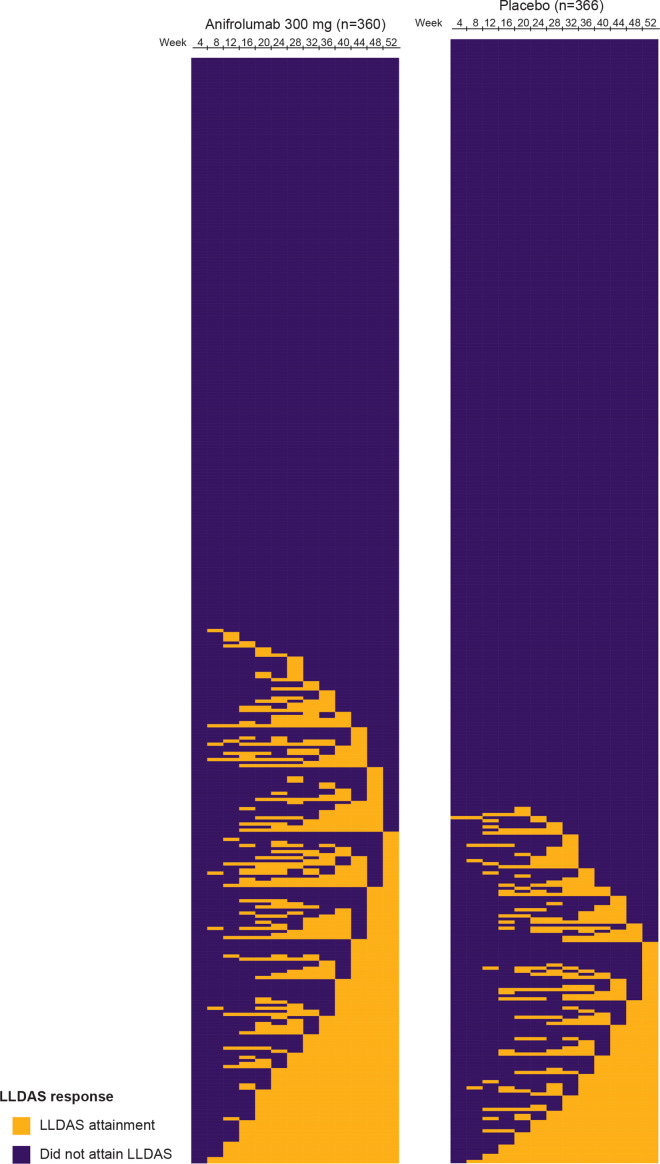
Agnostic to treatment, 205/819 (25.0%) patients attained LLDAS at week 52; 186/205 (90.7%) were also British Isles Lupus Assessment Group-based Composite Lupus Assessment (BICLA)-responders. Among BICLA-responders at week 52, 186/318 (58.5%) attained LLDAS; 203/380 (53.4%) SLE Responder Index-4 (SRI(4)) responders attained LLDAS. Improvements from baseline in patient global assessment scores at week 52 were threefold greater in LLDAS-attainers. At week 52, 30.0% of anifrolumab-treated patients and 19.6% of placebo were in LLDAS (OR 1.8, 95% CI 1.3 to 2.5, p=0.0011). Compared with placebo, anifrolumab treatment was associated with earlier LLDAS attainment (time to first LLDAS, HR 1.76, 95% CI 1.35 to 2.30, p<0.0001), increased cumulative time in LLDAS (p<0.0001) and higher likelihood of sustained LLDAS (p<0.001). Anifrolumab treatment was also associated with higher rates of Definition of Remission in SLE remission at week 52 (15.3% vs 7.6%; OR 2.2, 95% CI 1.4 to 3.6, p=0.0013).
LLDAS attainment was highly associated with, but more stringent than, BICLA and SRI(4) responses. Compared with placebo, anifrolumab treatment was associated with earlier, more frequent, and more prolonged and sustained LLDAS.
NCT02446912 and NCT02446899.
在系统性红斑狼疮(SLE)患者中,达到狼疮低疾病活动状态(LLDAS)与改善结局相关。我们调查了阿尼鲁单抗治疗患者中达到 LLDAS 的情况。
我们对接受标准治疗的中重度 SLE 患者进行了 TULIP-1(NCT02446912)和 TULIP-2(NCT02446899)阿尼鲁单抗 III 期试验的事后分析。LLDAS 的定义为:SLE 疾病活动指数 2000≤4 且无主要器官活动,无新的疾病活动,医生整体评估≤1,泼尼松≤7.5mg/天,无非标准免疫抑制剂剂量。使用 Cox 回归模型比较两组之间首次达到 LLDAS 的时间;使用逻辑回归比较应答。
在不考虑治疗的情况下,819 例患者中有 205 例(25.0%)在第 52 周达到 LLDAS;205 例中有 186 例(90.7%)也是基于不列颠群岛狼疮评估组综合狼疮评估(BICLA)的应答者。在第 52 周 BICLA 应答者中,186 例(58.5%)达到 LLDAS;203 例(53.4%)SRI(4)应答者达到 LLDAS。与基线相比,在第 52 周达到 LLDAS 的患者的患者整体评估评分改善了三倍。在第 52 周,30.0%的阿尼鲁单抗治疗患者和 19.6%的安慰剂患者处于 LLDAS(OR 1.8,95%CI 1.3 至 2.5,p=0.0011)。与安慰剂相比,阿尼鲁单抗治疗与更早达到 LLDAS(首次达到 LLDAS 的时间,HR 1.76,95%CI 1.35 至 2.30,p<0.0001)、累积时间更长(p<0.0001)和持续 LLDAS 的可能性更高(p<0.001)相关。阿尼鲁单抗治疗还与第 52 周 SLE 缓解时的缓解定义率更高相关(15.3%比 7.6%;OR 2.2,95%CI 1.4 至 3.6,p=0.0013)。
达到 LLDAS 与但比 BICLA 和 SRI(4)应答更严格的标准相关。与安慰剂相比,阿尼鲁单抗治疗与更早、更频繁、更持久和更持续的 LLDAS 相关。
NCT02446912 和 NCT02446899。