College of Agronomy, Anhui Agricultural University, Hefei, China.
PLoS One. 2021 Sep 16;16(9):e0257236. doi: 10.1371/journal.pone.0257236. eCollection 2021.
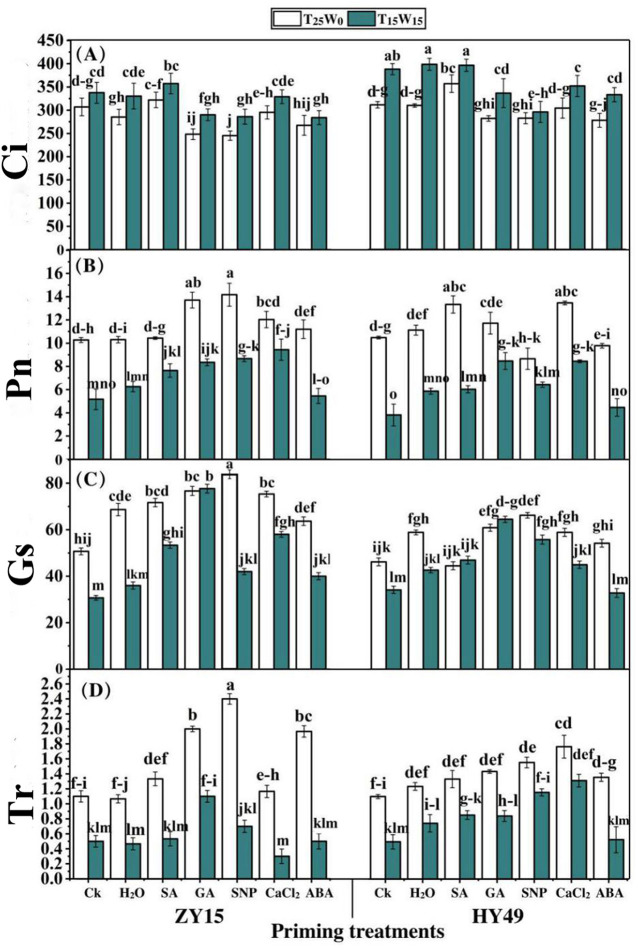
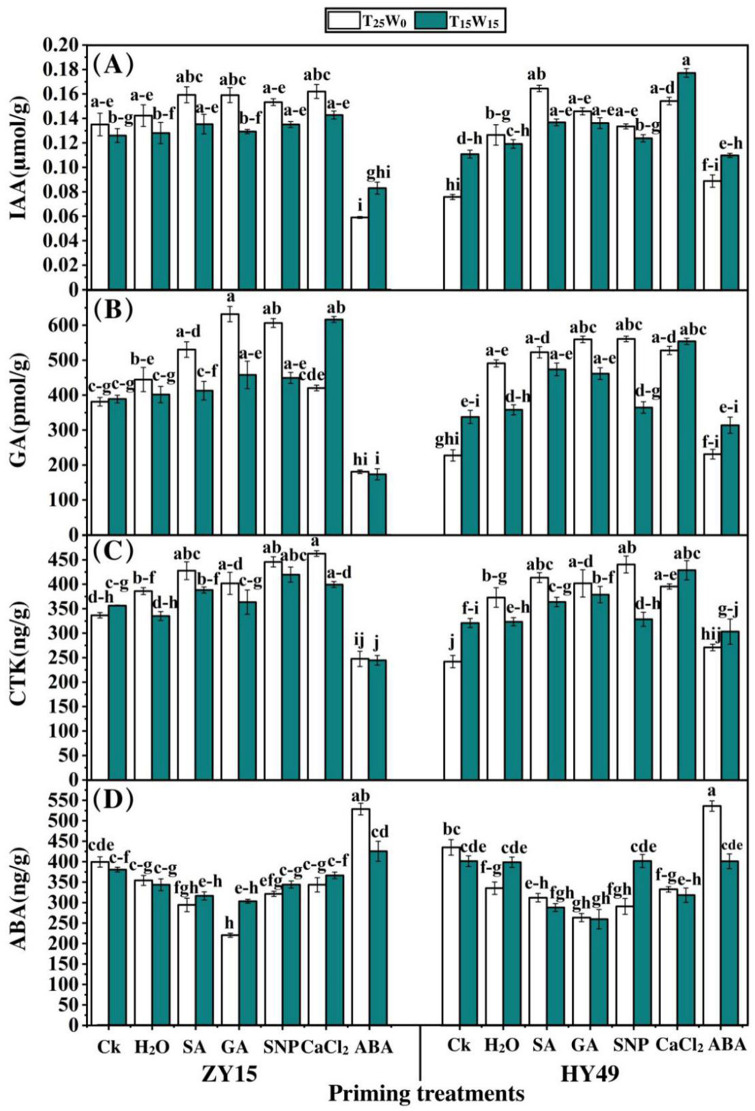
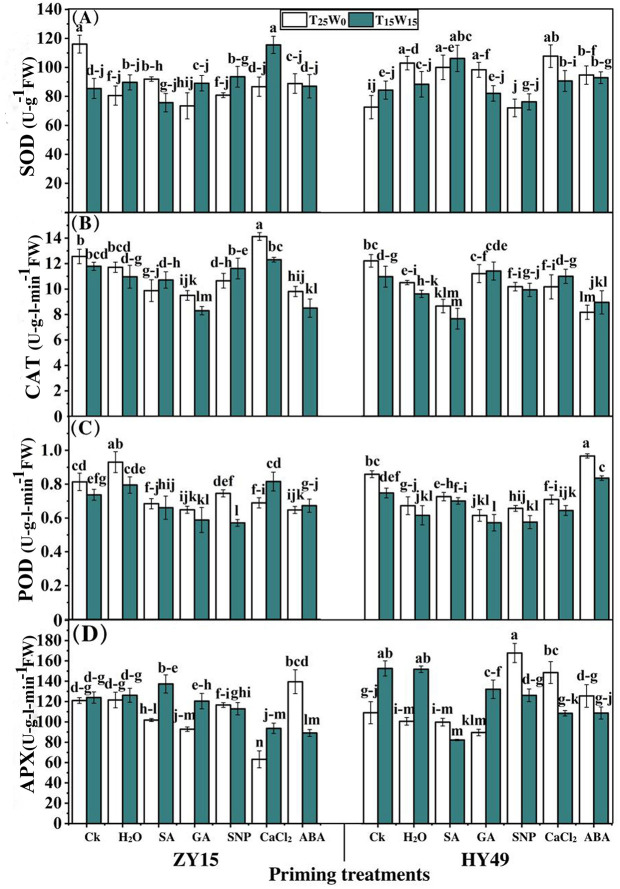
The present study was performed to evaluate the effects of seed priming. This was done by soaking the seeds of two rapeseed cultivars, namely, ZY15 (tolerant to low temperature and drought) and HY49 (sensitive to low temperature and drought), for 12 h in varying solutions: distilled water, 138 mg/L salicylic acid (SA), 300 mg/L gibberellic acid (GA), 89.4 mg/L sodium nitroprusside (SNP), 3000 mg/L calcium chloride (CaCl2), and 30 mg/L abscisic acid (ABA). Primed and non-primed seeds were left to germinate at 15°C and -0.15 MPa (T15W15) and at 25°C and 0 MPa (T25W0), respectively. The results showed that SA, GA, SNP, CaCl2, and ABA significantly improved the germination potential (GP), germination rate (GR), germination index (GI), stem fresh weight (SFW), stem dry weight (SDW), root length (RL), stem length (SL), and seed vigor index (SVI) under T15W15. For ZY15 seeds under T25W0, GA, SNP, CaCl2, and ABA priming reduced the average germination time (96% after 5 days) compared to that of the control (88% after 5 days). For ZY15 seeds under T15W15, SA, SNP, CaCl2, and ABA priming, with respect to the control and water-treated groups, shortened the average germination time (92% after 5 days) compared to that of the control (80% after 5 days). For HY49 seeds under T25W0, GA, SNP, CaCl2, and ABA priming reduced the average germination time (92% after 5 days) compared to that of the control (85% after 5 days). Similarly, for HY49 seeds under T15W15, GA priming shortened the average germination time (89% after 5 days) compared to that of the control (83% after 5 days). These priming agents increased the net photosynthesis, stomatal conductivity, and transpiration rate of rape seedlings under conditions of low temperature and drought stress, while also decreasing intercellular carbon dioxide (CO2) concentrations. Additionally, SA, GA, SNP, CaCl2, and ABA increased superoxide dismutase concentrations (SOD) and ascorbic peroxidase (APX) activities of rape seedlings under stress conditions, while decreasing catalase (CAT) and peroxidase (POD) activities in ZY15 seedlings. In HY49, which is sensitive to low temperature and drought, all priming solutions, except for SNP, led to an increase in SOD activity levels and a decrease in CAT activity levels. Overall, SA, GA, SNP, and CaCl2 increased the concentrations of indoleacetic acid (IAA), GA, ABA, and cytokinin (CTK) in seedlings under stress conditions. Moreover, compared to SA, CaCl2, and ABA, GA (300 mg/L) and SNP (300 mol/L) showed improved priming effects for ZY15 and HY49 under stress conditions.
本研究旨在评估种子引发的效果。通过将两种油菜品种(ZY15(耐低温干旱)和 HY49(对低温干旱敏感))的种子在不同溶液中浸泡 12 小时来进行种子引发,这些溶液包括:蒸馏水、138mg/L 水杨酸(SA)、300mg/L 赤霉素(GA)、89.4mg/L 硝普酸钠(SNP)、3000mg/L 氯化钙(CaCl2)和 30mg/L 脱落酸(ABA)。将引发和未引发的种子分别在 15°C 和-0.15 MPa(T15W15)以及 25°C 和 0 MPa(T25W0)下进行发芽。结果表明,SA、GA、SNP、CaCl2 和 ABA 显著提高了 T15W15 条件下 ZY15 和 HY49 种子的发芽势(GP)、发芽率(GR)、发芽指数(GI)、茎鲜重(SFW)、茎干重(SDW)、根长(RL)、茎长(SL)和种子活力指数(SVI)。对于 T25W0 条件下的 ZY15 种子,GA、SNP、CaCl2 和 ABA 引发处理与对照相比(5 天后达到 88%),平均发芽时间(5 天后达到 96%)缩短。对于 T15W15 条件下的 ZY15 种子,SA、SNP、CaCl2 和 ABA 引发处理与对照和水对照组相比,平均发芽时间(5 天后达到 92%)缩短。对于 T25W0 条件下的 HY49 种子,GA、SNP、CaCl2 和 ABA 引发处理与对照相比(5 天后达到 85%),平均发芽时间缩短。同样,对于 T15W15 条件下的 HY49 种子,GA 引发处理与对照相比(5 天后达到 83%),平均发芽时间缩短。这些引发剂增加了低温干旱胁迫下油菜幼苗的净光合速率、气孔导度和蒸腾速率,同时降低了胞间二氧化碳(CO2)浓度。此外,SA、GA、SNP、CaCl2 和 ABA 提高了胁迫条件下油菜幼苗的超氧化物歧化酶(SOD)和抗坏血酸过氧化物酶(APX)活性,同时降低了 ZY15 幼苗的过氧化氢酶(CAT)和过氧化物酶(POD)活性。在对低温干旱敏感的 HY49 中,除 SNP 外,所有引发溶液都导致 SOD 活性水平升高,CAT 活性水平降低。总体而言,SA、GA、SNP 和 CaCl2 增加了胁迫条件下幼苗中吲哚乙酸(IAA)、GA、ABA 和细胞分裂素(CTK)的浓度。此外,与 SA、CaCl2 和 ABA 相比,GA(300mg/L)和 SNP(300mol/L)在胁迫条件下对 ZY15 和 HY49 的引发效果更好。