Biology Department, University of Massachusetts Amherst, Amherst, MA, 01003, USA.
Nat Commun. 2021 Sep 16;12(1):5477. doi: 10.1038/s41467-021-25755-5.
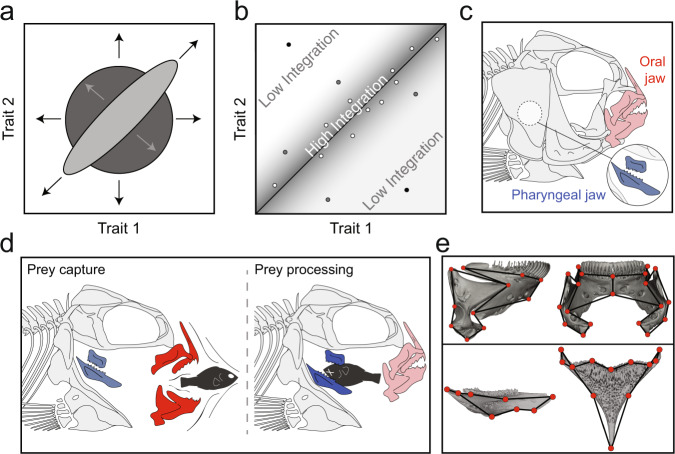
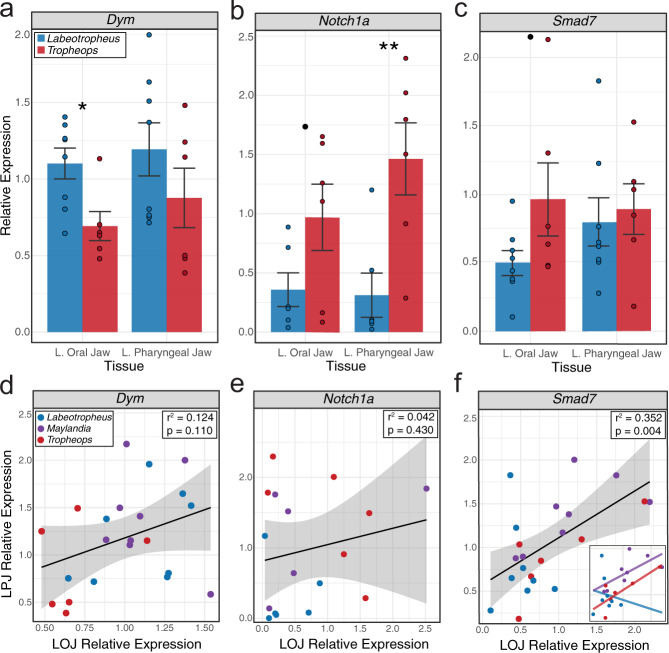
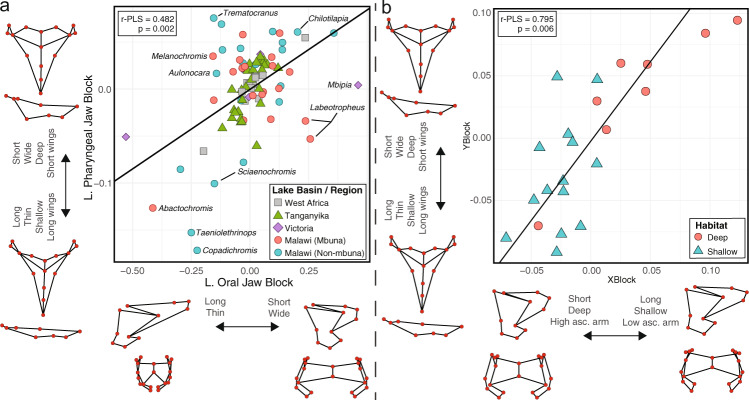
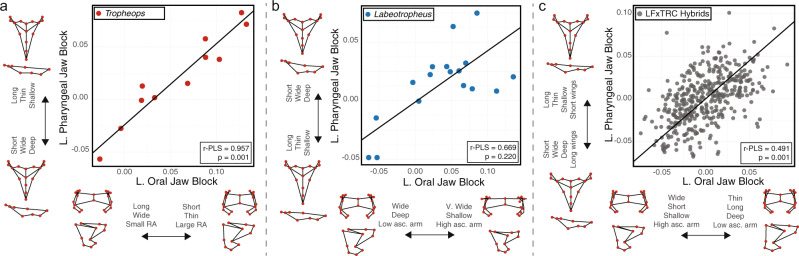
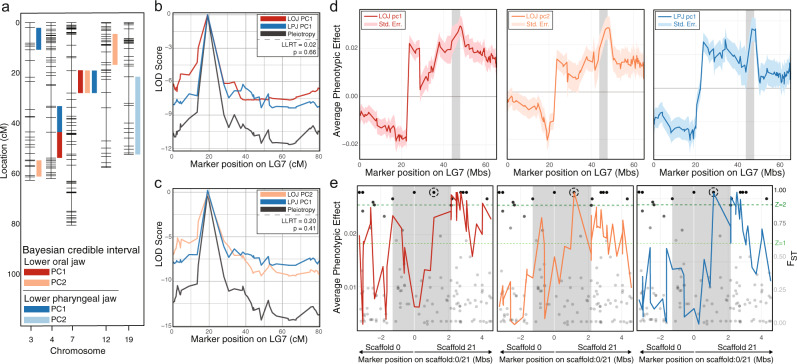
Evolutionary constraints may significantly bias phenotypic change, while "breaking" from such constraints can lead to expanded ecological opportunity. Ray-finned fishes have broken functional constraints by developing two jaws (oral-pharyngeal), decoupling prey capture (oral jaw) from processing (pharyngeal jaw). It is hypothesized that the oral and pharyngeal jaws represent independent evolutionary modules and this facilitated diversification in feeding architectures. Here we test this hypothesis in African cichlids. Contrary to our expectation, we find integration between jaws at multiple evolutionary levels. Next, we document integration at the genetic level, and identify a candidate gene, smad7, within a pleiotropic locus for oral and pharyngeal jaw shape that exhibits correlated expression between the two tissues. Collectively, our data show that African cichlid evolutionary success has occurred within the context of a coupled jaw system, an attribute that may be driving adaptive evolution in this iconic group by facilitating rapid shifts between foraging habitats, providing an advantage in a stochastic environment such as the East African Rift-Valley.
进化约束可能会显著影响表型变化,而“打破”这些约束则可以为生态机会的扩展提供可能。硬骨鱼类通过发展出两个下颚(口咽),从而“打破”了功能上的限制,实现了猎物捕获(口部下颚)和处理(咽部下颚)的分离。人们假设,口腔和咽部下颚代表独立的进化模块,这促进了摄食结构的多样化。在这里,我们在非洲慈鲷中测试了这一假设。与我们的预期相反,我们在多个进化水平上发现了下颚之间的整合。接下来,我们在遗传水平上记录了整合,并在一个对口腔和咽部下颚形状具有多效性的基因座内确定了一个候选基因 smad7,该基因在两个组织之间表现出相关表达。总的来说,我们的数据表明,非洲慈鲷的进化成功是在一个耦合的下颚系统的背景下发生的,这一特性可能通过促进在觅食栖息地之间的快速转换,为东非裂谷这样的随机环境提供优势,从而推动了这个标志性群体的适应性进化。