Siena Brain Investigation and Neuromodulation Lab (Si-BIN Lab), Unit of Neurology and Clinical Neurophysiology, Department of Medicine, Surgery and Neuroscience, University of Siena, Policlinico Le Scotte, Viale Bracci, 53100, Siena, Italy.
Department of Information Engineering and Mathematics, University of Siena, Siena, Italy.
Sci Rep. 2021 Sep 16;11(1):18487. doi: 10.1038/s41598-021-97876-2.
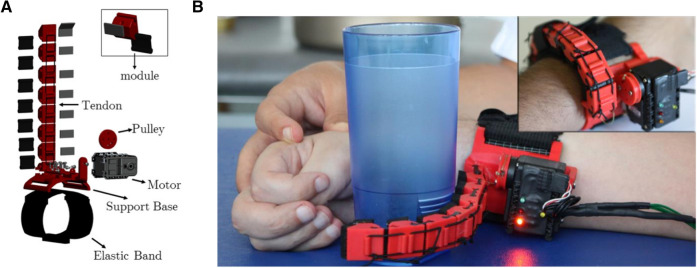
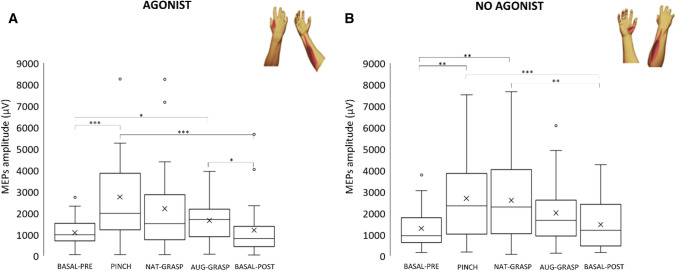
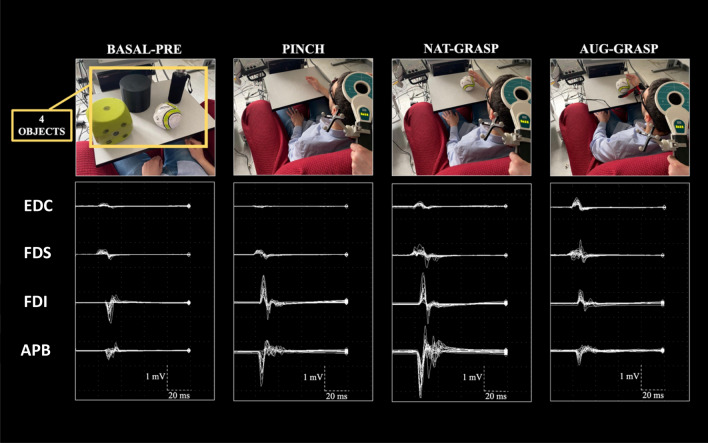
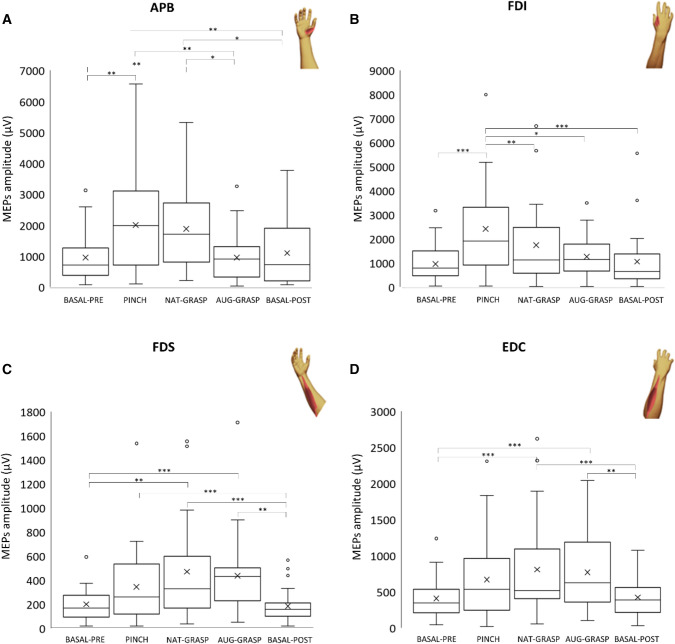
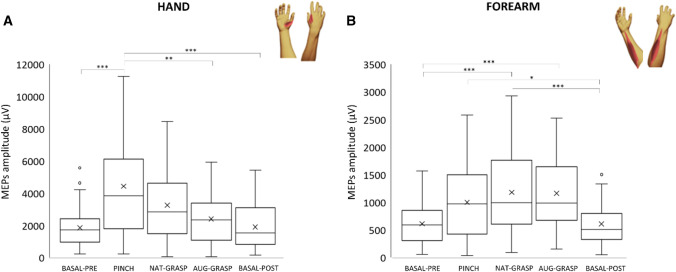
It is likely that when using an artificially augmented hand with six fingers, the natural five plus a robotic one, corticospinal motor synergies controlling grasping actions might be different. However, no direct neurophysiological evidence for this reasonable assumption is available yet. We used transcranial magnetic stimulation of the primary motor cortex to directly address this issue during motor imagery of objects' grasping actions performed with or without the Soft Sixth Finger (SSF). The SSF is a wearable robotic additional thumb patented for helping patients with hand paresis and inherent loss of thumb opposition abilities. To this aim, we capitalized from the solid notion that neural circuits and mechanisms underlying motor imagery overlap those of physiological voluntary actions. After a few minutes of training, healthy humans wearing the SSF rapidly reshaped the pattern of corticospinal outputs towards forearm and hand muscles governing imagined grasping actions of different objects, suggesting the possibility that the extra finger might rapidly be encoded into the user's body schema, which is integral part of the frontal-parietal grasping network. Such neural signatures might explain how the motor system of human beings is open to very quickly welcoming emerging augmentative bioartificial corticospinal grasping strategies. Such an ability might represent the functional substrate of a final common pathway the brain might count on towards new interactions with the surrounding objects within the peripersonal space. Findings provide a neurophysiological framework for implementing augmentative robotic tools in humans and for the exploitation of the SSF in conceptually new rehabilitation settings.
当使用具有六根手指的人工增强手时,可能会出现控制抓握动作的皮质脊髓运动协同作用不同的情况。然而,目前还没有直接的神经生理学证据支持这一合理假设。我们使用经颅磁刺激初级运动皮层,在使用或不使用软第六指(Soft Sixth Finger,SSF)进行物体抓握动作的运动想象期间,直接解决这个问题。SSF 是一种可穿戴的机器人附加拇指,专门为帮助手部瘫痪和拇指对掌能力丧失的患者而设计。为此,我们基于一个坚实的概念,即运动想象的神经回路和机制与生理自愿动作的神经回路和机制重叠。经过几分钟的训练,佩戴 SSF 的健康人迅速重塑了控制前臂和手部肌肉的皮质脊髓输出模式,这些肌肉负责想象不同物体的抓握动作,这表明额外的手指可能会迅速被编码到用户的身体图式中,身体图式是额顶抓握网络的组成部分。这些神经特征可能解释了人类运动系统如何能够快速接受新兴的增强生物人工皮质脊髓抓握策略。这种能力可能代表了大脑在与周围物体进行新的互动时所依赖的最终共同途径的功能基础,这些互动发生在个人空间内。研究结果为在人类中实施增强型机器人工具以及在新概念的康复环境中利用 SSF 提供了神经生理学框架。