Yuan Shiyi, Chen Jianjun, Zeng Li, Zhou Chanjuan, Yu Shenrun, Fang Liang
Department of Nephrology Yongchuan Hospital of Chongqing Medical University Chongqing China.
Department of Nephrology The People's Hospital of Yongchuan District Chongqing China.
Food Sci Nutr. 2021 Jul 19;9(9):4780-4792. doi: 10.1002/fsn3.2379. eCollection 2021 Sep.
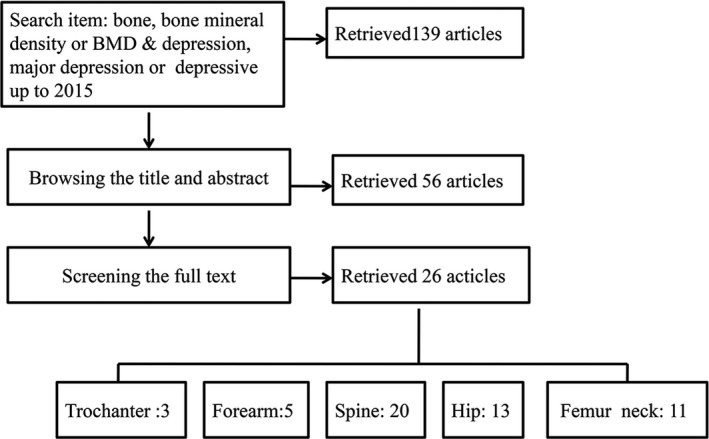
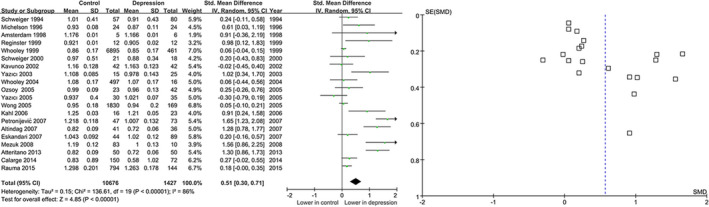
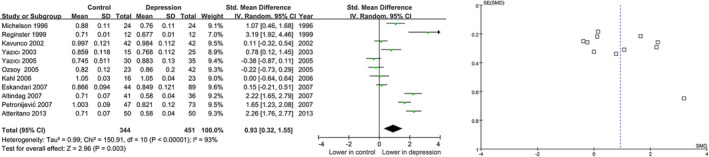
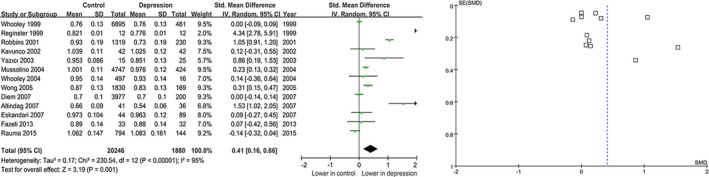
Major depressive disorder (MDD) is considered as a risk factor for osteoporosis. Bone mineral density (BMD), as the main tool for diagnosing osteoporosis, has been reported to have correlation with MDD in different cohorts. However, the information in causative link and etiology determinants of osteoporosis in MDD is still under investigation. The results are unclear. Thus, we perform a meta-analysis to evaluate the association between altered BMD and MDD. We searched the electronic databases to find studies examining BMD in patients with MDD. Finally, 26 published studies were included in our meta-analysis up from January 1990 to January 2019. All the data were pooled analysis using RevMan software. The association between altered BMD and MDD was assessed by std. mean difference (STD) and their 95% confidence intervals (CIs) for each study. Twenty-six studies were included in this meta-analysis. Pooled results showed a significant lower BMD in spine (STD=0.51, 95% CI=0.30-0.71, < .00001), total hip (STD=0.41, 95% CI=0.16 to 0.66, = .001), and femoral neck (STD=0.93, 95% CI=0.32 to 1.55, = .003) in MDD compared with controls. After stratification by mean age, gender, recruitment, diagnostic criteria, and measuring methods, no significant difference of BMD was found in bone mineral density of male total hip between MDD and controls( > .05). Moreover, adults appear to have lower BMD than old cohorts. This is an updated meta-analysis to reveal the a, suggesting that BMD appears to be more susceptible to occur in spine, total hip, femoral neck in MDD, especially for adults and women. Our meta-analysis may provide clinicians and public health administrators with an important screening tool for assessing depression and avoiding osteoporosis in adult subjects and female.
重度抑郁症(MDD)被认为是骨质疏松症的一个风险因素。骨矿物质密度(BMD)作为诊断骨质疏松症的主要工具,在不同队列研究中已被报道与MDD存在相关性。然而,关于MDD中骨质疏松症的因果关系和病因决定因素的信息仍在研究中,结果尚不清楚。因此,我们进行了一项荟萃分析,以评估BMD改变与MDD之间的关联。我们检索了电子数据库,以查找研究MDD患者BMD的研究。最终,从1990年1月至2019年1月,共有26项已发表的研究纳入我们的荟萃分析。所有数据均使用RevMan软件进行汇总分析。通过各研究的标准化均数差(STD)及其95%置信区间(CI)评估BMD改变与MDD之间的关联。本荟萃分析纳入了26项研究。汇总结果显示,与对照组相比,MDD患者的脊柱(STD = 0.51,95% CI = 0.30 - 0.71,P <.00001)、全髋部(STD = 0.41,95% CI = 0.16至0.66,P =.001)和股骨颈(STD = 0.93,95% CI = 0.32至1.55,P =.003)的BMD显著降低。按平均年龄、性别、招募方式、诊断标准和测量方法进行分层后,MDD患者与对照组之间男性全髋部骨矿物质密度无显著差异(P >.05)。此外,成年人的BMD似乎低于老年人群。这是一项更新的荟萃分析,结果表明,BMD在MDD患者的脊柱、全髋部、股骨颈更易出现,尤其是成年人和女性。我们的荟萃分析可能为临床医生和公共卫生管理人员提供一种重要的筛查工具,用于评估成年人和女性的抑郁症及预防骨质疏松症。