Wang Yang, Zhang Rui, Pan Weijun, Xu Zhe, Yang Huan, Luo Qi, Ye Xiping, Cheng Xianfeng
Department of Pharmacy, Ma'anshan Maternal and Child Health Hospital, Anhui, China.
Department of Andrology, Ma'anshan Maternal and Child Health Hospital, Anhui, China.
Transl Androl Urol. 2021 Aug;10(8):3515-3523. doi: 10.21037/tau-21-680.
To study the effects of L-carnitine (LC) combined with pancreatic kininogenase on thioredoxin 2 (Trx 2), thioredoxin reductase 1 (TrxR 1), and sperm quality in patients with oligoasthenospermia.
A total of 300 male infertility patients with oligoasthenospermia who were treated in the andrology clinic of our hospital from December 2019 to December 2020 were randomly divided into an LC group and combined treatment group, and 50 males with normal semen were selected as a control group. The computer-assisted semen analysis system (CASA) was used to detect the total number, vitality, and forward motility of the sperm before and after treatment, and sperm morphology was detected by the Diff-Quik method of the sperm staining kit. Sperm chromatin dispersion (SCD) method was used to detect sperm DNA fragments, and Western-blot was used to detect the protein expression of Trx 2 and TrxR 1.
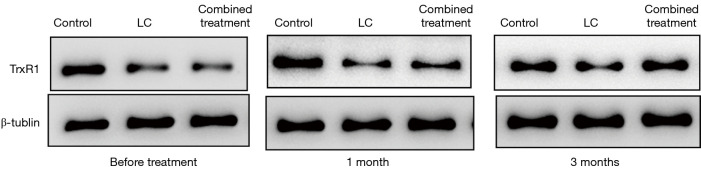
There were no significant differences in sperm density, motility rate, forward motile sperm rate, and DNA fragmentation rate in oligoasthenospermia patients before treatment (P>0.05). However, after 1 month of treatment, the sperm density, motility rate, and forward motile sperm rate were all higher than before treatment (P<0.05), while the DNA fragmentation rate was lower than before treatment. At the same time, each index of semen in the combination group was higher than that in the LC group (P<0.05), and the total effective rate in the combination group was significantly higher than in the LC group (P<0.01). The expression of Trx2 protein in oligoasthenospermia patients was significantly increased (P<0.05), while the expression of TrxR1 protein was significantly decreased (P<0.05). After 3 months of treatment, the expression of Trx2 protein was significantly decreased (P<0.05), while the expression of TrxR1 protein was significantly increased (P<0.05).
The results suggest Trx 2 and TrxR 1 may be candidate protein markers for oligoasthenospermia. LC combined with pancreatic kininogenase in the treatment of male oligoasthenospermia can effectively promote sperm maturation, enhance sperm motility, and improve semen quality, which has high application value.
研究左旋肉碱(LC)联合胰激肽原酶对少弱精子症患者硫氧还蛋白2(Trx 2)、硫氧还蛋白还原酶1(TrxR 1)及精子质量的影响。
选取2019年12月至2020年12月在我院男科门诊治疗的300例少弱精子症男性不育患者,随机分为LC组和联合治疗组,另选取50例精液正常的男性作为对照组。采用计算机辅助精液分析系统(CASA)检测治疗前后精子总数、活力及前向运动能力,采用精子染色试剂盒的Diff - Quik法检测精子形态。采用精子染色质扩散(SCD)法检测精子DNA片段,采用蛋白质免疫印迹法检测Trx 2和TrxR 1的蛋白表达。
少弱精子症患者治疗前精子密度、活动率、前向运动精子率及DNA碎片率比较,差异无统计学意义(P>0.05)。然而,治疗1个月后,精子密度、活动率及前向运动精子率均高于治疗前(P<0.05),而DNA碎片率低于治疗前。同时,联合治疗组精液各项指标均高于LC组(P<0.05),联合治疗组总有效率显著高于LC组(P<0.01)。少弱精子症患者Trx2蛋白表达显著升高(P<0.05),而TrxR1蛋白表达显著降低(P<0.05)。治疗3个月后,Trx2蛋白表达显著降低(P<0.05),而TrxR1蛋白表达显著升高(P<0.05)。
结果提示Trx 2和TrxR 1可能是少弱精子症的候选蛋白标志物。LC联合胰激肽原酶治疗男性少弱精子症可有效促进精子成熟,增强精子活力,改善精液质量,具有较高的应用价值。