Su Longxiang, Ma Xudong, Rui Xi, He Huaiwu, Wang Ye, Shan Guangliang, Kang Yan, Shang You, Zheng Ruiqiang, Li Shusheng, Zhan Qingyuan, Ding Renyu, Yin Yongjie, Jiang Li, Zhang Lina, Ge Qinggang, Zhang Liu, Lu Junyu, Wan Linjun, Yan Jing, Liu Dawei, Long Yun, Guan Xiangdong, Chen Dechang, Zhou Xiang, Zhang Shuyang
Department of Critical Care Medicine, State Key Laboratory of Complex Severe and Rare Diseases, Peking Union Medical College Hospital, Peking Union Medical College & Chinese Academy of Medical Sciences, Beijing, China.
Department of Medical Administration, National Health Commission of the People's Republic of China, Beijing, China.
Ann Transl Med. 2021 Aug;9(15):1219. doi: 10.21037/atm-21-310.
Shock is a critical illness that seriously threatens the lives of patients. This study explains the epidemiology of shock, mortality of shock, and identify factors that related to hospital death.
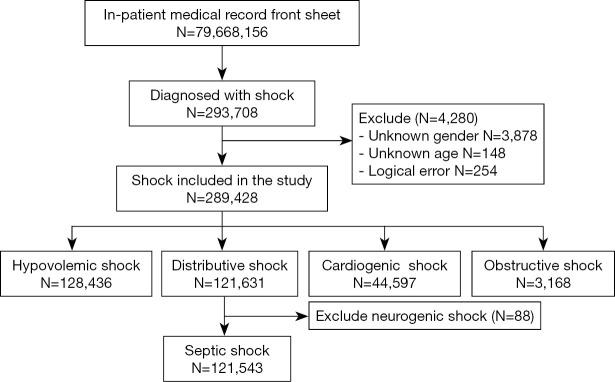
This is a multi-centre cross-sectional survey, which included 1,064 tertiary hospitals in 31 provinces, municipalities, and autonomous regions across China mainland. Totally 289,428 patients who diagnosed with shock based on the ICD-10 abstracted from the Hospital Quality Monitoring System (HQMS) in 2018, a national database administrated by National Health Commission of the PRC.
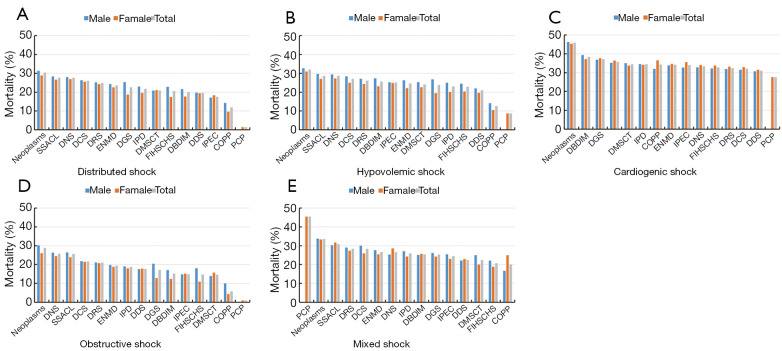
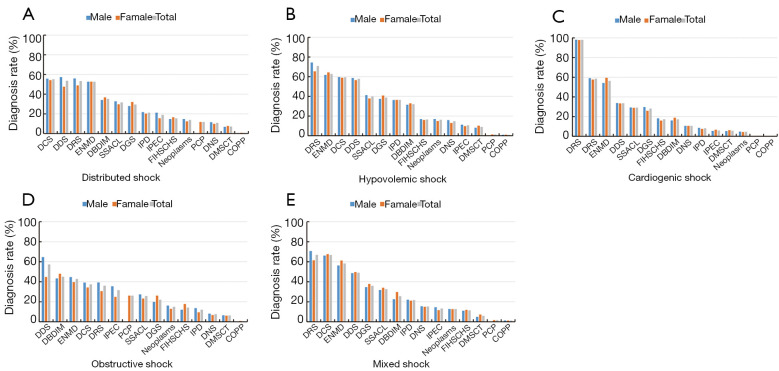
Patients diagnosed with shock were screened and classified according to the type of shock. Regression analysis was used to identify factors that related to death. A total of 79,668,156 medical records were included in HQMS in 2018, from which a total of 289,428 records with shock were identified. Hypovolemic shock occurred in 128,436 cases (44.38%), septic shock occurred in 121,543 cases (41.99%), cardiogenic shock occurred in 44,597 cases (15.41), and obstructive shock occurred in 3,168 cases (1.09%). Of these, 8,147 cases (2.81%) had mixed shock, which means had two or more types of shock. For all the shock cases, the top three frequent concomitant diseases recorded were circulatory system diseases (55.22%), digestive system diseases (53.64%), and respiratory system diseases (53.31%). Of the four types of shock, cases with cardiogenic shock had the highest in-hospital mortality (31.6%), followed by those with obstructive shock (25.2%), septic shock (22.9%), and hypovolemic shock (15.5%). Interestingly, the combination of shock and malignant tumors is one of the major factors that related to hospital deaths.
Shock is a serious disease with a high fatality rate and huge clinical costs. According to this epidemiological survey of shock in China 2018, we should clarify the factors related to the hospital death in shock cases.
休克是一种严重威胁患者生命的危重症。本研究阐述了休克的流行病学、休克死亡率,并确定与医院死亡相关的因素。
这是一项多中心横断面调查,纳入了中国大陆31个省、直辖市和自治区的1064家三级医院。从中国国家卫生健康委员会管理的全国数据库——医院质量监测系统(HQMS)中提取了2018年基于国际疾病分类第十版(ICD-10)诊断为休克的289428例患者。
根据休克类型对诊断为休克的患者进行筛选和分类。采用回归分析确定与死亡相关的因素。2018年HQMS共纳入79668156份病历,从中确定了289428份休克病历。低血容量性休克128436例(44.38%),感染性休克121543例(41.99%),心源性休克44597例(15.41%),梗阻性休克3168例(1.09%)。其中,8147例(2.81%)为混合性休克,即有两种或更多类型的休克。在所有休克病例中,记录的前三位常见伴随疾病是循环系统疾病(55.22%)、消化系统疾病(53.64%)和呼吸系统疾病(53.31%)。在四种类型的休克中,心源性休克患者的院内死亡率最高(31.6%),其次是梗阻性休克(25.2%)、感染性休克(22.9%)和低血容量性休克(15.5%)。有趣的是,休克与恶性肿瘤的合并是与医院死亡相关的主要因素之一。
休克是一种死亡率高、临床成本巨大的严重疾病。根据2018年中国休克的这项流行病学调查,我们应明确休克病例中与医院死亡相关的因素。