Spoor Jonathan, Eyck Ben M, Atmodimedjo Peggy N, Jansen Maurice P H M, Helmijr Jean C A, Martens John W M, van der Wilk Berend J, van Lanschot J Jan B, Dinjens Winand N M
Department of Surgery, Erasmus MC Cancer Institute, University Medical Center, Rotterdam, The Netherlands.
Department of Pathology, Erasmus MC Cancer Institute, University Medical Center, Rotterdam, The Netherlands.
Ann Transl Med. 2021 Aug;9(15):1264. doi: 10.21037/atm-21-525.
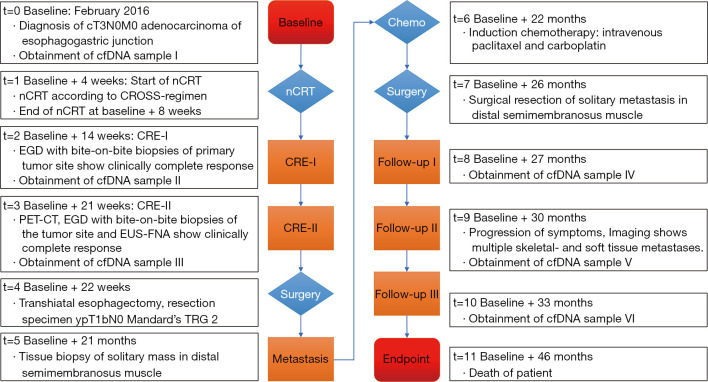
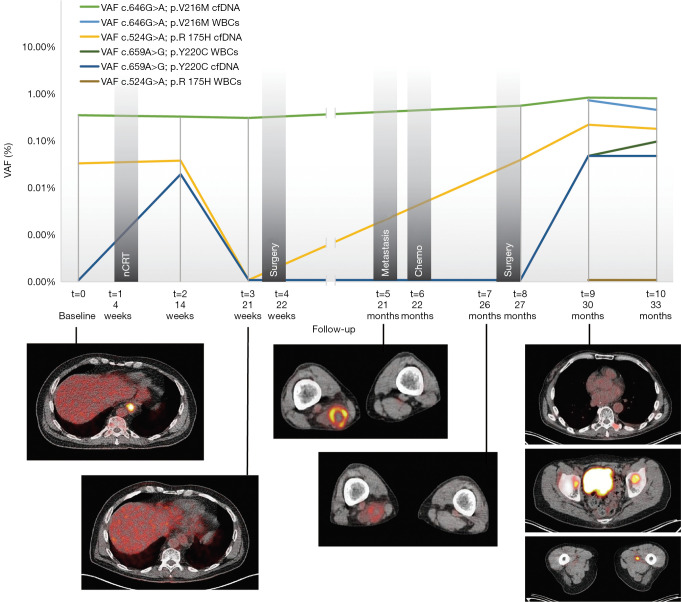
Circulating tumor DNA (ctDNA) analysis is a promising non-invasive technique for active surveillance after chemoradiotherapy for locally advanced resectable esophageal carcinoma. In other malignancies false-positive results in ctDNA analysis have been reported due to clonal hematopoiesis. In this case, we present a 66-year-old male who had adenocarcinoma of the gastroesophageal junction for which he received neoadjuvant chemoradiotherapy and underwent a transhiatal esophagectomy. Postoperatively our patient received follow-up with ctDNA analysis using next generation sequencing (NGS) and droplet digital PCR (ddPCR). This case report illustrates a number of the current challenges in ctDNA diagnostics in esophageal carcinoma. Firstly, the TP53 c.524G>A; p.R175H mutation that was found in preoperative tumor biopsies became detectable in ctDNA only after distant metastases had already been confirmed by clinical symptoms and standard imaging- and biopsy techniques. Secondly our patient repeatedly had false-positive outcomes of ctDNA analysis. Genomic analysis of white blood cells revealed that the origin of these discordant mutations lies in clonal hematopoiesis. Failure to detect TP53 c.524G>A; p.R175H in cell-free DNA (cfDNA) is most likely due to the amount of ctDNA in the cfDNA fraction being below the limit of detection for NGS and ddPCR analyses. Clinicians should be aware of the possibility of finding mutations originating from clonal hematopoiesis when using ctDNA analysis during active surveillance for esophageal carcinoma. We recommend correlation of mutations in cfDNA with mutations in tumor biopsies.
循环肿瘤DNA(ctDNA)分析是一种很有前景的非侵入性技术,用于局部晚期可切除食管癌放化疗后的主动监测。在其他恶性肿瘤中,由于克隆性造血,已报道了ctDNA分析出现假阳性结果的情况。在此病例中,我们介绍了一名66岁男性,他患有胃食管交界腺癌,接受了新辅助放化疗,并接受了经裂孔食管切除术。术后,我们的患者接受了使用下一代测序(NGS)和液滴数字PCR(ddPCR)进行ctDNA分析的随访。本病例报告说明了食管癌ctDNA诊断中当前面临的一些挑战。首先,术前肿瘤活检中发现的TP53基因c.524G>A;p.R175H突变,仅在远处转移已通过临床症状以及标准影像学和活检技术得到证实时,才在ctDNA中检测到。其次,我们的患者ctDNA分析多次出现假阳性结果。对白细胞的基因组分析表明,这些不一致突变的来源是克隆性造血。在游离DNA(cfDNA)中未能检测到TP53基因c.524G>A;p.R175H,很可能是由于cfDNA组分中ctDNA的量低于NGS和ddPCR分析的检测限。临床医生在对食管癌进行主动监测期间使用ctDNA分析时,应意识到发现源自克隆性造血的突变的可能性。我们建议将cfDNA中的突变与肿瘤活检中的突变进行关联分析。