Mobayen Golzar, Dhutia Amrita, Clarke Candice, Prendecki Maria, McAdoo Stephen, Keniyopoullos Renos, Malik Talat, Laffan Michael, Willicombe Michelle, McKinnon Thomas
Department of Immunology and Inflammation Centre for Haematology Commonwealth Building Hammersmith Campus Imperial College of Science Technology and Medicine London UK.
Department of Immunology and Inflammation Centre for Inflammatory Disease Commonwealth Building Hammersmith Campus Imperial College of Science Technology and Medicine London UK.
Res Pract Thromb Haemost. 2021 Sep 12;5(6):e12582. doi: 10.1002/rth2.12582. eCollection 2021 Aug.
A major clinical feature of severe coronavirus diease 2019 (COVID-19) is microvascular thrombosis linked to endothelial cell activation. Consistent with this, a number of studies have shown that patients with severe COVID-19 have highly elevated plasma levels of von Willebrand Factor (VWF) that may contribute to the prothrombotic phenotype. In the current study, we investigated the extent of endothelial activation in patients receiving hemodialysis who had either mild or severe COVID-19.
Plasma VWF, ADAMTS-13, angiopoietin-2 (Ang2), and syndecan-1 levels were determined by ELISA. The sialic acid content of VWF was investigated using a modified ELISA to measure elderberry bark lectin, specific for sialic acid residues, binding to VWF.
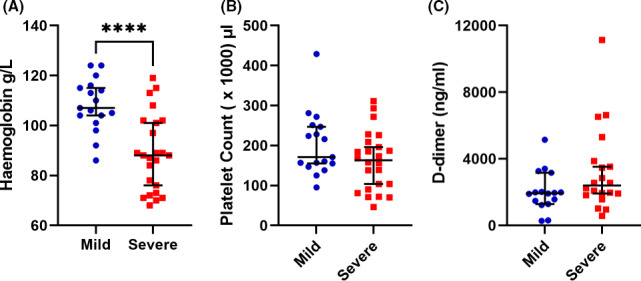
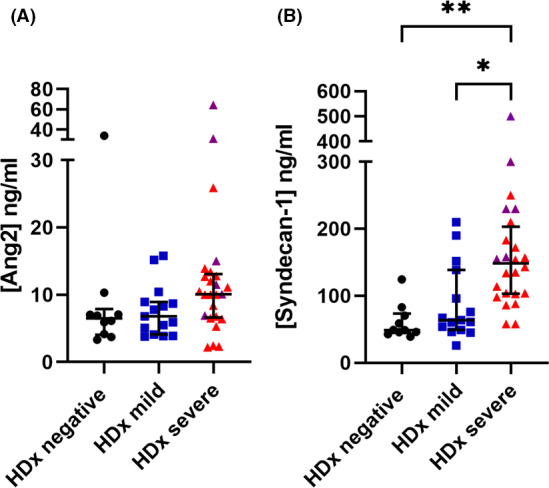
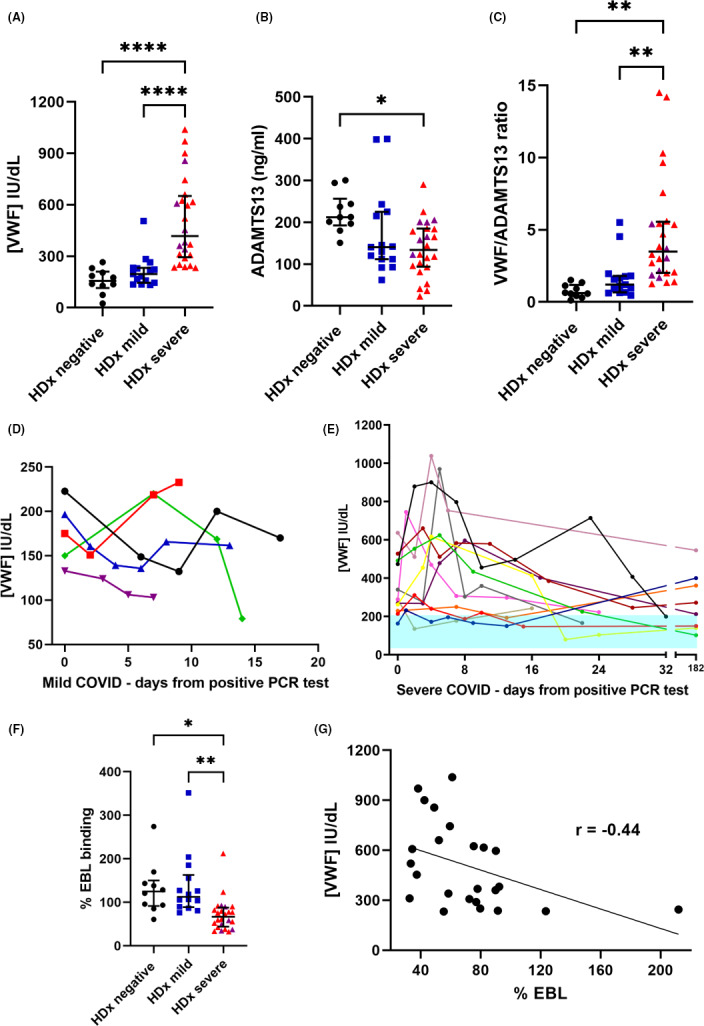
Patients receiving hemodialysis with severe COVID-19 had significantly higher plasma levels of VWF and lower ADAMTS-13. VWF levels peaked and were sustained during the first 10 days after positive confirmation of infection. While Ang2 trended toward being higher in severely ill patients, this did not reach significance; however, severely ill patients had significantly higher soluble syndecan-1 levels, with high levels related to risk of death. Finally, higher VWF levels in severely ill patients were correlated with lower VWF sialic acid content.
Severe COVID-19 in patients undergoing hemodialysis is associated with both acute and sustained activation of the endothelium, leading to alteration of the VWF/ADAMTS-13 axis. Lower VWF sialic acid content represents altered VWF processing and further confirms the disturbance caused to the endothelium in COVID-19.
2019年冠状病毒病(COVID-19)重症的一个主要临床特征是与内皮细胞活化相关的微血管血栓形成。与此一致的是,多项研究表明,重症COVID-19患者的血浆血管性血友病因子(VWF)水平显著升高,这可能导致血栓前表型。在本研究中,我们调查了接受血液透析的轻症或重症COVID-19患者的内皮活化程度。
采用酶联免疫吸附测定法(ELISA)测定血浆VWF、含凝血酶敏感蛋白基的去整合素样金属蛋白酶13(ADAMTS-13)、血管生成素-2(Ang2)和多配体蛋白聚糖-1水平。使用改良的ELISA法研究VWF的唾液酸含量,该方法用于测量接骨木树皮凝集素(对唾液酸残基具有特异性)与VWF的结合情况。
接受血液透析的重症COVID-19患者的血浆VWF水平显著更高,而ADAMTS-13水平更低。VWF水平在感染确诊后的前10天达到峰值并持续存在。虽然Ang2在重症患者中呈升高趋势,但未达到显著水平;然而,重症患者的可溶性多配体蛋白聚糖-1水平显著更高,高水平与死亡风险相关。最后,重症患者中较高的VWF水平与较低的VWF唾液酸含量相关。
接受血液透析的患者发生重症COVID-19与内皮的急性和持续活化相关,导致VWF/ADAMTS-13轴发生改变。较低的VWF唾液酸含量代表VWF加工过程改变,并进一步证实了COVID-19对内皮造成的干扰。