Section of Cardiology Baylor College of Medicine Houston TX.
Division of Internal Medicine Rochester General Hospital Rochester NY.
J Am Heart Assoc. 2021 Sep 21;10(18):e022043. doi: 10.1161/JAHA.121.022043. Epub 2021 Sep 17.
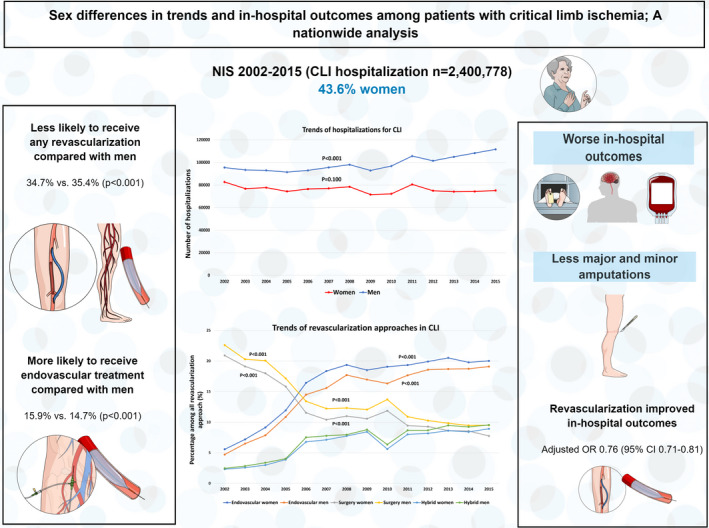
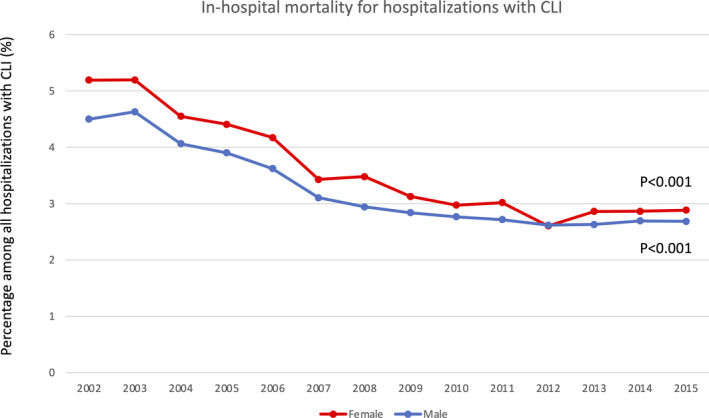
Background Critical limb ischemia (CLI) represents the most severe form of peripheral artery disease and is associated with significant mortality and morbidity. Contemporary data comparing the sex differences in trends, revascularization strategies, and in-hospital outcomes among patients with CLI are scarce. Methods and Results Using the National Inpatient Sample database years 2002 to 2015, we identified hospitalizations for CLI. Temporal trends for hospitalizations for CLI were evaluated. The differences in demographics, revascularization, and in-hospital outcomes between both sexes were compared. Among 2 400 778 CLI hospitalizations, 43.6% were women. Women were older and had a higher prevalence of obesity, hypertension, heart failure, and prior stroke. Women were also less likely to receive any revascularization (34.7% versus 35.4%, <0.001), but the trends of revascularization have been increasing among both sexes. Revascularization was associated with lower in-hospital mortality among women (adjusted odds ratio [OR], 0.76; 95% CI, 0.71-0.81) and men (adjusted OR, 0.69; 95% CI, 0.65-0.73). On multivariable analysis adjusting for patient- and hospital-related characteristics as well as revascularization, women had a higher incidence of in-hospital mortality, postoperative hemorrhage, need for blood transfusion, postoperative infection, ischemic stroke, and discharge to facilities compared with men. Conclusions In this nationwide contemporary analysis of CLI hospitalizations, women were older and less likely to undergo revascularization. Women had a higher incidence of in-hospital mortality and bleeding complications compared with men. Sex-specific studies and interventions are needed to minimize these gaps among this high-risk population.
严重肢体缺血(CLI)代表外周动脉疾病最严重的形式,与显著的死亡率和发病率相关。目前关于 CLI 患者中性别差异的趋势、血运重建策略和住院结局的相关数据十分有限。
利用 2002 年至 2015 年的全国住院患者样本数据库,我们确定了 CLI 的住院病例。评估了 CLI 住院的时间趋势。比较了两性之间的人口统计学、血运重建和住院结局差异。在 2400778 例 CLI 住院病例中,43.6%为女性。女性年龄更大,肥胖症、高血压、心力衰竭和既往卒中的发病率更高。女性接受任何血运重建的可能性也较低(34.7%比 35.4%,<0.001),但两性的血运重建趋势一直在增加。血运重建与女性(校正比值比[OR],0.76;95%置信区间[CI],0.71-0.81)和男性(校正 OR,0.69;95%CI,0.65-0.73)的住院死亡率降低相关。在多变量分析中,调整患者和医院相关特征以及血运重建后,与男性相比,女性的住院死亡率、术后出血、输血需求、术后感染、缺血性卒中和出院至疗养机构的发生率更高。
在这项针对 CLI 住院患者的全国性当代分析中,女性年龄更大,接受血运重建的可能性更小。与男性相比,女性的住院死亡率和出血并发症发生率更高。需要针对这一高危人群进行性别特异性研究和干预,以缩小这些差距。