Department of Physiology and Cell Biology, University of Nevada, Reno School of Medicine, Reno, Nevada 89557, United States.
School of Public Health, University of Nevada, Reno, Nevada 89557, United States.
ACS Chem Neurosci. 2021 Oct 6;12(19):3535-3549. doi: 10.1021/acschemneuro.1c00542. Epub 2021 Sep 17.
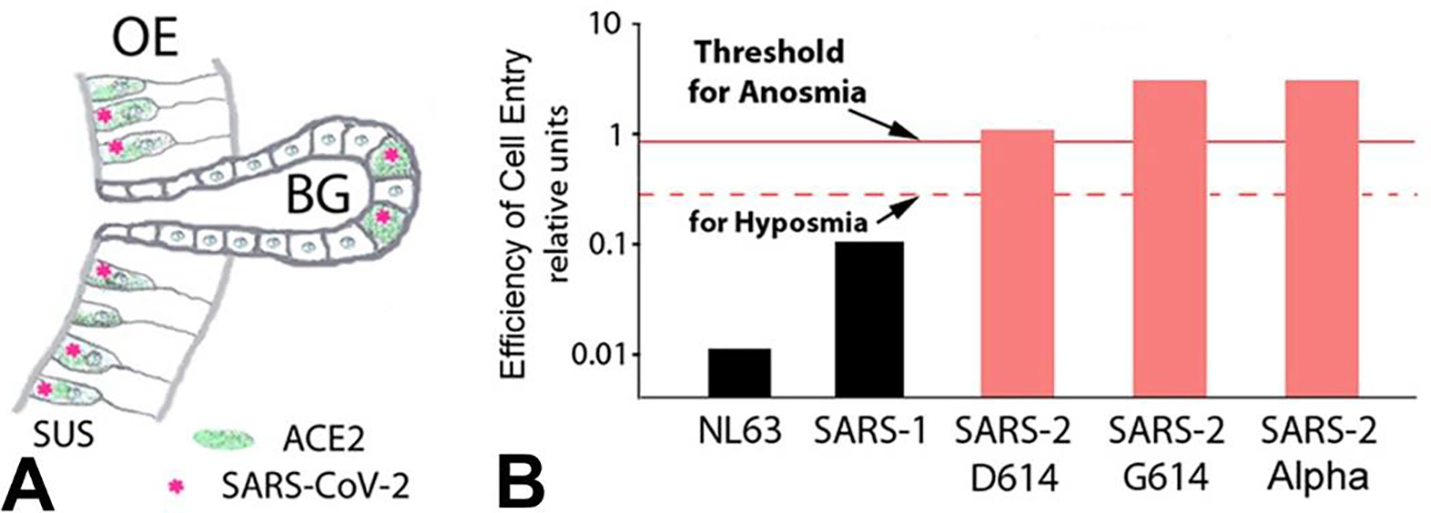
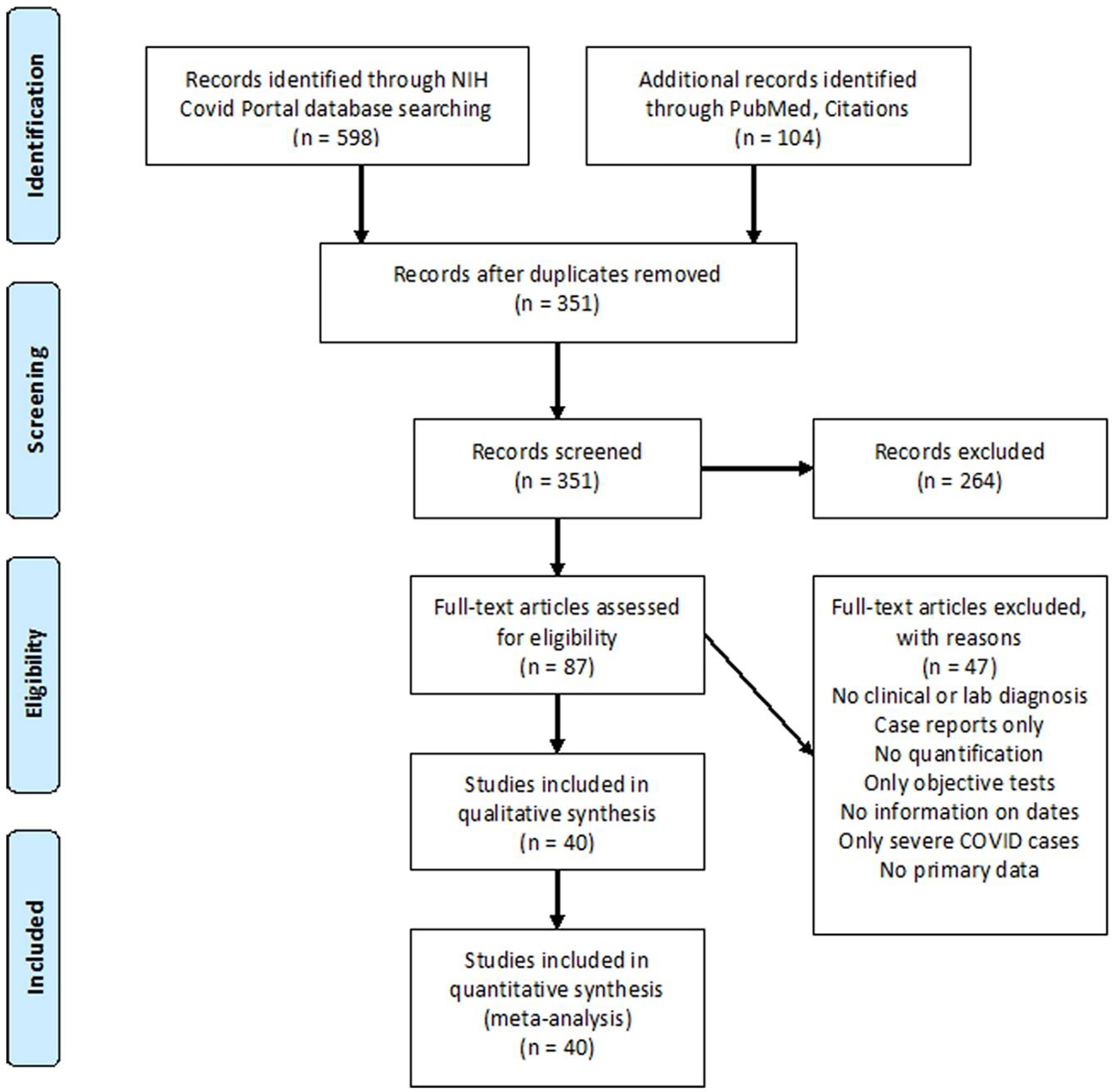
The prevalence of chemosensory dysfunction in patients with COVID-19 varies greatly between populations. It is unclear whether such differences are due to factors at the level of the human host, or at the level of the coronavirus, or both. At the host level, the entry proteins which allow virus binding and entry have variants with distinct properties, and the frequency of such variants differs between ethnicities. At the level of the virus, the D614G mutation enhances virus entry to the host cell. Since the two virus strains (D614 and G614) coexisted in the first six months of the pandemic in most populations, it has been difficult to distinguish between contributions of the virus and contributions of the host for anosmia. To answer this question, we conducted a systematic review and meta-analysis of studies in South Asian populations when either the D614 or the G614 virus was dominant. We show that populations infected predominantly with the G614 virus had a much higher prevalence of anosmia (pooled prevalence of 31.8%) compared with the same ethnic populations infected mostly with the D614 virus strain (pooled anosmia prevalence of 5.3%). We conclude that the D614G mutation is a major contributing factor that increases the prevalence of anosmia in COVID-19, and that this enhanced effect on olfaction constitutes a previously unrecognized phenotype of the D614G mutation. The new virus strains that have additional mutations on the background of the D614G mutation can be expected to cause a similarly increased prevalence of chemosensory dysfunctions.
在 COVID-19 患者中,化学感觉功能障碍的流行率在不同人群之间差异很大。目前尚不清楚这些差异是由于宿主层面的因素、冠状病毒层面的因素还是两者兼而有之。在宿主层面,允许病毒结合和进入的进入蛋白具有不同特性的变体,而这些变体的频率在不同种族之间存在差异。在病毒层面,D614G 突变增强了病毒进入宿主细胞的能力。由于在大流行的最初六个月中,两种病毒株(D614 和 G614)在大多数人群中同时存在,因此很难区分嗅觉丧失是由病毒还是宿主引起的。为了回答这个问题,我们对南亚人群中当 D614 或 G614 病毒占优势时的研究进行了系统评价和荟萃分析。我们发现,主要感染 G614 病毒的人群中嗅觉丧失的患病率要高得多(汇总患病率为 31.8%),而同一族裔人群中主要感染 D614 病毒株的人群中嗅觉丧失的患病率则要低得多(汇总患病率为 5.3%)。我们得出结论,D614G 突变是导致 COVID-19 中嗅觉丧失患病率增加的一个主要因素,而这种对嗅觉的增强作用构成了 D614G 突变的一个以前未被认识的表型。在 D614G 突变的基础上具有其他突变的新病毒株可能会导致化学感觉功能障碍的患病率类似增加。