Department of Human Development & Family Sciences, University of Connecticut, 348 Mansfield Rd. U-1058, Storrs, CT, 06269, USA.
Child Psychiatry Hum Dev. 2022 Feb;53(1):183-196. doi: 10.1007/s10578-021-01243-1. Epub 2021 Sep 17.
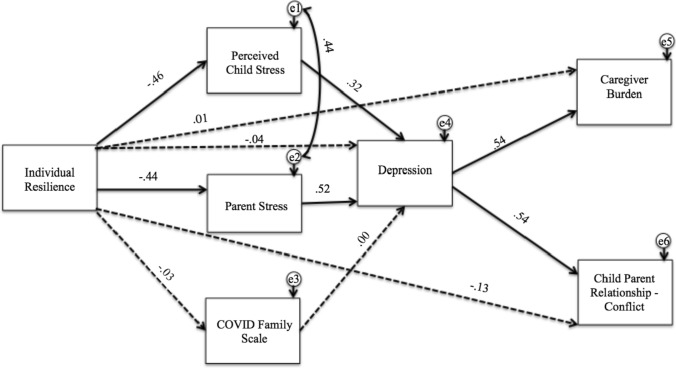
The COVID-19 pandemic is linked to particularly potent psychological effects for children and their caregivers while families adjust to new daily routines for work, education, and self-care. Longitudinal associations are presented from a national sample of 271 parents (mean age = 35.29 years, 48.5% female) on resilience, mental health and stress indicators, and parenting outcomes. Multigroup path model results indicate significant associations between resilience and parent stress or parent perceived child stress initiates a sequence of significant linkages to parent depression, followed by caregiver burden and parent-child relationship quality. This final set of linkages between depression and both parenting outcomes were significantly stronger for men, who also reported higher rates of perceived child stress. Results suggest that fathers' depression symptoms and associated spill-over to perceived child stress is producing stronger effects on their parenting experiences than effects reported by mothers.
COVID-19 大流行对儿童及其照顾者产生了特别强烈的心理影响,因为家庭需要适应工作、教育和自我保健的新日常。本研究从全国范围内的 271 名父母(平均年龄为 35.29 岁,女性占 48.5%)的样本中呈现了纵向关联,研究内容涉及适应力、心理健康和压力指标,以及养育结果。多群组路径模型的结果表明,适应力与父母压力或父母感知到的孩子压力之间存在显著关联,这种关联会引发一系列显著的关联,从而导致父母抑郁,继而导致照顾者负担和亲子关系质量下降。对于男性来说,这种抑郁与这两种养育结果之间的最后一组关联更为显著,因为男性报告的孩子压力感知程度更高。研究结果表明,父亲的抑郁症状及其对感知到的孩子压力的溢出效应,对他们的育儿体验产生的影响比母亲报告的影响更强。