School of Life Sciences, Arizona State University, Tempe, AZ 85287;
Department of Entomology, Plant Pathology, and Nematology, University of Idaho, Moscow, ID 83844.
Proc Natl Acad Sci U S A. 2021 Sep 21;118(38). doi: 10.1073/pnas.2026029118.
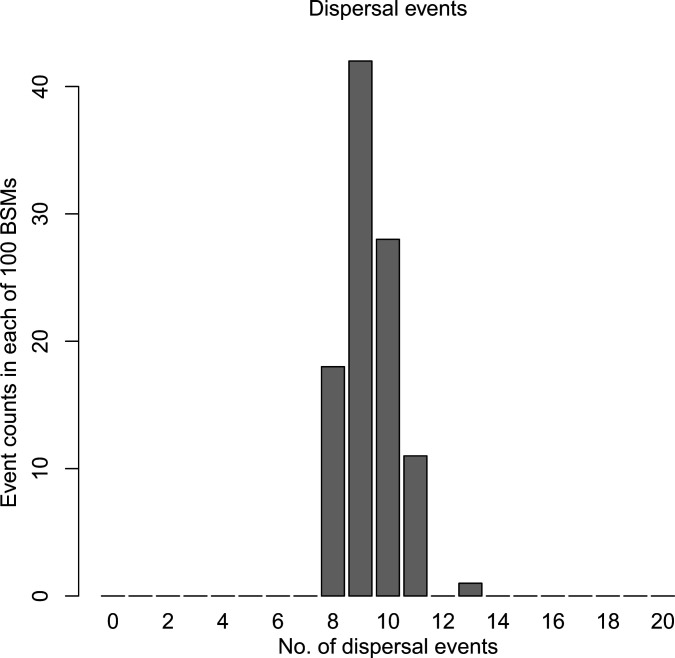
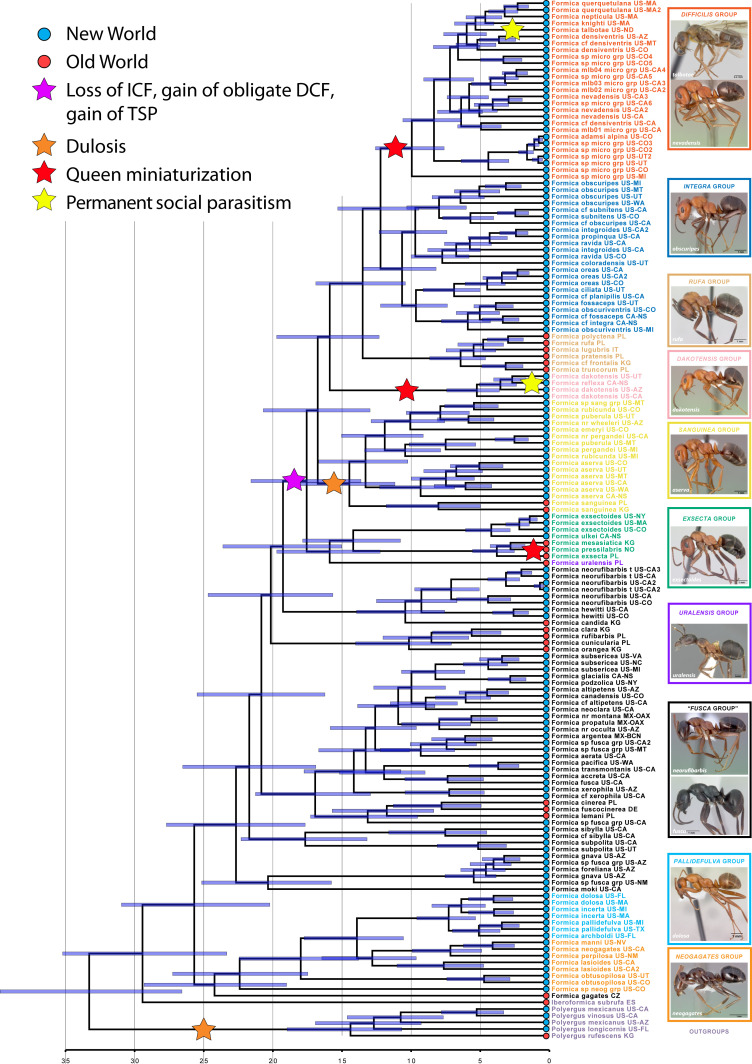
Studying the behavioral and life history transitions from a cooperative, eusocial life history to exploitative social parasitism allows for deciphering the conditions under which changes in behavior and social organization lead to diversification. The Holarctic ant genus is ideally suited for studying the evolution of social parasitism because half of its 172 species are confirmed or suspected social parasites, which includes all three major classes of social parasitism known in ants. However, the life history transitions associated with the evolution of social parasitism in this genus are largely unexplored. To test competing hypotheses regarding the origins and evolution of social parasitism, we reconstructed a global phylogeny of ants. The genus originated in the Old World ∼30 Ma ago and dispersed multiple times to the New World and back. Within , obligate dependent colony-founding behavior arose once from a facultatively polygynous common ancestor practicing independent and facultative dependent colony foundation. Temporary social parasitism likely preceded or arose concurrently with obligate dependent colony founding, and dulotic social parasitism evolved once within the obligate dependent colony-founding clade. Permanent social parasitism evolved twice from temporary social parasitic ancestors that rarely practiced colony budding, demonstrating that obligate social parasitism can originate from a facultative parasitic background in socially polymorphic organisms. In contrast to permanently socially parasitic ants in other genera, the high parasite diversity in likely originated via allopatric speciation, highlighting the diversity of convergent evolutionary trajectories resulting in nearly identical parasitic life history syndromes.
研究从合作的、真社会性生命史向掠夺性社会寄生转变的行为和生活史,可以揭示行为和社会组织变化导致多样化的条件。全北美的蚂蚁属是研究社会寄生进化的理想选择,因为其 172 个物种中有一半是已确认或疑似的社会寄生虫,其中包括蚂蚁中已知的所有三种主要的社会寄生类群。然而,该属中与社会寄生进化相关的生活史转变在很大程度上仍未被探索。为了检验关于社会寄生起源和进化的竞争假说,我们重建了 蚂蚁的全球系统发育。该属起源于旧世界,大约 3000 万年前,并多次向新世界扩散,然后又返回。在 属中,从一个实行独立和有条件依赖的殖民地建立的兼性多配偶共同祖先中,一次出现了强制性依赖殖民地建立的行为。临时社会寄生可能先于或与强制性依赖殖民地建立同时出现,并且在强制性依赖殖民地建立的分支中,一次出现了奴役性社会寄生。永久性社会寄生从很少进行殖民地萌芽的临时社会寄生祖先中进化了两次,这表明在具有社会多态性的生物体中,强制性的社会寄生可以从有条件的寄生背景中起源。与其他属中的永久性社会性寄生蚂蚁不同, 属中的高寄生虫多样性可能是通过地理隔离形成的,这突出了导致几乎相同寄生生活史综合征的趋同进化轨迹的多样性。