Klarman Cell Observatory, Broad Institute of MIT and Harvard, Cambridge, MA, USA.
Broad Institute of MIT and Harvard, Cambridge, MA, USA.
Nat Commun. 2021 Sep 17;12(1):5506. doi: 10.1038/s41467-021-25777-z.
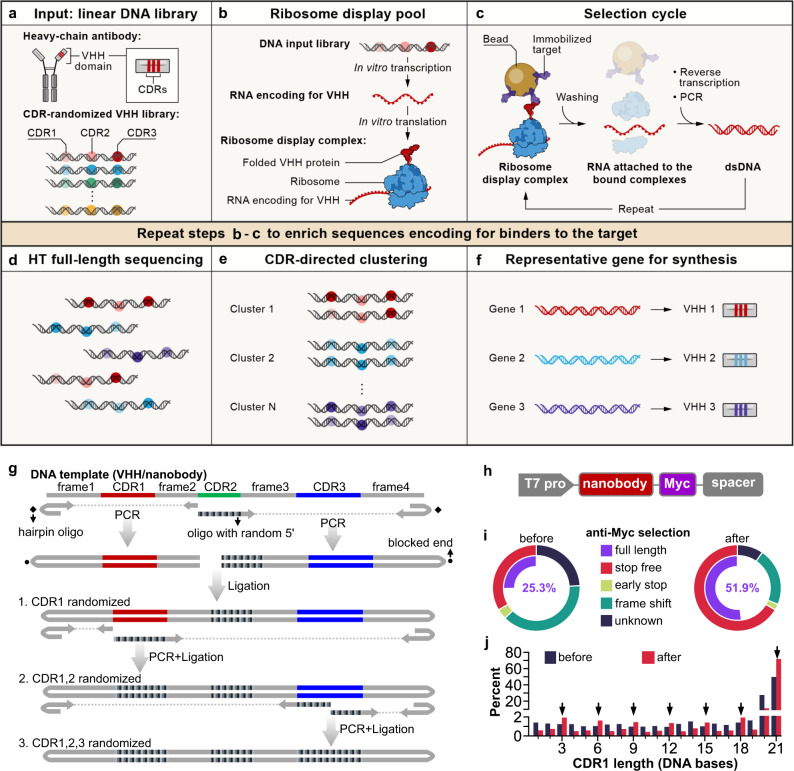
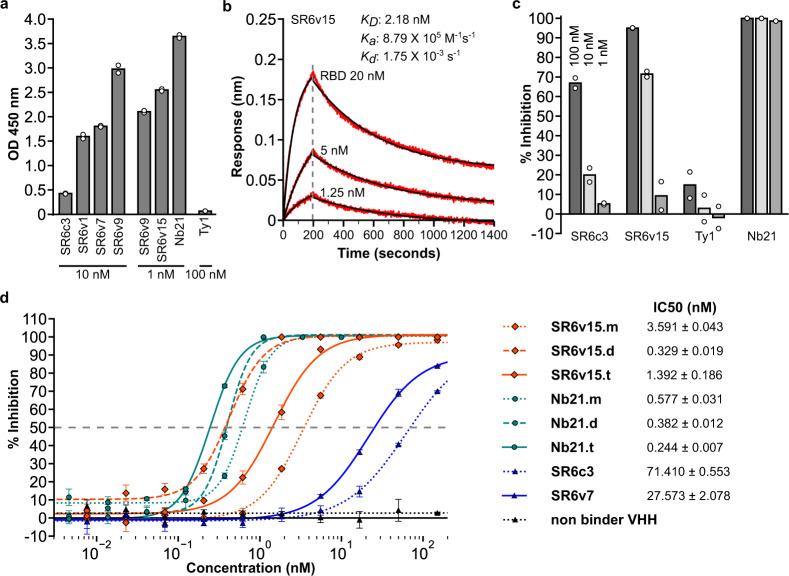
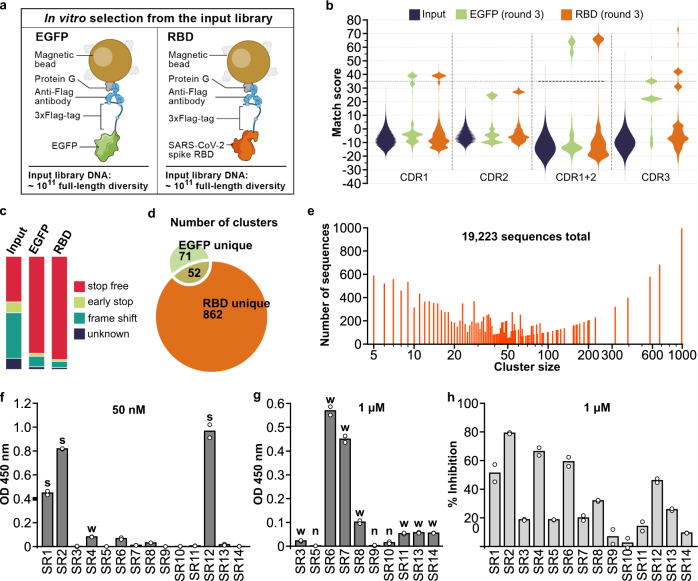
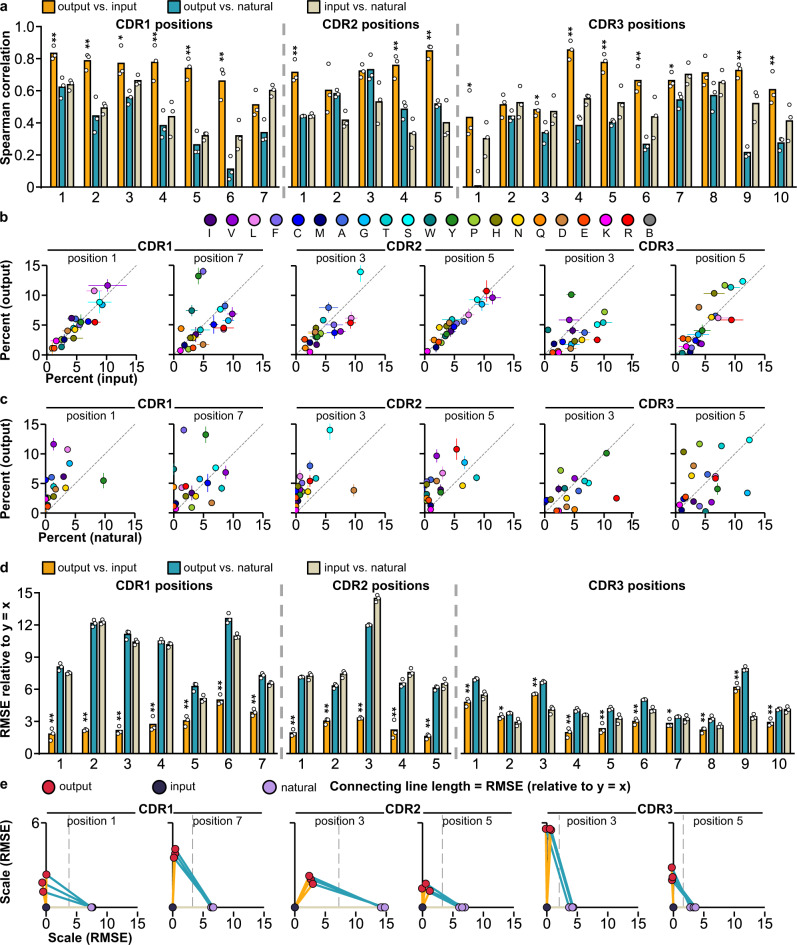
Antibody engineering technologies face increasing demands for speed, reliability and scale. We develop CeVICA, a cell-free nanobody engineering platform that uses ribosome display for in vitro selection of nanobodies from a library of 10 randomized sequences. We apply CeVICA to engineer nanobodies against the Receptor Binding Domain (RBD) of SARS-CoV-2 spike protein and identify >800 binder families using a computational pipeline based on CDR-directed clustering. Among 38 experimentally-tested families, 30 are true RBD binders and 11 inhibit SARS-CoV-2 pseudotyped virus infection. Affinity maturation and multivalency engineering increase nanobody binding affinity and yield a virus neutralizer with picomolar IC50. Furthermore, the capability of CeVICA for comprehensive binder prediction allows us to validate the fitness of our nanobody library. CeVICA offers an integrated solution for rapid generation of divergent synthetic nanobodies with tunable affinities in vitro and may serve as the basis for automated and highly parallel nanobody engineering.
抗体工程技术面临着对速度、可靠性和规模日益增长的需求。我们开发了 CeVICA,这是一种无细胞纳米体工程平台,它使用核糖体展示技术从 10 个随机序列的文库中体外选择纳米体。我们应用 CeVICA 来工程化针对 SARS-CoV-2 刺突蛋白受体结合域(RBD)的纳米体,并使用基于 CDR 定向聚类的计算管道识别了 >800 个结合家族。在 38 个经过实验测试的家族中,有 30 个是真正的 RBD 结合体,有 11 个抑制 SARS-CoV-2 假型病毒感染。亲和力成熟和多价工程提高了纳米体的结合亲和力,产生了具有皮摩尔 IC50 的病毒中和剂。此外,CeVICA 进行全面结合物预测的能力允许我们验证我们的纳米体文库的适应性。CeVICA 为快速生成具有体外可调亲和力的不同合成纳米体提供了一个集成解决方案,并且可以作为自动化和高度并行纳米体工程的基础。