Department of Cardiovascular Medicine, Gunma University Graduate School of Medicine, Maebashi, Gunma, Japan.
J Cardiovasc Electrophysiol. 2021 Nov;32(11):2979-2986. doi: 10.1111/jce.15242. Epub 2021 Sep 22.
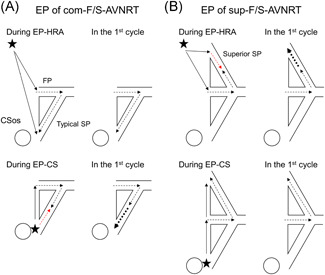
We tested our hypothesis that atrial entrainment pacing (EP) of a) the common-type (com-) fast-slow (F/S-) atypical atrioventricular nodal reentrant tachycardia (AVNRT) using a typical slow pathway (SP), or b) the superior-type (sup-) F/S-AVNRT using a superior SP, both modify the retrograde conduction time across the SP immediately after termination of EP (retro-SP-time).
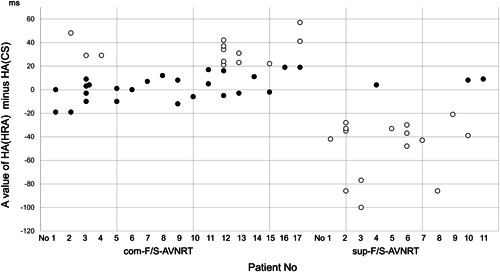
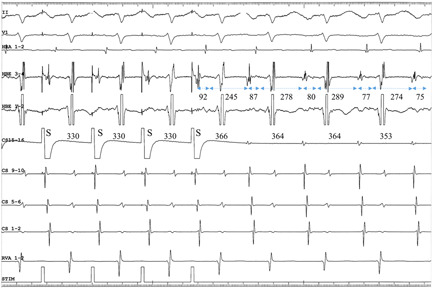
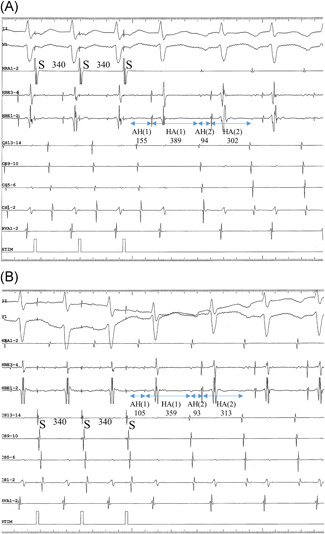
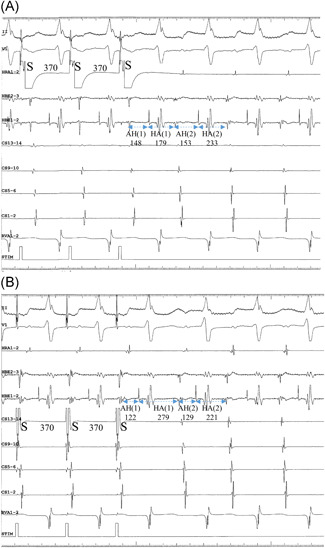
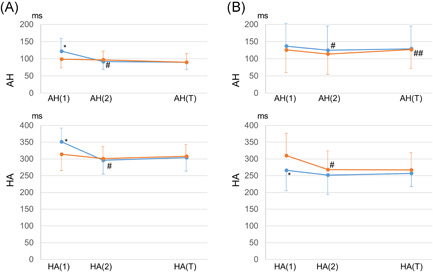
We measured the difference in the His-atrial interval (HA difference) immediately after cessation of EP, performed at 2 ± 2 rates from the high right atrium (HA[1]-HRA) versus from the proximal coronary sinus (HA[1]-CS) in 17 patients with com-F/S-AVNRT and 11 patients with sup-F/S-AVNRT. We also measured the atrial-His and HA intervals of the first and second cycles immediately after cessation of EP and during stable tachycardia.
Unequal responses, defined as a ≥ 20-ms HA difference at ≥1 EP rates, were observed in 16 patients (57%), including 7 with com- and 9 with sup-F/S-AVNRT. Irrespective of the EP rate, all unequal responses of com-F/S-AVNRT were due to a shorter HA[1]-CS than HA[1]-HRA, with a mean 34 ± 11 ms HA difference, whereas all unequal responses of sup-F/S-AVNRT were due to a longer HA[1]-CS than HA[1]-HRA, with a mean 49 ± 25 ms HA difference. The unequal responses resolved within two cycles after the cessation of EP.
We have identified a little-known pacing site- and pacing rate-dependent shortening of the retro-SP-time.
我们验证了我们的假设,即心房夺获起搏(EP)a)使用典型慢径(SP)对常见型(com-)快-慢(F/S-)非典型房室结折返性心动过速(AVNRT)进行起搏,或 b)使用上部 SP 对上部型(sup-)F/S-AVNRT 进行起搏,均能在 EP 终止后即刻改变 SP 中的逆行传导时间(逆行 SP 时间)。
我们测量了 17 例 com-F/S-AVNRT 患者和 11 例 sup-F/S-AVNRT 患者在 EP 终止后立即进行的从高位右心房(HA[1]-HRA)和近端冠状窦(HA[1]-CS)测量的 His 心房间期(HA 差值)的差异,共进行了 2±2 种不同的 EP 频率。我们还测量了 EP 终止后立即和心动过速稳定期间的心房-His 和 HA 间期。
在 16 例患者(57%)中观察到不等反应,定义为至少一种 EP 频率下的 HA 差值≥20 毫秒,包括 7 例 com-F/S-AVNRT 和 9 例 sup-F/S-AVNRT。无论 EP 频率如何,com-F/S-AVNRT 的所有不等反应均归因于 HA[1]-CS 比 HA[1]-HRA 短,平均 HA 差值为 34±11 毫秒,而 sup-F/S-AVNRT 的所有不等反应均归因于 HA[1]-CS 比 HA[1]-HRA 长,平均 HA 差值为 49±25 毫秒。EP 终止后两个心动周期内不等反应消失。
我们发现了一种鲜为人知的起搏部位和起搏频率依赖性逆行 SP 时间缩短现象。