Nadal-Sala Daniel, Grote Rüdiger, Birami Benjamin, Knüver Timo, Rehschuh Romy, Schwarz Selina, Ruehr Nadine K
Karlsruhe Institute of Technology, Institute of Meteorology and Climate Research - Atmospheric Environmental Research (IMK-IFU), Garmisch-Partenkirchen, Germany.
University of Bayreuth, Chair of Plant Ecology, Bayreuth, Germany.
Front Plant Sci. 2021 Sep 3;12:715127. doi: 10.3389/fpls.2021.715127. eCollection 2021.
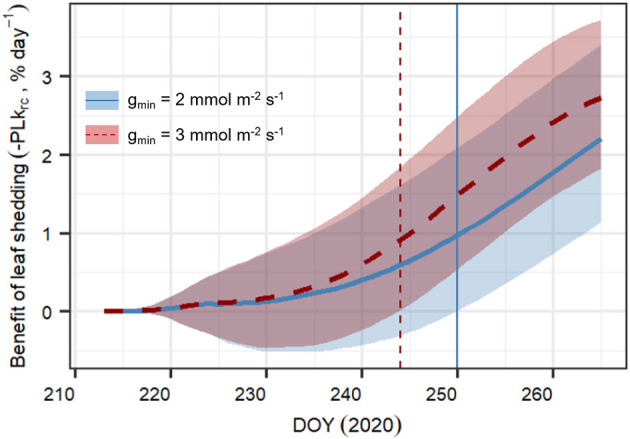
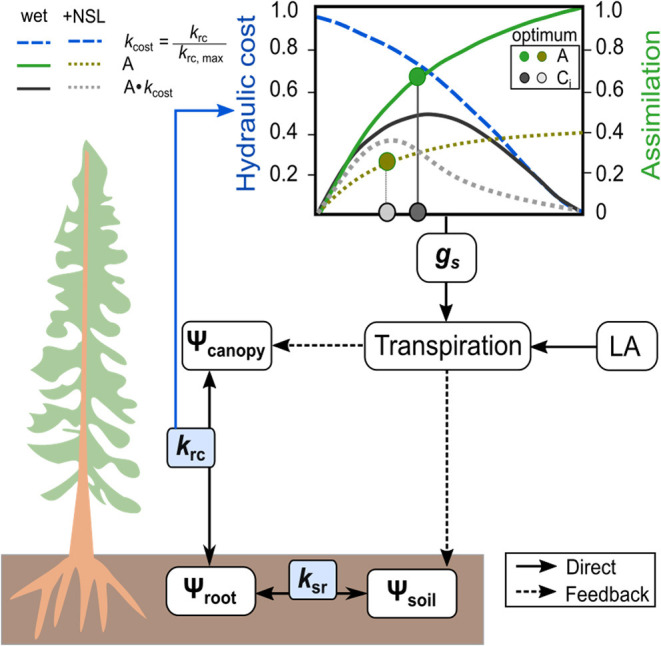
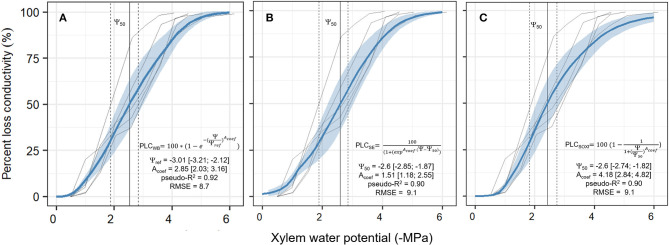
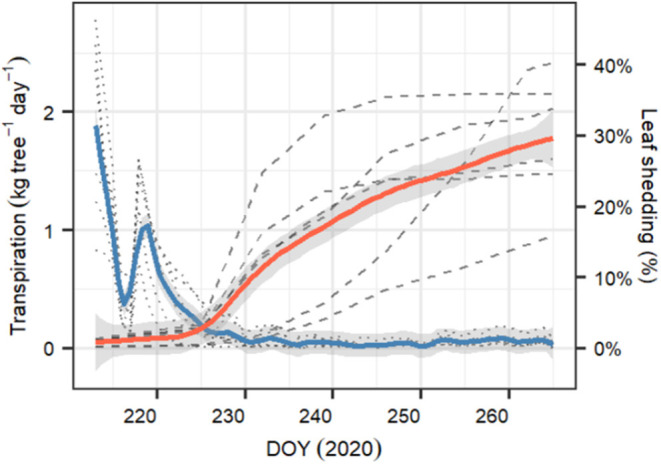
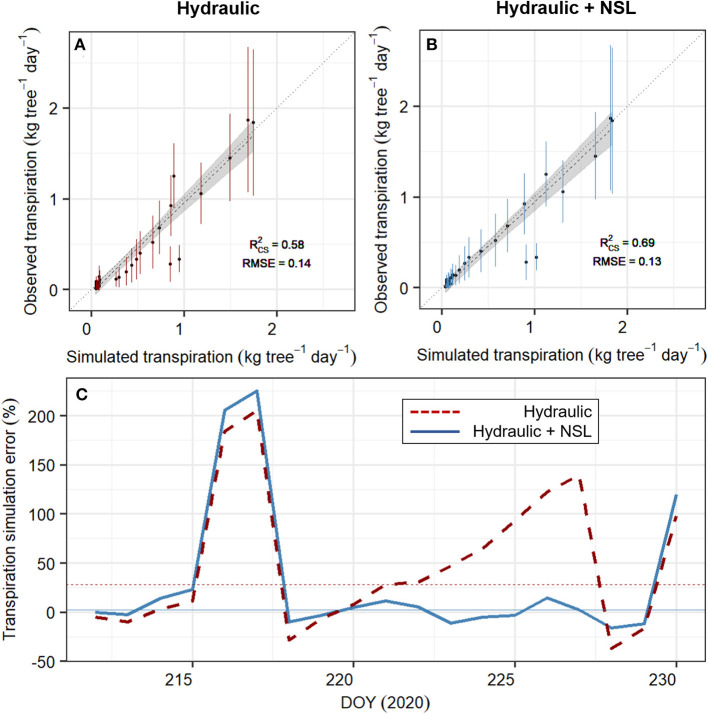
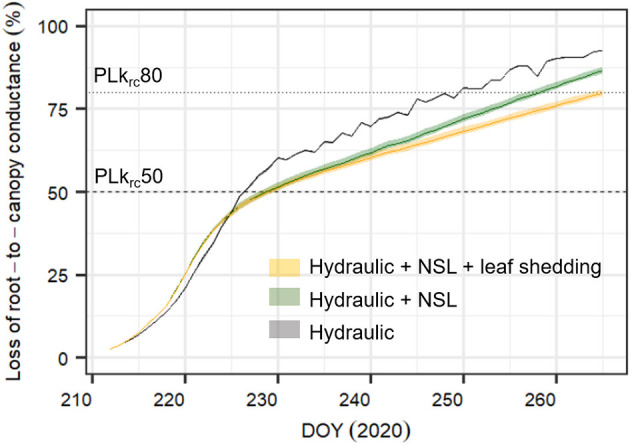
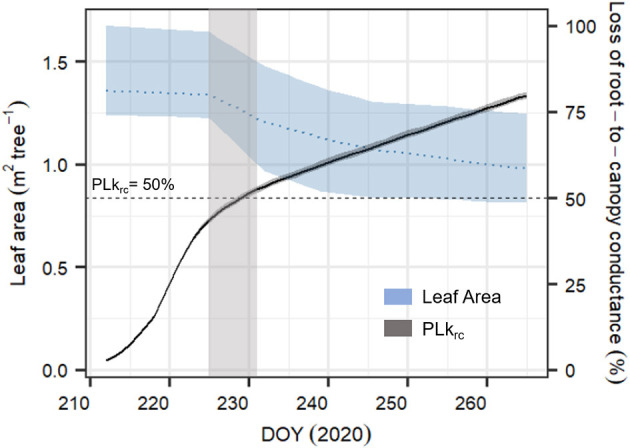
During drought, trees reduce water loss and hydraulic failure by closing their stomata, which also limits photosynthesis. Under severe drought stress, other acclimation mechanisms are trigged to further reduce transpiration to prevent irreversible conductance loss. Here, we investigate two of them: the reversible impacts on the photosynthetic apparatus, lumped as non-stomatal limitations (NSL) of photosynthesis, and the irreversible effect of premature leaf shedding. We integrate NSL and leaf shedding with a state-of-the-art tree hydraulic simulation model (SOX+) and parameterize them with example field measurements to demonstrate the stress-mitigating impact of these processes. We measured xylem vulnerability, transpiration, and leaf litter fall dynamics in (L.) saplings grown for 54 days under severe dry-down. The observations showed that, once transpiration stopped, the rate of leaf shedding strongly increased until about 30% of leaf area was lost on average. We trained the SOX+ model with the observations and simulated changes in root-to-canopy conductance with and without including NSL and leaf shedding. Accounting for NSL improved model representation of transpiration, while model projections about root-to-canopy conductance loss were reduced by an overall 6%. Together, NSL and observed leaf shedding reduced projected losses in conductance by about 13%. In summary, the results highlight the importance of other than purely stomatal conductance-driven adjustments of drought resistance in Scots pine. Accounting for acclimation responses to drought, such as morphological (leaf shedding) and physiological (NSL) adjustments, has the potential to improve tree hydraulic simulation models, particularly when applied in predicting drought-induced tree mortality.
在干旱期间,树木通过关闭气孔来减少水分流失和水力故障,这也限制了光合作用。在严重干旱胁迫下,会触发其他适应机制以进一步减少蒸腾作用,防止不可逆的导度损失。在此,我们研究其中两种机制:对光合机构的可逆影响,归结为光合作用的非气孔限制(NSL),以及过早落叶的不可逆影响。我们将NSL和落叶与一个先进的树木水力模拟模型(SOX+)相结合,并用现场实测数据对其进行参数化,以证明这些过程的缓解胁迫作用。我们测量了在严重干旱条件下生长54天的欧洲赤松(Pinus sylvestris L.)幼树的木质部脆弱性、蒸腾作用和落叶动态。观察结果表明,一旦蒸腾作用停止,落叶速率会急剧增加,直到平均约30%的叶面积损失。我们用这些观测数据训练了SOX+模型,并模拟了包含和不包含NSL及落叶情况下根冠导度的变化。考虑NSL改善了模型对蒸腾作用的表征,而模型对根冠导度损失的预测总体降低了6%。综合来看,NSL和观测到的落叶使预测的导度损失降低了约13%。总之,结果突出了欧洲赤松中除了纯粹由气孔导度驱动的抗旱调节之外的其他调节的重要性。考虑对干旱的适应反应,如形态学(落叶)和生理学(NSL)调节,有可能改进树木水力模拟模型,特别是在用于预测干旱引起的树木死亡时。