Saponaro Concetta, Scarpi Emanuela, Sonnessa Margherita, Cioffi Antonella, Buccino Francesca, Giotta Francesco, Pastena Maria Irene, Zito Francesco Alfredo, Mangia Anita
Functional Biomorphology Laboratory, IRCCS Istituto Tumori "Giovanni Paolo II", Bari, Italy.
Unit of Biostatistics and Clinical Trials, IRCCS Istituto Scientifico Romagnolo per lo Studio dei Tumori (IRST) "Dino Amadori", Meldola (FC), Italy.
Front Oncol. 2021 Sep 2;11:705331. doi: 10.3389/fonc.2021.705331. eCollection 2021.
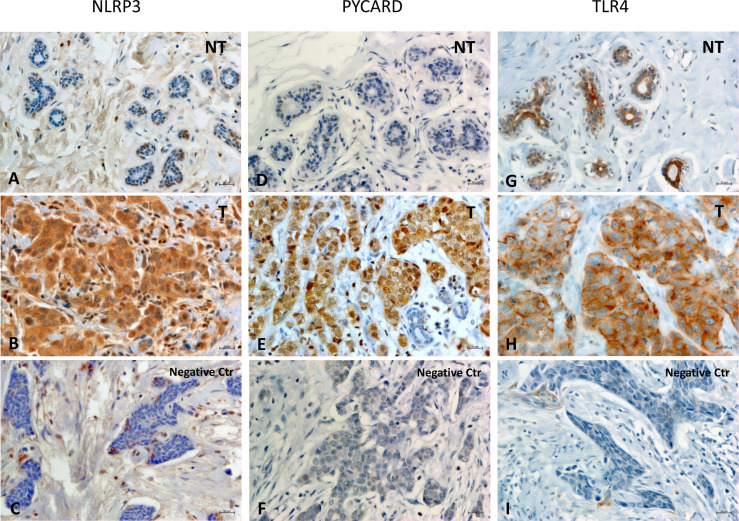
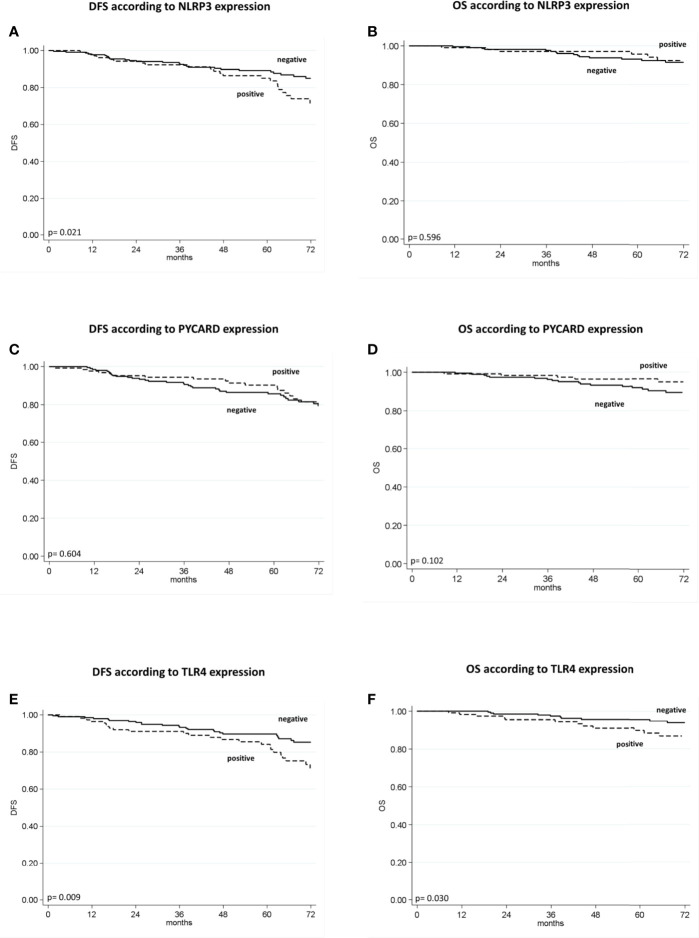
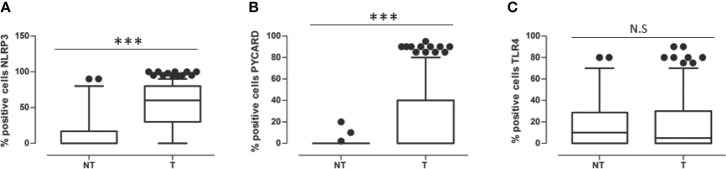
Inflammasome complexes play a pivotal role in different cancer types. NOD-like receptor protein 3 (NLRP3) inflammasome is one of the most well-studied inflammasomes. Activation of the NLRP3 inflammasome induces abnormal secretion of soluble cytokines, generating advantageous inflammatory surroundings that support tumor growth. The expression levels of the NLRP3, PYCARD and TLR4 were determined by immunohistochemistry in a cohort of primary invasive breast carcinomas (BCs). We observed different NLRP3 and PYCARD expressions in non-tumor tumor areas (p<0.0001). All the proteins were associated to more aggressive clinicopathological characteristics (tumor size, grade, tumor proliferative activity etc.). Univariate analyses were carried out and related Kaplan-Meier curves plotted for NLRP3, PYCARD and TLR4 expression. Patients with higher NLRP3 and TLR4 expression had worse 5-year disease-free survival (DFS) compared to patients with lower NLRP3 and TLR4 expression (p =0.021 and p = 0.009, respectively). In multivariate analysis, TLR4 was confirmed as independent prognostic factors for DFS (HR = 2.03, 95% CI 1.16-3.57, p = 0.014), and high NLRP3 expression showed a slight association with DFS (HR = 1.75, 95% CI 0.98-3.15, p = 0.06). In conclusion, we showed TLR4 expression as independent prognostic factors and we highlighted for the first time that high expression of NLRP3 is linked to a poor prognosis in BC patients. These results suggest that NLRP3 and TLR4 could be two new good prognostic factor for BC patients.
炎性小体复合物在不同类型癌症中起关键作用。NOD样受体蛋白3(NLRP3)炎性小体是研究最为深入的炎性小体之一。NLRP3炎性小体的激活会诱导可溶性细胞因子异常分泌,产生有利于肿瘤生长的炎性环境。通过免疫组织化学法测定了一组原发性浸润性乳腺癌(BC)中NLRP3、PYCARD和TLR4的表达水平。我们观察到非肿瘤区域和肿瘤区域的NLRP3和PYCARD表达存在差异(p<0.0001)。所有这些蛋白均与更具侵袭性的临床病理特征(肿瘤大小、分级、肿瘤增殖活性等)相关。进行了单因素分析,并绘制了NLRP3、PYCARD和TLR4表达的相关Kaplan-Meier曲线。与NLRP3和TLR4低表达的患者相比,NLRP3和TLR4高表达的患者5年无病生存率(DFS)更差(分别为p = 0.021和p = 0.009)。在多因素分析中,TLR4被确认为DFS的独立预后因素(HR = 2.03,95%CI 1.16 - 3.57,p = 0.014),NLRP3高表达与DFS有轻微关联(HR = 1.75,95%CI 0.98 - 3.15,p = 0.06)。总之,我们表明TLR4表达是独立的预后因素,并且首次强调NLRP3高表达与BC患者预后不良有关。这些结果表明,NLRP3和TLR4可能是BC患者的两个新的良好预后因素。