Cherchi Claudio, Chiarini Testa Maria B, Deriu Daniele, Schiavino Alessandra, Petreschi Francesca, Ullmann Nicola, Paglietti Maria G, Cutrera Renato
Pediatric Pulmonology and Respiratory Intermediate Care Unit, Sleep and Long Term Ventilation Unit, Academic Department of Pediatrics (DPUO), Pediatric Hospital "Bambino Gesù" Research Institute, Rome, Italy.
Rare Diseases and Medical Genetics Unit, Bambino Gesù Children Hospital (IRCCS), Rome, Italy.
Front Pediatr. 2021 Sep 1;9:625751. doi: 10.3389/fped.2021.625751. eCollection 2021.
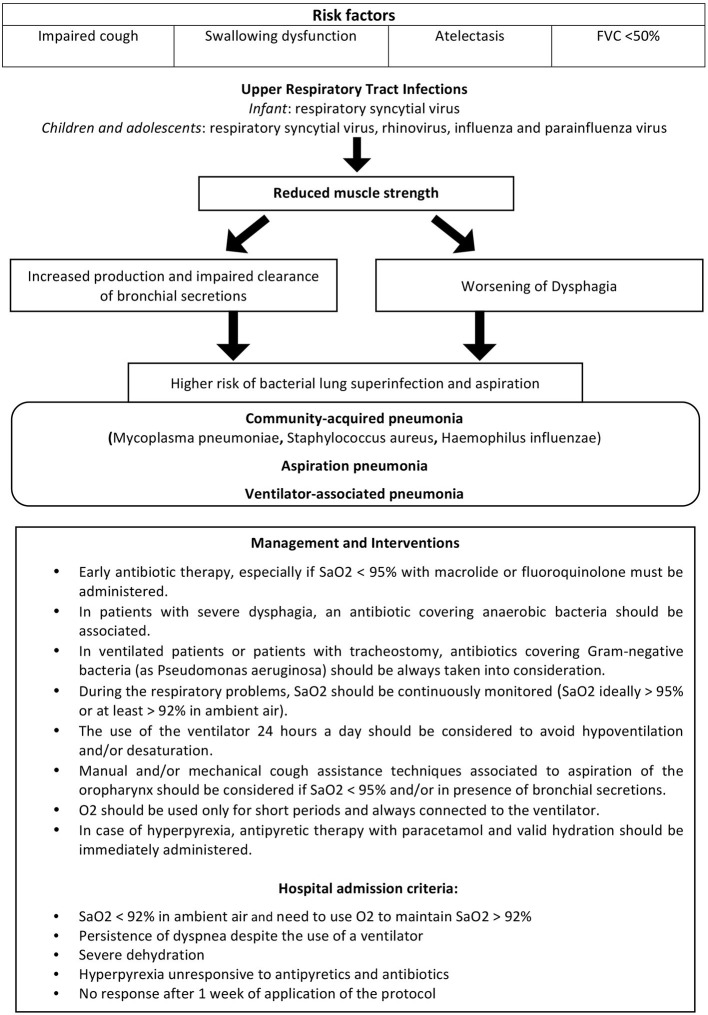
Neuromuscular diseases may involve all major respiratory muscles groups including inspiratory, expiratory, and bulbar muscles. Respiratory complications are the major cause of morbidity and mortality. Pneumonia represents a frequent cause of morbidity in children with neuromuscular disease. The aim of this review is to collect knowledge about pneumonia in children with neuromuscular diseases. Pneumonia usually follows viral respiratory infections of the upper respiratory tract, due to the combination of an increased amount of nasal and oral secretions and an impairment of the cough efficiency and of the clearance of secretions due to the muscle weakness, further compromised by the infection itself. The accumulation of bronchial secretions leads to atelectasis and promote bacterial infection. Moreover, dysfunction of swallowing mechanism exposes these children to the risk of developing aspiration pneumonia. However, etiology of viral and bacterial respiratory infection in these patients is still poorly studied.
神经肌肉疾病可能累及所有主要呼吸肌群,包括吸气肌、呼气肌和延髓肌。呼吸并发症是发病和死亡的主要原因。肺炎是神经肌肉疾病患儿发病的常见原因。本综述的目的是收集有关神经肌肉疾病患儿肺炎的知识。肺炎通常继发于上呼吸道病毒感染,这是由于鼻腔和口腔分泌物增多,以及肌肉无力导致咳嗽效率和分泌物清除功能受损,而感染本身会进一步加重这种情况。支气管分泌物的积聚导致肺不张并促进细菌感染。此外,吞咽机制功能障碍使这些儿童面临发生吸入性肺炎的风险。然而,这些患者病毒和细菌呼吸道感染的病因仍研究不足。