Fox-Fuller Joshua T, Torrico-Teave Heirangi, d'Oleire Uquillas Federico, Chen Kewei, Su Yi, Chen Yinghua, Brickhouse Michael, Sanchez Justin S, Aguero Cinthya, Jacobs Heidi I L, Hampton Olivia, Guzmán-Vélez Edmarie, Vila-Castelar Clara, Aguirre-Acevedo Daniel C, Baena Ana, Artola Arabiye, Martinez Jairo, Pluim Celina F, Alvarez Sergio, Ochoa-Escudero Martin, Reiman Eric M, Sperling Reisa A, Lopera Francisco, Johnson Keith A, Dickerson Bradford C, Quiroz Yakeel T
Department of Psychological and Brain Sciences Boston University Boston Massachusetts USA.
Department of Psychiatry Massachusetts General Hospital Harvard Medical School Boston Massachusetts USA.
Alzheimers Dement (Amst). 2021 Sep 14;13(1):e12233. doi: 10.1002/dad2.12233. eCollection 2021.
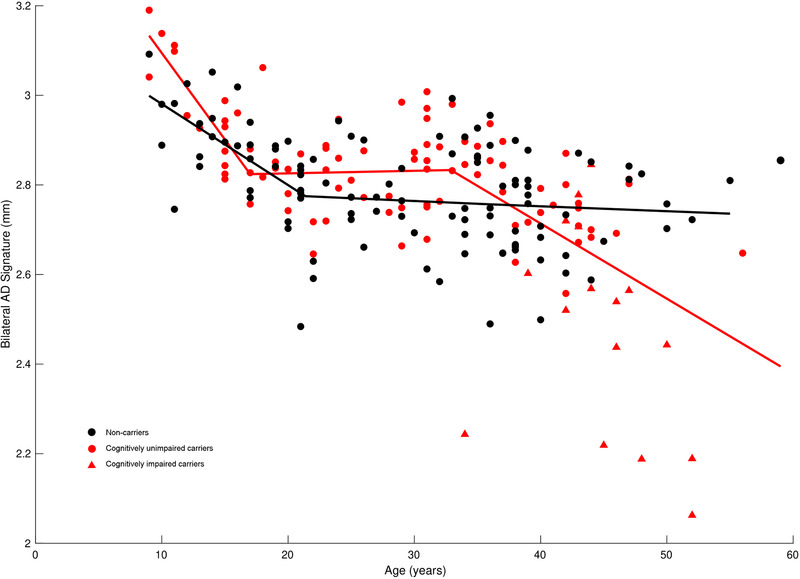
Cortical thinning is a marker of neurodegeneration in Alzheimer's disease (AD). We investigated the age-related trajectory of cortical thickness across the lifespan (9-59 years) in a Colombian kindred with autosomal dominant AD (ADAD).
Two hundred eleven participants (105 presenilin-1 [] E280A mutation carriers, 16 with cognitive impairment; 106 non-carriers) underwent magnetic resonance imaging. A piecewise linear regression identified change-points in the age-related trajectory of cortical thickness in carriers and non-carriers.
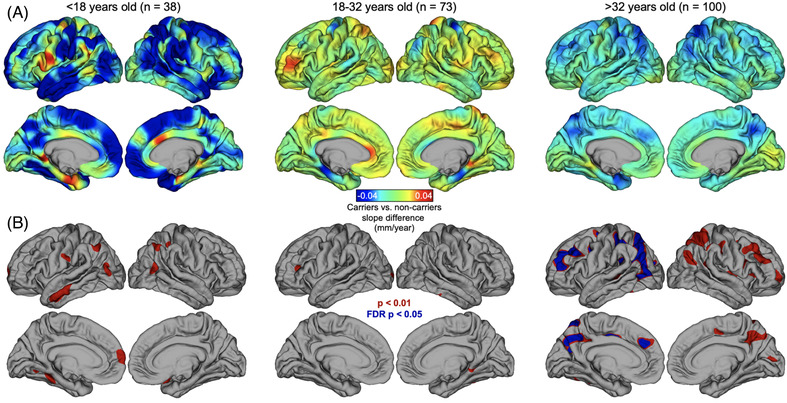
Unimpaired carriers exhibited elevated cortical thickness compared to non-carriers, and thickness more negatively correlated with age and cognition in carriers relative to non-carriers. We found increased cortical thickness in child carriers, after which thickness steadied compared to non-carriers prior to a rapid reduction in the decade leading up to the expected age at cognitive impairment in carriers.
Findings suggest that cortical thickness may fluctuate across the ADAD lifespan, from early-life increased thickness to atrophy proximal to clinical onset.
皮质变薄是阿尔茨海默病(AD)神经退行性变的一个标志。我们研究了一个患有常染色体显性AD(ADAD)的哥伦比亚家族中,整个生命周期(9 - 59岁)皮质厚度与年龄相关的变化轨迹。
211名参与者(105名早老素-1 [PSEN1] E280A突变携带者,其中16名有认知障碍;106名非携带者)接受了磁共振成像检查。采用分段线性回归确定携带者和非携带者皮质厚度与年龄相关轨迹的变化点。
与非携带者相比,未受损的携带者皮质厚度升高,且相对于非携带者,携带者的皮质厚度与年龄和认知的负相关性更强。我们发现儿童携带者的皮质厚度增加,此后与非携带者相比,在携带者预期出现认知障碍的十年前快速变薄之前,皮质厚度保持稳定。
研究结果表明,在ADAD的整个生命周期中,皮质厚度可能会发生波动,从生命早期厚度增加到临床发病前近端萎缩。