Davoodi Lotfollah, Jafarpour Hamed, Oladi Ziaeddin, Zakariaei Zakaria, Tabarestani Mohammad, Ahmadi Bahareh Moayed, Razavi Alireza, Hessami Amirhossein
Department of Infectious Diseases, School of Medicine, Antimicrobial Resistance Research Center, Communicable Diseases Research Institutes, Ghaem Shahr Razi Hospital, Mazandaran University of Medical Sciences, Sari, Iran.
Student Research Committee, School of Medicine, Mazandaran University of Medical Sciences, Sari, Iran.
Int J Cardiol Heart Vasc. 2021 Oct;36:100875. doi: 10.1016/j.ijcha.2021.100875. Epub 2021 Sep 14.
Efficacious therapies are urgently required to tackle the coronavirus disease 2019 (COVID-19). This trial aims to evaluate the effects of atorvastatin in comparison with standard care for adults hospitalized with COVID-19.
We conducted a randomized controlled clinical trial on adults hospitalized with COVID-19. Patients were randomized into a treatment group receiving atorvastatin + lopinavir/ritonavir or a control group receiving lopinavir/ritonavir alone. The primary outcome of the trial was the duration of hospitalization. The secondary outcomes were the need for interferon or immunoglobulin, receipt of invasive mechanical ventilation, and O2 saturation (O2sat), and level of C-reactive protein (CRP) which were assessed at the onset of admission and on the 6th day of treatment.
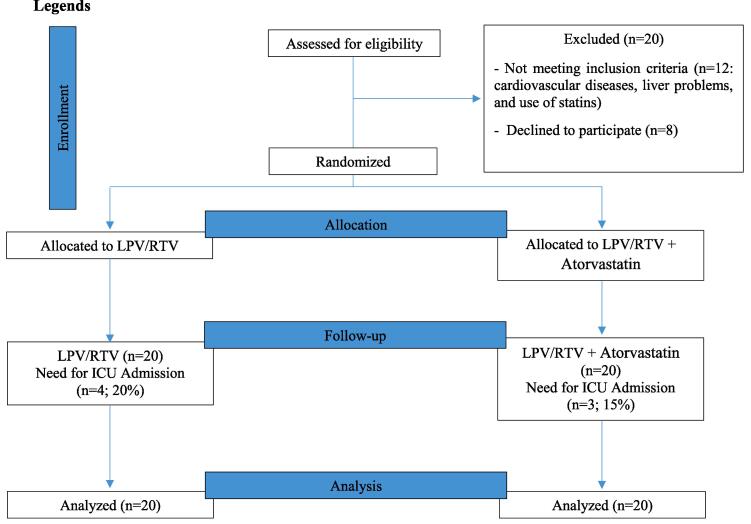
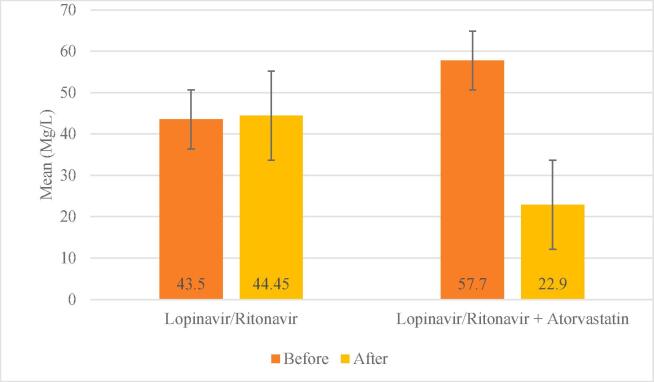
Forty patients were allocated and enrolled in the study with a 1 to 1 ratio in atorvastatin + lopinavir/ritonavir and lopinavir/ritonavir groups. Clinical and demographic characteristics were similar between the two groups. CRP level was significantly decreased in the lopinavir/ritonavir + atorvastatin group (P < 0.0001, Cohen's d = 0.865) so that there was a significant difference in CRP level on the 6th day between the two groups (P = 0.01). Nevertheless, there was no significant difference in O2sat on day 6. Although the duration of hospitalization in the lopinavir/ritonavir + atorvastatin group was significantly reduced compared to the control group (P = 0.012), there was no significant difference in the invasive mechanical ventilation reception and the need for interferon and immunoglobulin.
Atorvastatin + lopinavir/ritonavir may be more effective than lopinavir/ritonavir in treating COVID-19 adult hospitalized patients.
迫切需要有效的治疗方法来应对2019冠状病毒病(COVID-19)。本试验旨在评估阿托伐他汀与标准治疗相比,对COVID-19住院成人患者的疗效。
我们对COVID-19住院成人患者进行了一项随机对照临床试验。患者被随机分为接受阿托伐他汀+洛匹那韦/利托那韦的治疗组或仅接受洛匹那韦/利托那韦的对照组。试验的主要结局是住院时间。次要结局包括是否需要使用干扰素或免疫球蛋白、是否接受有创机械通气、氧饱和度(O2sat)以及入院时和治疗第6天的C反应蛋白(CRP)水平。
40名患者被分配并纳入研究,阿托伐他汀+洛匹那韦/利托那韦组和洛匹那韦/利托那韦组的比例为1:1。两组的临床和人口统计学特征相似。洛匹那韦/利托那韦+阿托伐他汀组的CRP水平显著降低(P<0.0001,科恩d值=0.865),因此两组在第6天的CRP水平存在显著差异(P=0.01)。然而,第6天的O2sat没有显著差异。虽然洛匹那韦/利托那韦+阿托伐他汀组的住院时间与对照组相比显著缩短(P=0.012),但在接受有创机械通气以及使用干扰素和免疫球蛋白方面没有显著差异。
阿托伐他汀+洛匹那韦/利托那韦在治疗COVID-19住院成人患者方面可能比洛匹那韦/利托那韦更有效。