Eickhoff Claudia R, Hoffstaedter Felix, Caspers Julian, Reetz Kathrin, Mathys Christian, Dogan Imis, Amunts Katrin, Schnitzler Alfons, Eickhoff Simon B
Institute of Neuroscience and Medicine (INM-1, INM-7, INM-11), Jülich, Germany.
Institute of Clinical Neuroscience and Medical Psychology, Medical Faculty, Heinrich-Heine University Düsseldorf, Düsseldorf, Germany.
Brain Commun. 2021 Aug 23;3(3):fcab191. doi: 10.1093/braincomms/fcab191. eCollection 2021.
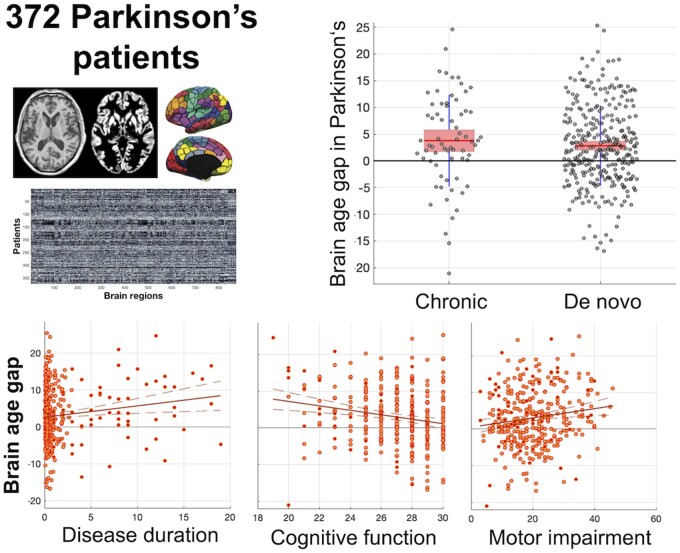
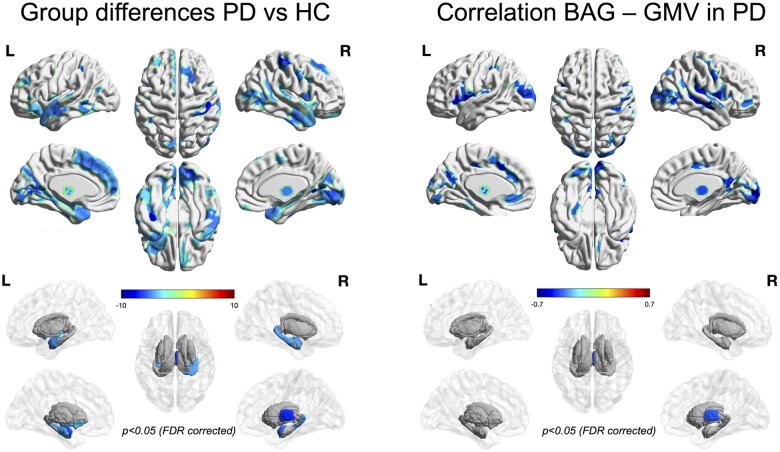
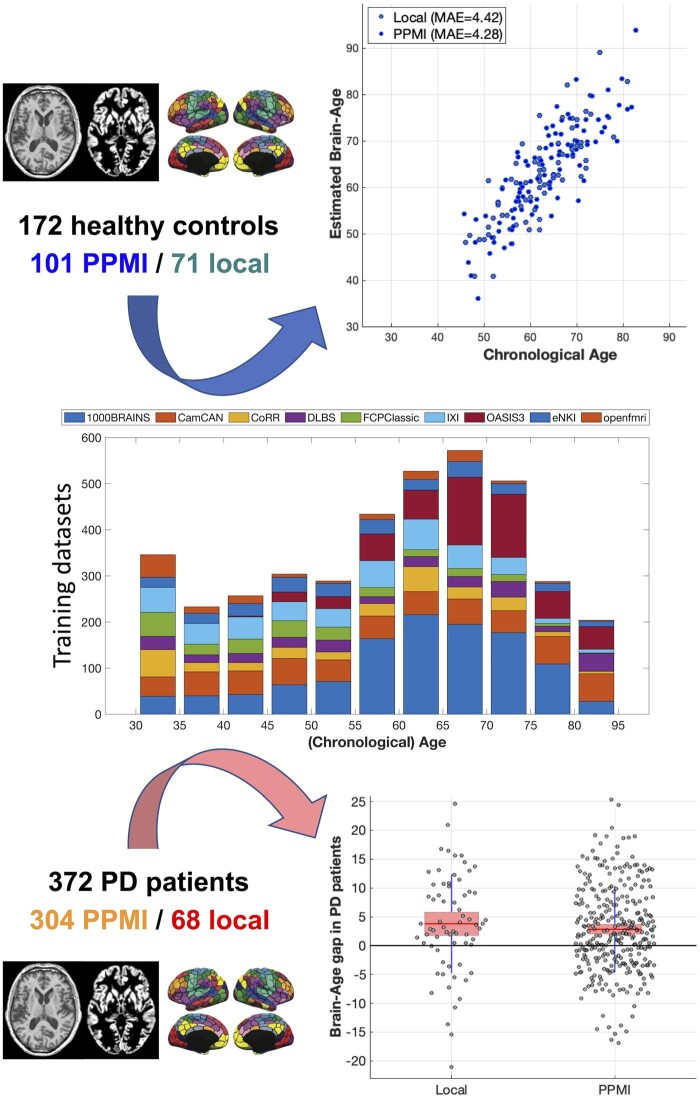
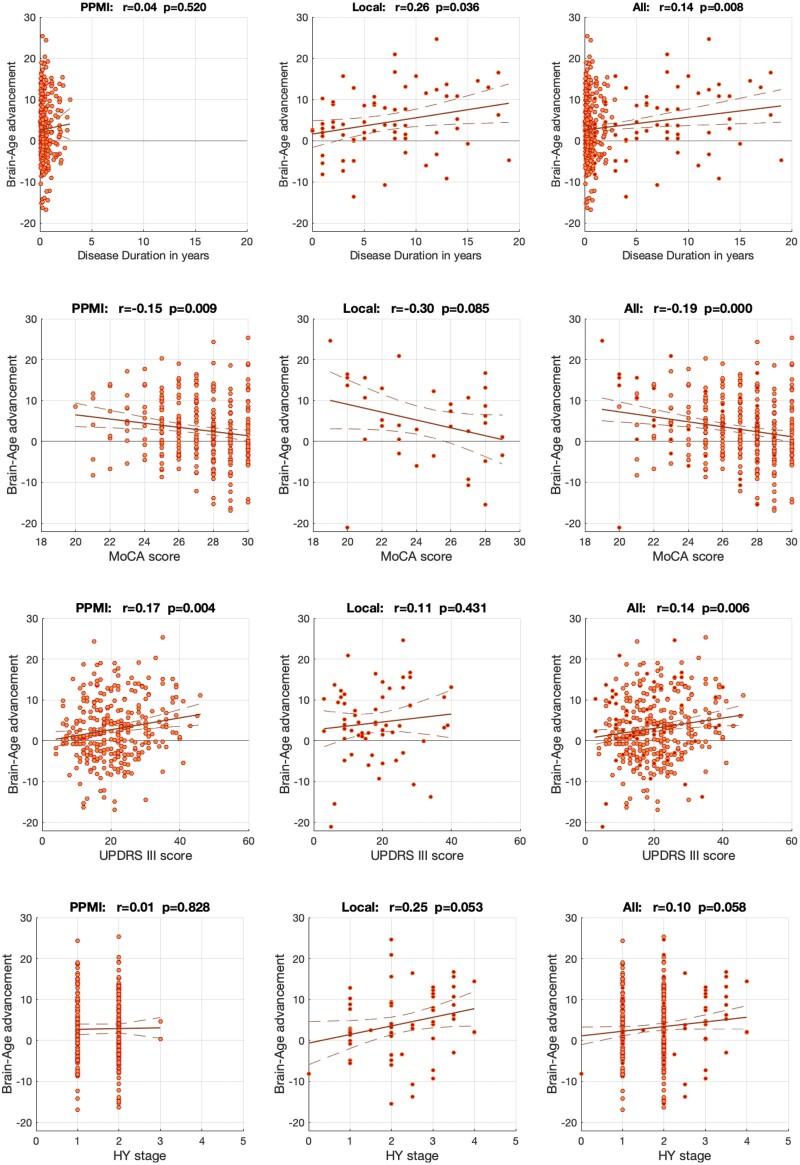
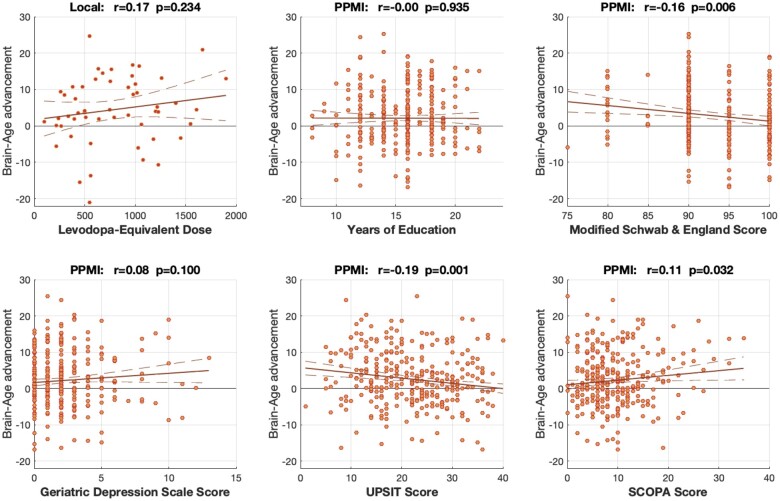
Machine learning can reliably predict individual age from MRI data, revealing that patients with neurodegenerative disorders show an elevated biological age. A surprising gap in the literature, however, pertains to Parkinson's disease. Here, we evaluate brain age in two cohorts of Parkinson's patients and investigated the relationship between individual brain age and clinical characteristics. We assessed 372 patients with idiopathic Parkinson's disease, newly diagnosed cases from the Parkinson's Progression Marker Initiative database and a more chronic local sample, as well as age- and sex-matched healthy controls. Following morphometric preprocessing and atlas-based compression, individual brain age was predicted using a multivariate machine learning model trained on an independent, multi-site reference sample. Across cohorts, healthy controls were well predicted with a mean error of 4.4 years. In turn, Parkinson's patients showed a significant (controlling for age, gender and site) increase in brain age of ∼3 years. While this effect was already present in the newly diagnosed sample, advanced biological age was significantly related to disease duration as well as worse cognitive and motor impairment. While biological age is increased in patients with Parkinson's disease, the effect is at the lower end of what is found for other neurological and psychiatric disorders. We argue that this may reflect a heterochronicity between forebrain atrophy and small but behaviourally salient midbrain pathology. Finally, we point to the need to disentangle physiological ageing trajectories, lifestyle effects and core pathological changes.
机器学习能够根据磁共振成像(MRI)数据可靠地预测个体年龄,这表明神经退行性疾病患者的生物学年龄有所升高。然而,文献中一个令人惊讶的空白涉及帕金森病。在此,我们评估了两组帕金森病患者的脑龄,并研究了个体脑龄与临床特征之间的关系。我们评估了372例特发性帕金森病患者,这些患者来自帕金森病进展标志物倡议数据库的新诊断病例以及一个病程更长的本地样本,同时还有年龄和性别匹配的健康对照。经过形态学预处理和基于图谱的压缩后,使用在一个独立的多中心参考样本上训练的多变量机器学习模型来预测个体脑龄。在各个队列中,健康对照的预测效果良好,平均误差为4.4岁。相比之下,帕金森病患者的脑龄显著增加(控制年龄、性别和研究地点后)约3岁。虽然这种效应在新诊断的样本中就已存在,但生物学年龄的增加与疾病持续时间以及更严重的认知和运动障碍显著相关。虽然帕金森病患者的生物学年龄增加了,但这种效应处于其他神经和精神疾病所发现的范围的下限。我们认为,这可能反映了前脑萎缩与虽小但在行为上显著的中脑病变之间的异时性。最后,我们指出需要区分生理衰老轨迹、生活方式影响和核心病理变化。