Jiang Lan-Lan, Xu Xiao-Hua, Luo Meng-Hui, Wang Hui-Ying, Ding Bo, Yan Reng-Na, Hu Yun, Ma Jian-Hua
Department of Endocrinology, Nanjing First Hospital, Nanjing Medical University, No. 32 Gongqingtuan Road, Nanjing, 210012, Jiangsu, China.
Diabetes Ther. 2021 Nov;12(11):2955-2969. doi: 10.1007/s13300-021-01151-6. Epub 2021 Sep 20.
Prevalence of sarcopenia has increased in patients with type 2 diabetes. The influence of glucose-lowering drugs on muscles in these patients remains unclear. We aimed to investigate the association between muscle mass/function and glucose-lowering drugs.
Data of 1042 hospitalized patients with type 2 diabetes were included in this retrospective, cross-sectional study. All the patients had stable hypoglycemic therapy in the last 3 months, and performed bioelectrical impedance analysis, grip strength, and gait speed tests on admission.
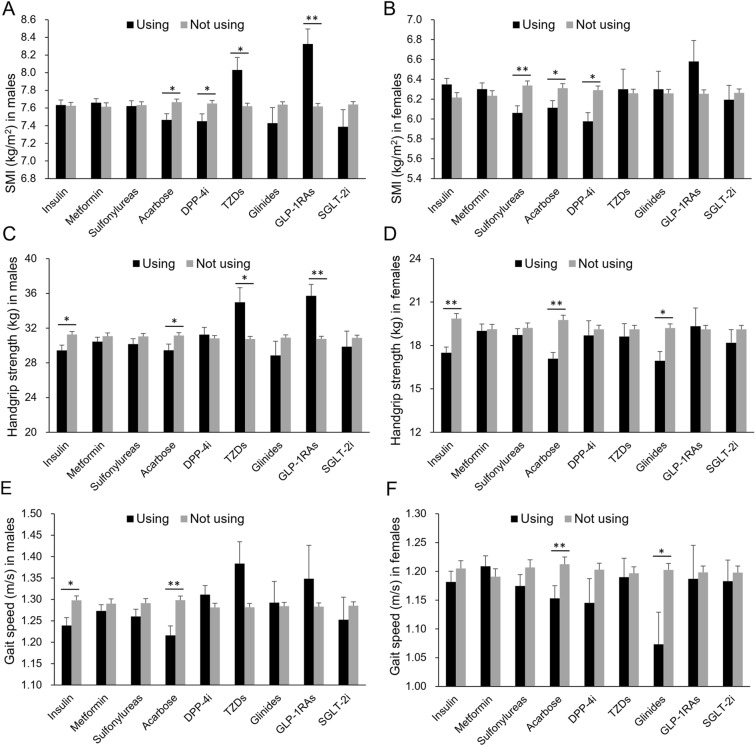
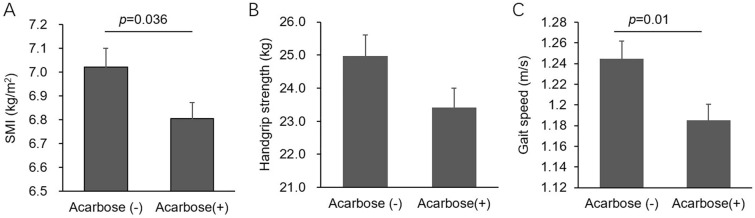
Skeletal muscle index [6.81 (95% CI 6.67, 6.94) vs. 7.17 (7.09, 7.24) kg/m], handgrip strength [23.41 (22.24, 24.58) vs. 26.93 (26.33, 27.54) kg], and gait speed [1.19 (1.15, 1.22) vs. 1.27 (1.25, 1.28) m/s] decreased in patients using acarbose compared with the others (all p < 0.001). Gait speed and skeletal muscle index remained lower in patients using acarbose compared to their matched patients in propensity score matching (p = 0.036 and 0.010, respectively). Among drug-naïve patients and patients using insulin, metformin, sulfonylureas, or acarbose monotherapy, the acarbose group had lowest skeletal muscle index and handgrip strength [6.81 (6.52, 7.11) kg/m and 22.54 (19.28, 25.79) kg, p = 0.028 and 0.001, respectively].
Acarbose treatment was associated with decreased muscle mass and strength. Assessment and exercise of muscles in patients with long-term acarbose treatment should be considered.
2型糖尿病患者中肌肉减少症的患病率有所上升。降糖药物对这些患者肌肉的影响尚不清楚。我们旨在研究肌肉质量/功能与降糖药物之间的关联。
本回顾性横断面研究纳入了1042例住院的2型糖尿病患者的数据。所有患者在过去3个月内接受稳定的降糖治疗,并在入院时进行生物电阻抗分析、握力和步速测试。
与其他患者相比,使用阿卡波糖的患者骨骼肌指数[6.81(95%CI 6.67,6.94)对7.17(7.09,7.24)kg/m]、握力[23.41(22.24,24.58)对26.93(26.33,27.54)kg]和步速[1.19(1.15,1.22)对1.27(1.25,1.28)m/s]均降低(所有p<0.001)。在倾向得分匹配中,使用阿卡波糖的患者与匹配患者相比,步速和骨骼肌指数仍然较低(分别为p = 0.036和0.010)。在未使用过药物的患者以及使用胰岛素、二甲双胍、磺脲类药物或阿卡波糖单药治疗的患者中,阿卡波糖组的骨骼肌指数和握力最低[6.81(6.52,7.11)kg/m和22.54(19.28,25.79)kg,分别为p = 0.028和0.001]。
阿卡波糖治疗与肌肉质量和力量下降有关。应考虑对长期接受阿卡波糖治疗的患者进行肌肉评估和锻炼。