Department of Medicine and.
Research Unit in Translational Hematology, Faculty of Medicine, Chulalongkorn University and King Chulalongkorn Memorial Hospital, Thai Red Cross Society, Bangkok, Thailand; and.
Blood Adv. 2021 Nov 9;5(21):4521-4534. doi: 10.1182/bloodadvances.2021005314.
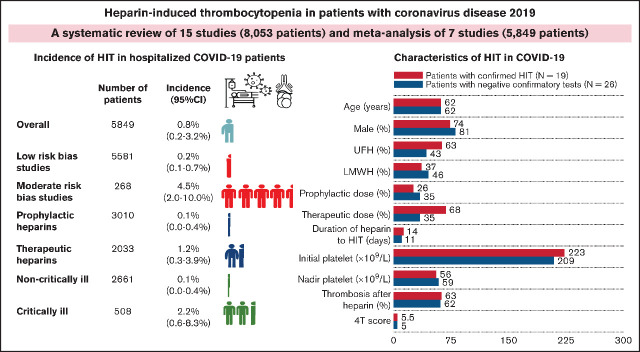
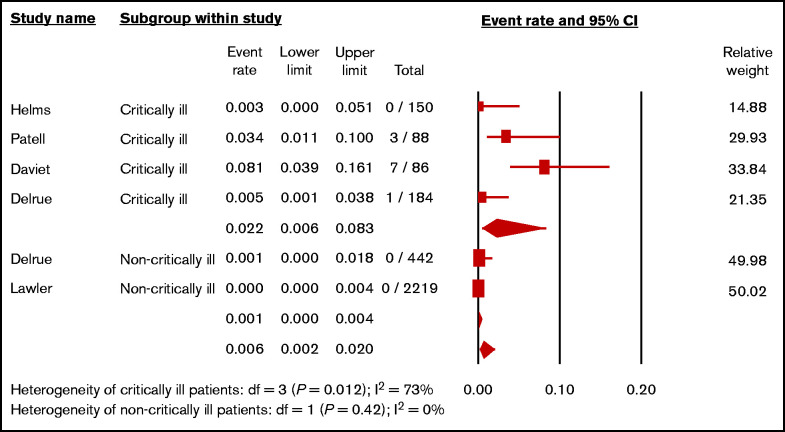
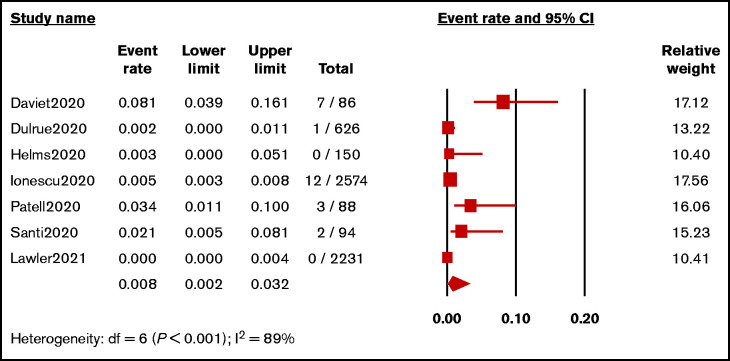
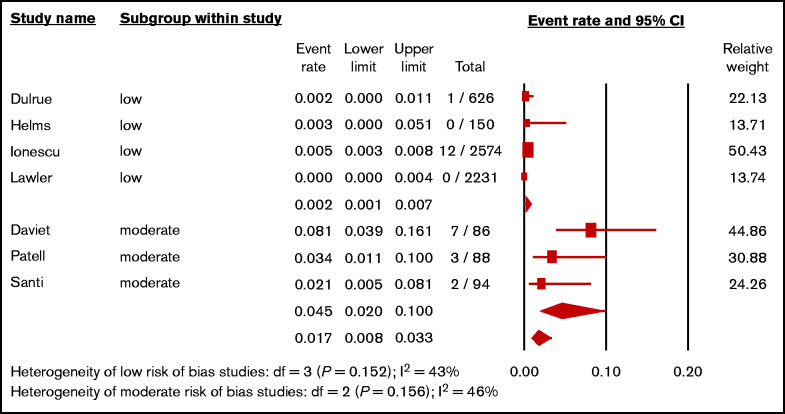
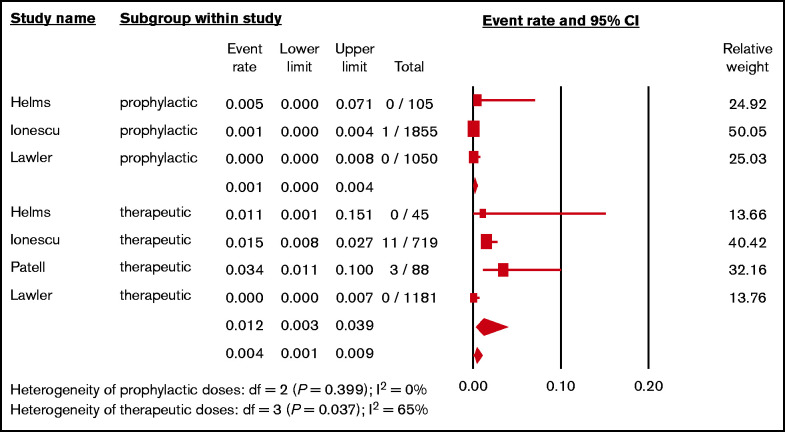
Heparin thromboprophylaxis is routinely administered during hospitalization for COVID-19. Because of the immune stimulation related to COVID-19, there is ongoing concern regarding a heightened incidence of heparin-induced thrombocytopenia (HIT). We performed a literature search using PubMed, EMBASE, Cochrane, and medRxiv database to identify studies that reported clinical and laboratory characteristics and/or the incidence of HIT in patients with COVID-19. The primary aim was to systematically review the clinical features and outcomes of patients with COVID-19 with confirmed HIT. The secondary objective was to perform a meta-analysis to estimate the incidence of HIT in hospitalized patients with COVID-19. A meta-analysis of 7 studies including 5849 patients revealed the pooled incidence of HIT in COVID-19 of 0.8% (95% confidence interval [CI], 0.2%-3.2%; I2 = 89%). The estimated incidences were 1.2% (95% CI, 0.3%-3.9%; I2 = 65%) vs 0.1% (95% CI, 0.0%-0.4%; I2 = 0%) in therapeutic vs prophylactic heparin subgroups, respectively. The pooled incidences of HIT were higher in critically ill patients with COVID-19 (2.2%; 95% CI, 0.6%-8.3%; I2 = 72.5%) compared with noncritically ill patients (0.1%; 95% CI, 0.0%-0.4%: I2 = 0%). There were 19 cases of confirmed HIT and 1 with autoimmune HIT for clinical and laboratory characterization. The median time from heparin initiation to HIT diagnosis was 13.5 days (interquartile range, 10.75-16.25 days). Twelve (63%) developed thromboembolism after heparin therapy. In conclusion, the incidence of HIT in patients with COVID-19 was comparable to patients without COVID-19, with higher incidences with therapeutic anticoagulation and in critically ill patients.
肝素预防性抗凝治疗通常用于 COVID-19 住院患者。由于 COVID-19 会引起免疫刺激,因此人们一直担心肝素诱导的血小板减少症(HIT)的发病率会升高。我们使用 PubMed、EMBASE、Cochrane 和 medRxiv 数据库进行文献检索,以确定报告 COVID-19 患者临床和实验室特征和/或 HIT 发生率的研究。主要目的是系统回顾 COVID-19 合并确诊 HIT 患者的临床特征和结局。次要目标是进行荟萃分析以估计 COVID-19 住院患者中 HIT 的发生率。纳入 7 项研究(共 5849 例患者)的荟萃分析显示,COVID-19 患者中 HIT 的汇总发生率为 0.8%(95%置信区间[CI],0.2%-3.2%;I2 = 89%)。治疗性肝素与预防性肝素亚组的估计发生率分别为 1.2%(95%CI,0.3%-3.9%;I2 = 65%)和 0.1%(95%CI,0.0%-0.4%;I2 = 0%)。COVID-19 重症患者 HIT 的汇总发生率高于非重症患者(2.2%;95%CI,0.6%-8.3%;I2 = 72.5%)。与非 COVID-19 患者相比,COVID-19 患者的 HIT 发生率更高,在接受肝素治疗的患者中有 19 例确诊为 HIT,1 例为自身免疫性 HIT,用于临床和实验室特征描述。从肝素起始到 HIT 诊断的中位时间为 13.5 天(四分位距,10.75-16.25 天)。12 例(63%)在肝素治疗后发生血栓栓塞。总之,COVID-19 患者的 HIT 发生率与无 COVID-19 患者相似,治疗性抗凝和重症患者的发生率更高。