Department of Liver Surgery and Transplantation, Liver Cancer Institute, Zhongshan Hospital, Fudan University, Shanghai, China.
Key Laboratory of Carcinogenesis and Cancer Invasion of Ministry of Education, Shanghai, China.
Mol Oncol. 2022 Jan;16(2):549-561. doi: 10.1002/1878-0261.13105. Epub 2021 Oct 4.
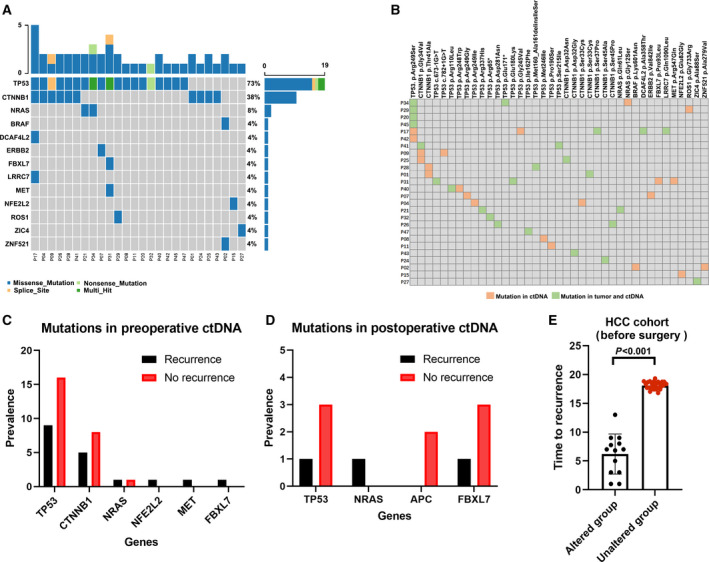
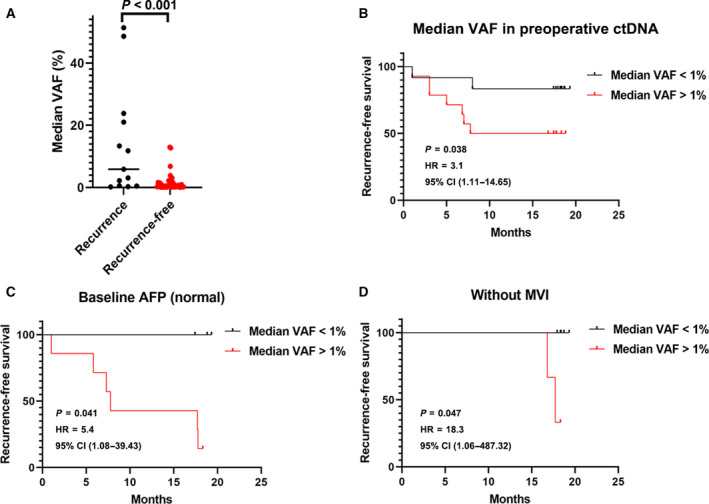
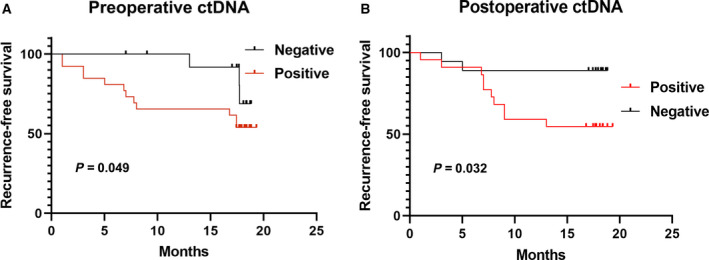
We studied the value of circulating tumor DNA (ctDNA) in predicting early postoperative tumor recurrence and monitoring tumor burden in patients with hepatocellular carcinoma (HCC). Plasma-free DNA, germline DNA, and tissue DNA were isolated from 41 patients with HCC. Serial ctDNAs were analyzed by next-generation sequencing before and after operation. Whole-exome sequencing was used to detect the DNA of HCC and adjacent tissues. In total, 47 gene mutations were identified in the ctDNA of the 41 patients analyzed before surgery. ctDNA was detected in 63.4% and 46% of the patient plasma pre- and postoperation, respectively. The preoperative ctDNA positivity rate was significantly lower in the nonrecurrence group than in the recurrence group. With a median follow-up of 17.7 months, nine patients (22%) experienced tumor recurrence. ctDNA positivity at two time-points was associated with significantly shorter recurrence-free survival (RFS). Tumors with NRAS, NEF2L2, and MET mutations had significantly shorter times to recurrence than those without mutations and showed high recurrence prediction performance by machine learning. Multivariate analyses showed that the median variant allele frequency (VAF) of mutations in preoperative ctDNA was a strong independent predictor of RFS. ctDNA is a real-time monitoring indicator that can accurately reflect tumor burden. The median VAF of baseline ctDNA is a strong independent predictor of RFS in individuals with HCC.
我们研究了循环肿瘤 DNA(ctDNA)在预测肝细胞癌(HCC)患者术后早期肿瘤复发和监测肿瘤负担方面的价值。从 41 例 HCC 患者中分离血浆游离 DNA、种系 DNA 和组织 DNA。在手术前后通过下一代测序分析连续的 ctDNA。使用全外显子组测序检测 HCC 和相邻组织的 DNA。在分析的 41 例术前患者的 ctDNA 中共鉴定出 47 个基因突变。在术前和术后分别有 63.4%和 46%的患者血浆中检测到 ctDNA。非复发组术前 ctDNA 阳性率明显低于复发组。中位随访 17.7 个月后,9 例(22%)患者发生肿瘤复发。两次时间点的 ctDNA 阳性与明显较短的无复发生存(RFS)相关。具有 NRAS、NEF2L2 和 MET 突变的肿瘤比无突变的肿瘤复发时间明显缩短,并且通过机器学习具有较高的复发预测性能。多变量分析显示,术前 ctDNA 中突变的中位变异等位基因频率(VAF)是 RFS 的强独立预测因子。ctDNA 是一种实时监测指标,可准确反映肿瘤负担。基线 ctDNA 的中位 VAF 是 HCC 个体 RFS 的强独立预测因子。