Division of Biomedical Informatics, Seoul National University Biomedical Informatics (SNUBI), Seoul National University College of Medicine, Seoul, 03080, South Korea.
Department of Ophthalmology, Institute of Human Barrier Research, Gangnam Severance Hospital, Yonsei University College of Medicine, Seoul, South Korea.
Sci Rep. 2021 Sep 20;11(1):18594. doi: 10.1038/s41598-021-98084-8.
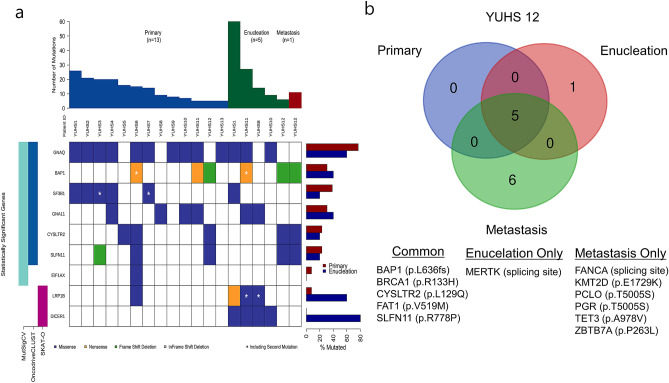
Uveal melanoma(UM) is the most common primary intraocular malignancy in adults. However, the incidence of UM in Asia is 10 to 20 times less than in Western populations. Therefore, for the first time, we report our whole exome sequencing (WES) data analysis to discover differences in the molecular features of Asian and Western UM, and to determine the disparities between the primary tumor before brachytherapy and enucleated samples after brachytherapy. WES of 19 samples (13 primary tumors, 5 enucleation samples after brachytherapy, and 1 liver metastasis) from 13 patients diagnosed with UM and treated between 2007 and 2019 at the Yonsei University Health System (YUHS) were analyzed using bioinformatics pipelines. We identified significantly altered genes in Asian UM and changes in mutational profiles before and after brachytherapy using various algorithms. GNAQ, BAP1, GNA11, SF3B1 and CYSLTR2 were significantly mutated in Asian UM, which is similar that reported frequently in previous Western-based UM studies. There were also similar copy number alterations (M3, 1p loss, 6p gain, 8q gain) in both groups. In paired comparisons of the same patients, DICER1 and LRP1B were distinctly mutated only in tumor samples obtained after brachytherapy using rare-variant association tests (P = 0.01, 0.01, respectively). The mutational profiles of Asian UM were generally similar to the data from previous Western-based studies. DICER1 and LRP1B were newly mutated genes with statistical significance in the regrowth samples after brachytherapy compared to the primary tumors, which may be related to resistance to brachytherapy.
葡萄膜黑色素瘤(UM)是成年人中最常见的原发性眼内恶性肿瘤。然而,UM 在亚洲的发病率比西方人群低 10 到 20 倍。因此,我们首次报告了我们的全外显子组测序(WES)数据分析结果,以发现亚洲和西方 UM 的分子特征差异,并确定在近距离放射治疗前的原发性肿瘤和近距离放射治疗后的眼内容剜除样本之间的差异。我们分析了 2007 年至 2019 年期间在延世大学健康系统(YUHS)被诊断为 UM 并接受治疗的 13 名患者的 19 个样本(13 个原发性肿瘤、5 个近距离放射治疗后眼内容剜除样本和 1 个肝转移样本)的 WES,使用生物信息学分析。我们使用各种算法在亚洲 UM 中鉴定出明显改变的基因,并在近距离放射治疗前后发现突变谱的变化。GNAQ、BAP1、GNA11、SF3B1 和 CYSLTR2 在亚洲 UM 中明显突变,这与以前基于西方的 UM 研究中经常报道的相似。两组中也存在相似的拷贝数改变(M3、1p 缺失、6p 增益、8q 增益)。在同一患者的配对比较中,DICER1 和 LRP1B 仅在使用罕见变异关联测试的近距离放射治疗后获得的肿瘤样本中明显突变(分别为 P = 0.01、0.01)。亚洲 UM 的突变谱与以前基于西方的研究数据总体相似。与原发性肿瘤相比,DICER1 和 LRP1B 是在近距离放射治疗后再生长样本中具有统计学意义的新突变基因,这可能与近距离放射治疗的耐药性有关。