Klinton Joel Shyam, Heitkamp Petra, Rashid Aamna, Faleye Bolanle Olusola, Win Htat Han, Hussain Hamidah, Syed Imran, Farough Khalid, Mortera Lalaine, Moh Lwin Moh, Jha Nita, Ananthakrishnan Ramya, Mahfuza Rifat, Chadha Sarabjit Singh, Banu Sayera, Mannan Shamim, Vijayan Shibu, Ahmed Shahriar, Ali Taofeekat, Oga-Omenka Charity, Kaur Manjot, Singh Urvashi, Wells William A, Stallworthy Guy, Dias Hannah Monica Yesudian, Pai Madhukar
McGill International TB Centre, Montreal, Canada.
TBPPM Learning Network, Canada.
J Clin Tuberc Other Mycobact Dis. 2021 Dec;25:100277. doi: 10.1016/j.jctube.2021.100277. Epub 2021 Sep 16.
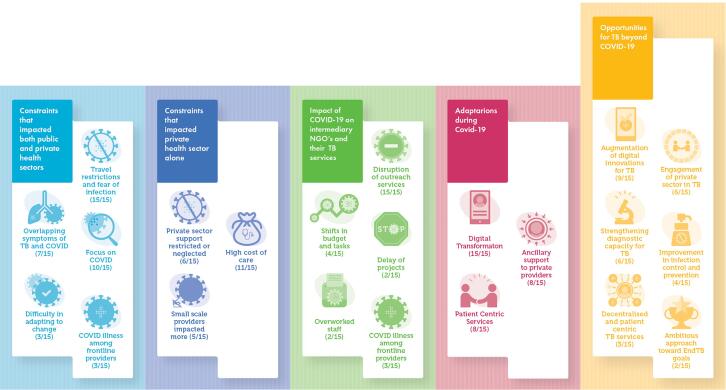
The COVID-19 pandemic has impacted health systems and health programs across the world. For tuberculosis (TB), it is predicted to set back progress by at least twelve years. Public private mix (PPM)has made a vital contribution to reach End TB targets with a ten-fold rise in TB notifications from private providers between 2012 and 2019. This is due in large part to the efforts of intermediary agencies, which aggregate demand from private providers. The COVID-19 pandemic has put these gains at risk over the past year. In this rapid assessment, representatives of 15 intermediary agencies from seven countries that are considered the highest priority for PPM in TB care (the Big Seven) share their views on the impact of COVID-19 on their programs, the private providers operating under their PPM schemes, and their private TB clients. All intermediaries reported a drop in TB testing and notifications, and the closure of some private practices. While travel restrictions and the fear of contracting COVID-19 were the main contributing factors, there were also unanticipated expenses for private providers, which were transferred to patients via increased prices. Intermediaries also had their routine activities disrupted and had to shift tasks and budgets to meet the new needs. However, the intermediaries and their partners rapidly adapted, including an increased use of digital tools, patient-centric services, and ancillary support for private providers. Despite many setbacks, the COVID-19 pandemic has underlined the importance of effective private sector engagement. The robust approach to fight COVID-19 has shown the possibilities for ending TB with a similar approach, augmented by the digital revolution around treatment and diagnostics and the push to decentralize health services.
新冠疫情对全球卫生系统和卫生项目产生了影响。对于结核病而言,预计其进展将倒退至少12年。公私混合(PPM)模式为实现终结结核病目标做出了重要贡献,2012年至2019年间,私营医疗服务提供者报告的结核病病例数增长了10倍。这在很大程度上归功于中介机构的努力,这些机构汇总了私营医疗服务提供者的需求。在过去一年里,新冠疫情使这些成果面临风险。在这项快速评估中,来自七个国家的15个中介机构的代表分享了他们对新冠疫情对其项目、在其PPM计划下运营的私营医疗服务提供者以及他们的私营结核病患者的影响的看法。这七个国家被视为结核病防治中PPM的最高优先国家(七大国家)。所有中介机构都报告称结核病检测和病例报告有所下降,一些私营诊所也关闭了。虽然旅行限制和对感染新冠病毒的恐惧是主要促成因素,但私营医疗服务提供者也有意外开支,并通过提高价格转嫁给了患者。中介机构的日常活动也受到干扰,不得不调整任务和预算以满足新需求。然而,中介机构及其合作伙伴迅速做出了调整,包括更多地使用数字工具、以患者为中心的服务以及为私营医疗服务提供者提供辅助支持。尽管遭遇了诸多挫折,但新冠疫情凸显了私营部门有效参与的重要性。抗击新冠疫情的有力举措表明,采用类似方法并借助围绕治疗和诊断的数字革命以及推动卫生服务去中心化,有可能终结结核病。