Department of Epidemiology, Johns Hopkins Bloomberg School of Public Health, Baltimore, MD, USA.
Yonsei University College of Medicine, Seoul, Republic of Korea.
Eur Heart J. 2021 Oct 14;42(39):4053-4063. doi: 10.1093/eurheartj/ehab592.
The clinical manifestation and outcomes of thrombosis with thrombocytopenia syndrome (TTS) after adenoviral COVID-19 vaccine administration are largely unknown due to the rare nature of the disease. We aimed to analyse the clinical presentation, treatment modalities, outcomes, and prognostic factors of adenoviral TTS, as well as identify predictors for mortality.
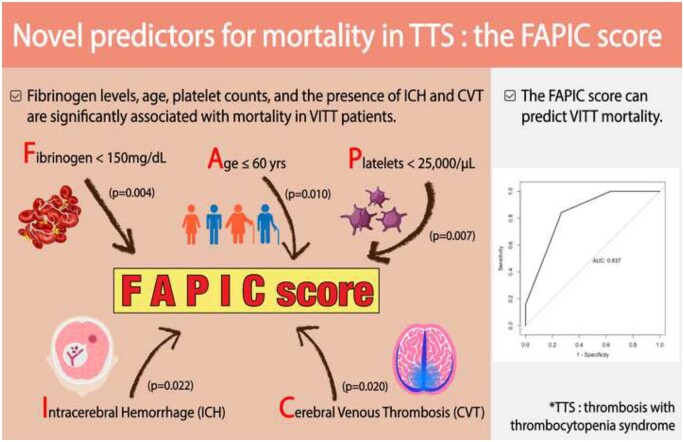
PubMed, Scopus, Embase, and Web of Science databases were searched and the resulting articles were reviewed. A total of 6 case series and 13 case reports (64 patients) of TTS after ChAdOx1 nCoV-19 vaccination were included. We performed a pooled analysis and developed a novel scoring system to predict mortality. The overall mortality of TTS after ChAdOx1 nCoV-19 vaccination was 35.9% (23/64). In our analysis, age ≤60 years, platelet count <25 × 103/µL, fibrinogen <150 mg/dL, the presence of intracerebral haemorrhage (ICH), and the presence of cerebral venous thrombosis (CVT) were significantly associated with death and were selected as predictors for mortality (1 point each). We named this novel scoring system FAPIC (fibrinogen, age, platelet count, ICH, and CVT), and the C-statistic for the FAPIC score was 0.837 (95% CI 0.732-0.942). Expected mortality increased with each point increase in the FAPIC score, at 2.08, 6.66, 19.31, 44.54, 72.94, and 90.05% with FAPIC scores 0, 1, 2, 3, 4, and 5, respectively. The FAPIC scoring model was internally validated through cross-validation and bootstrapping, then externally validated on a panel of TTS patients after Ad26.COV2.S administration.
Fibrinogen levels, age, platelet count, and the presence of ICH and CVT were significantly associated with mortality in patients with TTS, and the FAPIC score comprising these risk factors could predict mortality. The FAPIC score could be used in the clinical setting to recognize TTS patients at high risk of adverse outcomes and provide early intensive interventions including intravenous immunoglobulins and non-heparin anticoagulants.
由于血栓性血小板减少综合征(TTS)的罕见性质,腺病毒 COVID-19 疫苗接种后 TTS 的临床表现和结局在很大程度上尚不清楚。我们旨在分析腺病毒 TTS 的临床表现、治疗方式、结局和预后因素,并确定死亡率的预测因素。
检索了 PubMed、Scopus、Embase 和 Web of Science 数据库,并对检索到的文章进行了综述。共纳入了 6 项 ChAdOx1 nCoV-19 疫苗接种后 TTS 的病例系列研究和 13 项病例报告(共 64 例患者)。我们进行了汇总分析并建立了一种新的评分系统来预测死亡率。ChAdOx1 nCoV-19 疫苗接种后 TTS 的总体死亡率为 35.9%(64 例中的 23 例)。在我们的分析中,年龄≤60 岁、血小板计数<25×103/µL、纤维蛋白原<150mg/dL、存在颅内出血(ICH)和存在脑静脉血栓形成(CVT)与死亡显著相关,并被选为死亡率的预测因素(各 1 分)。我们将这个新的评分系统命名为 FAPIC(纤维蛋白原、年龄、血小板计数、ICH 和 CVT),FAPIC 评分的 C 统计量为 0.837(95%CI 0.732-0.942)。随着 FAPIC 评分的增加,预期死亡率也随之增加,分别为 FAPIC 评分 0、1、2、3、4 和 5 时的 2.08%、6.66%、19.31%、44.54%、72.94%和 90.05%。通过交叉验证和引导验证对内 FAPIC 评分模型进行了内部验证,然后在 Ad26.COV2.S 给药后 TTS 患者的小组中进行了外部验证。
纤维蛋白原水平、年龄、血小板计数以及 ICH 和 CVT 的存在与 TTS 患者的死亡率显著相关,包含这些危险因素的 FAPIC 评分可以预测死亡率。FAPIC 评分可用于临床识别 TTS 患者发生不良结局的高风险,并提供早期强化干预措施,包括静脉注射免疫球蛋白和非肝素抗凝剂。