Department of General and Applied Kinesiology, Faculty of Kinesiology, University of Zagreb, Horvaćanski zavoj 15, Zagreb, Croatia.
Department of Sport Motorics and Methodology in Kinanthropology, Faculty of Sports Studies, Masaryk University, Brno, Czech Republic.
BMC Pulm Med. 2021 Sep 21;21(1):297. doi: 10.1186/s12890-021-01666-5.
The 6-min walk test (6MWT) has become an established measure for assessing exercise capacity in children with chronic diseases. However, little evidence has been provided regarding population-based normal data in healthy children. The main purpose of the study was to provide normative data in a large sample of children.
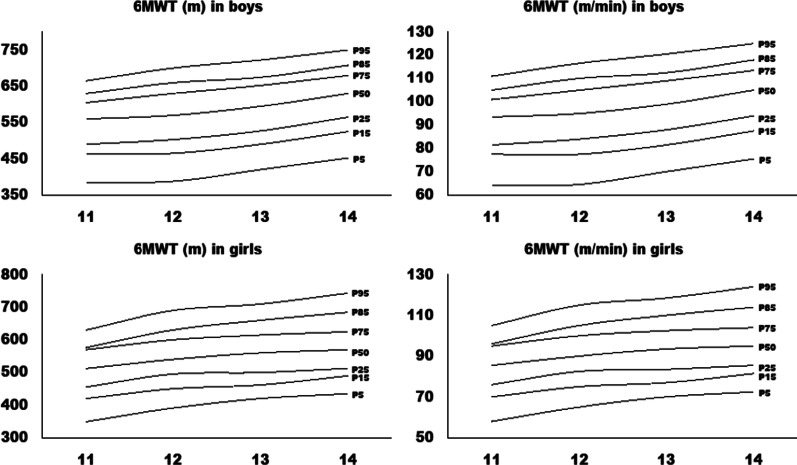
In this cross-sectional study, 4352 children between 11 and 14 years were recruited (66% girls). The main outcome measure was the distance walked for six minutes. Sex- and age-specific percentile values (5th, 15th, 25th, 50th, 75th, 85th and 95th) for the 6MWT were created and the differences and correlations were examined by the analysis of variance and Pearson's coefficient of correlation.
The mean distance walked in 6 min was 576 ± 93 m in boys and 545 ± 92 m in girls, respectively. The mean walking speed for boys and girls was 98 ± 5 m/min and 91 ± 6 m/min. Older boys and girls performed better, compared to their younger counterparts (p for age < 0.001). The 6MWT was significantly correlated with age (r = 0.24, p < 0.001), height (r = 0.09, p < 0.001), weight (r = - 0.13, p < 0.001) and body-mass index (r = - 0.26, p < 0.001).
This is the first population-based study aiming to provide normative data for the 6MWT in healthy children between 11 to 14 years. Children in lower percentiles are 'target groups' for special intervention aiming to enhance the performance.
6 分钟步行测试(6MWT)已成为评估慢性疾病儿童运动能力的一种既定方法。然而,在健康儿童中,关于基于人群的正常数据的证据很少。本研究的主要目的是为大量儿童提供正常数据。
在这项横断面研究中,招募了 4352 名 11 至 14 岁的儿童(66%为女孩)。主要的结局测量指标是六分钟内行走的距离。为 6MWT 制定了性别和年龄特异性百分位值(第 5、15、25、50、75、85 和 95),并通过方差分析和 Pearson 相关系数分析检查了差异和相关性。
男孩 6 分钟内的平均步行距离为 576±93m,女孩为 545±92m。男孩和女孩的平均步行速度分别为 98±5m/min 和 91±6m/min。与年龄较小的儿童相比,年龄较大的男孩和女孩表现更好(p 值均<0.001)。6MWT 与年龄(r=0.24,p<0.001)、身高(r=0.09,p<0.001)、体重(r=-0.13,p<0.001)和体重指数(r=-0.26,p<0.001)显著相关。
这是第一项旨在为 11 至 14 岁健康儿童提供 6MWT 正常数据的基于人群的研究。处于较低百分位的儿童是旨在提高表现的特殊干预的“目标群体”。