Department of Investigational Cancer Therapeutics (Phase I Program), The University of Texas MD Anderson Cancer Center, Houston, Texas.
Vall d'Hebron Institute of Oncology, Vall d'Hebron University Hospital, Barcelona, Spain.
Clin Cancer Res. 2021 Dec 15;27(24):6666-6676. doi: 10.1158/1078-0432.CCR-21-1504. Epub 2021 Sep 21.
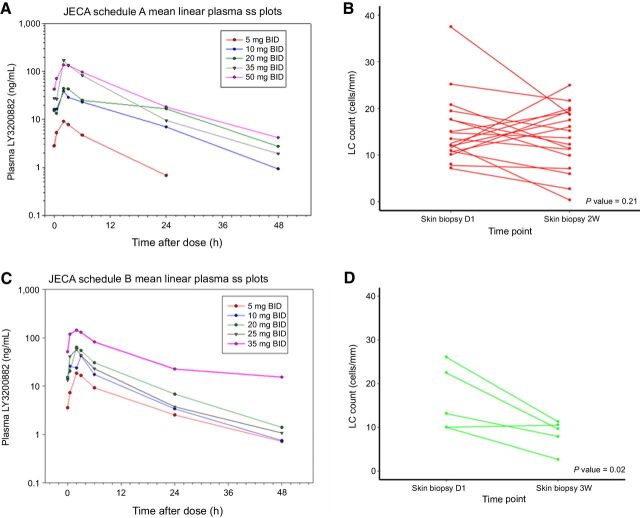
A novel, selective, next-generation transforming growth factor beta (TGFβ) receptor type-1 small molecule inhibitor, LY3200882, demonstrated promising preclinical data. This first-in-human trial evaluated safety, tolerability, recommended phase II dose (RP2D), pharmacokinetics, pharmacodynamics, and preliminary antitumor activity of LY3200882 as monotherapy or with other anticancer agents in patients with advanced cancer.
This phase I multicenter study of oral LY3200882 (NCT02937272) comprised dose escalation, monotherapy expansion in grade 4 glioma, and combination therapy in solid tumors (LY3200882 and PD-L1 inhibitor LY3300054), pancreatic cancer (LY3200882, gemcitabine, and nab-paclitaxel), and head and neck squamous cell cancer (LY3200882, cisplatin, and radiation).
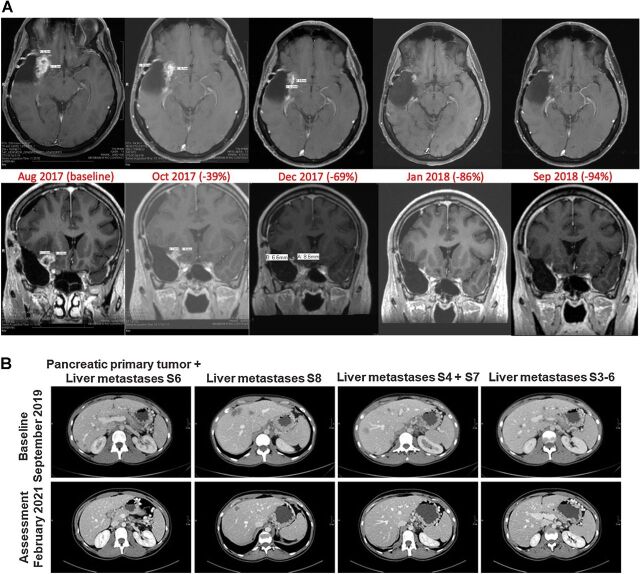
Overall, 139 patients with advanced cancer were treated. The majority (93.5%) of patients experienced ≥1 treatment-emergent adverse events (TEAE), with 39.6% LY3200882-related. Grade 3 LY3200882-related toxicities were only observed in combination therapy arms. One patient in the pancreatic cancer arm experienced cardiovascular toxicity. The LY3200882 monotherapy RP2Ds were established in two schedules: 50 mg twice a day 2-weeks-on/2-weeks-off and 35 mg twice a day 3-weeks-on/1-week-off. Four patients with grade 4 glioma had durable Revised Assessment in Neuro Oncology (RANO) partial responses (PR) with LY3200882 monotherapy ( = 3) or LY3200882-LY3300054 combination therapy ( = 1). In treatment-naïve patients with advanced pancreatic cancer, 6 of 12 patients achieved Response Evaluation Criteria in Solid Tumors (RECIST) v1.1 PR and 3 of 12 patients demonstrated stable disease, for an overall 75% disease-control rate with the combination of LY3200882, gemcitabine, and nab-paclitaxel.
LY3200882 as monotherapy and combination therapy was safe and well tolerated with preliminary antitumor activity observed in pancreatic cancer. Further studies to evaluate the efficacy of LY3200882 with gemcitabine and nab-paclitaxel in advanced pancreatic cancer are warranted.
一种新型、选择性的下一代转化生长因子β(TGFβ)受体 1 型小分子抑制剂 LY3200882,具有有前景的临床前数据。这项首次人体试验评估了 LY3200882 单药治疗或与其他抗癌药物联合治疗晚期癌症患者的安全性、耐受性、推荐的 II 期剂量(RP2D)、药代动力学、药效学和初步抗肿瘤活性。
这项口服 LY3200882 的 I 期多中心研究(NCT02937272)包括剂量递增、4 级脑胶质瘤的单药扩展以及实体瘤(LY3200882 和 PD-L1 抑制剂 LY3300054)、胰腺癌(LY3200882、吉西他滨和 nab-紫杉醇)和头颈部鳞状细胞癌(LY3200882、顺铂和放疗)的联合治疗。
总体而言,139 名患有晚期癌症的患者接受了治疗。大多数(93.5%)患者经历了≥1 次治疗出现的不良事件(TEAE),其中 39.6%与 LY3200882 相关。仅在联合治疗组观察到 3 级 LY3200882 相关毒性。1 名胰腺癌组患者出现心血管毒性。LY3200882 单药治疗的 RP2D 以两种方案确定:50mg,每日两次,2 周/2 周停药和 35mg,每日两次,3 周/1 周停药。4 名 4 级脑胶质瘤患者接受 LY3200882 单药治疗(=3)或 LY3200882-LY3300054 联合治疗(=1),获得了持久的修订神经肿瘤学评估(RENO)部分缓解(PR)。在未经治疗的晚期胰腺癌患者中,12 名患者中的 6 名达到了实体瘤反应评估标准(RECIST)v1.1 的 PR,12 名患者中的 3 名显示疾病稳定,联合 LY3200882、吉西他滨和 nab-紫杉醇的疾病控制率为 75%。
LY3200882 单药治疗和联合治疗安全且耐受良好,在胰腺癌中观察到初步抗肿瘤活性。需要进一步研究评估 LY3200882 联合吉西他滨和 nab-紫杉醇在晚期胰腺癌中的疗效。