Guangdong Institute of Gastroenterology, Guangdong Provincial Key Laboratory of Colorectal and Pelvic Floor Disease, The Sixth Affiliated Hospital, Sun Yat-sen University, Guangzhou, China.
Department of Colorectal Surgery, The Sixth Affiliated Hospital, Sun Yat-sen University, Guangzhou, China.
J Immunother Cancer. 2021 Sep;9(9). doi: 10.1136/jitc-2021-002671.
Tumor-infiltrating lymphocytes (TILs), especially CD8+ TILs, can be used for predicting immunotherapy responsiveness and survival outcome. However, the evaluation of CD8+ TILs currently relies on histopathological methodology with high variability. We therefore aimed to develop a DNA methylation signature for CD8+ TILs (CD8+ MeTIL) that could evaluate immune response and prognosis in colorectal cancer (CRC).
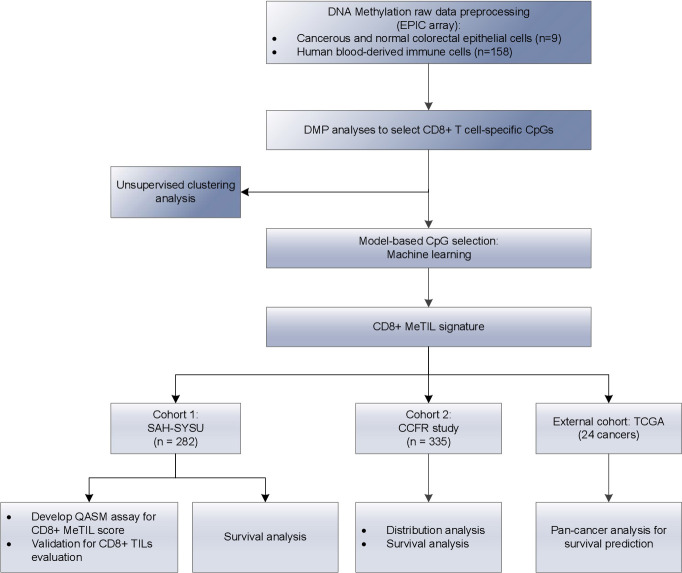
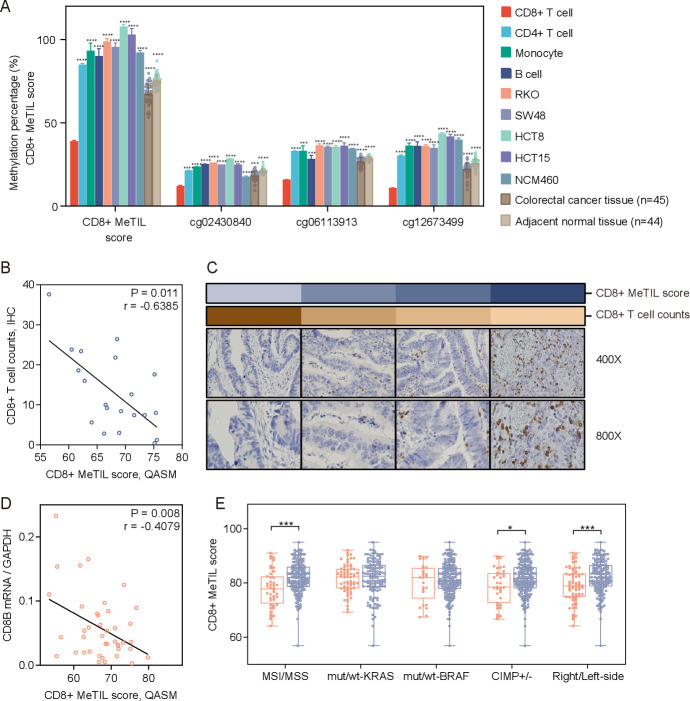
A CD8+ MeTIL signature score was constructed by using CD8+ T cell-specific differentially methylated positions (DMPs) that were identified from Illumina EPIC methylation arrays. Immune cells, colon epithelial cells, and two CRC cohorts (n=282 and 335) were used to develop a PCR-based assay for quantitative analysis of DNA methylation at single-base resolution (QASM) to determine CD8 + MeTIL signature score.
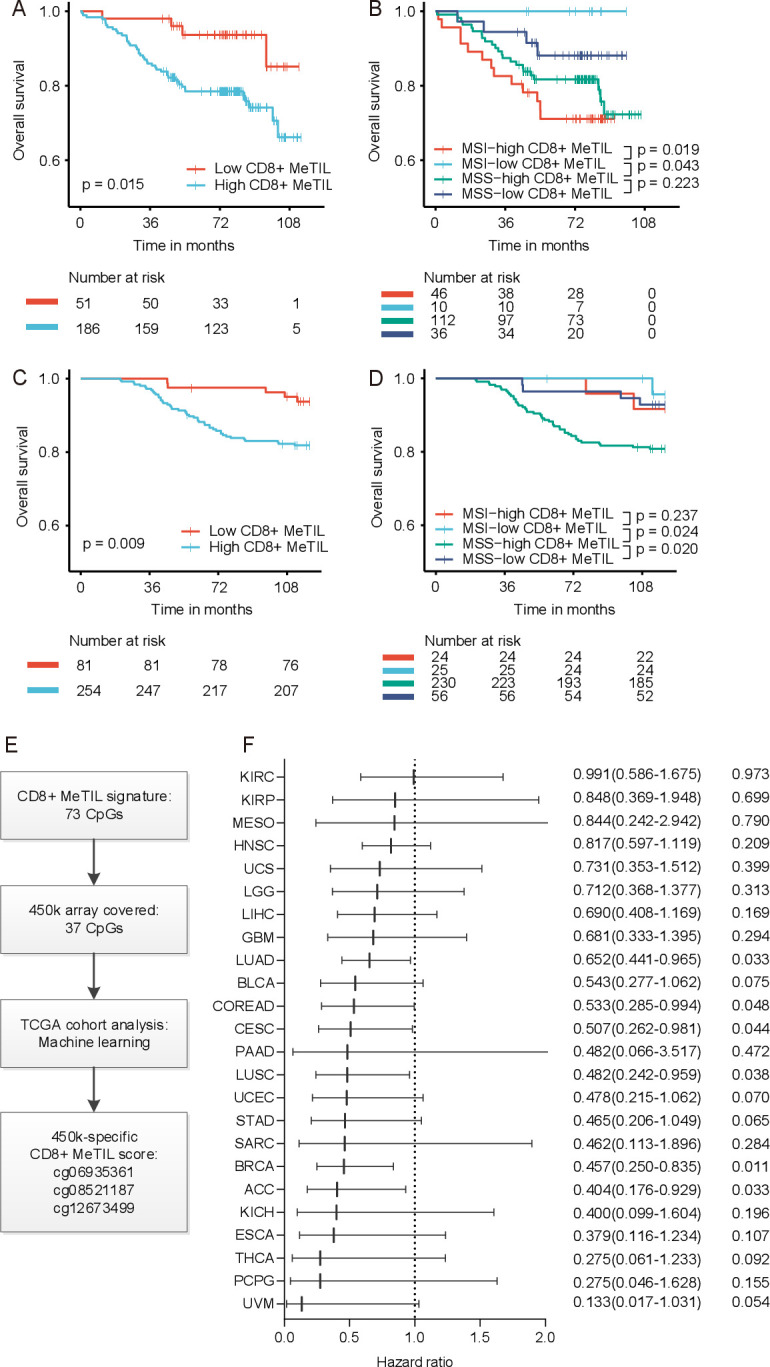
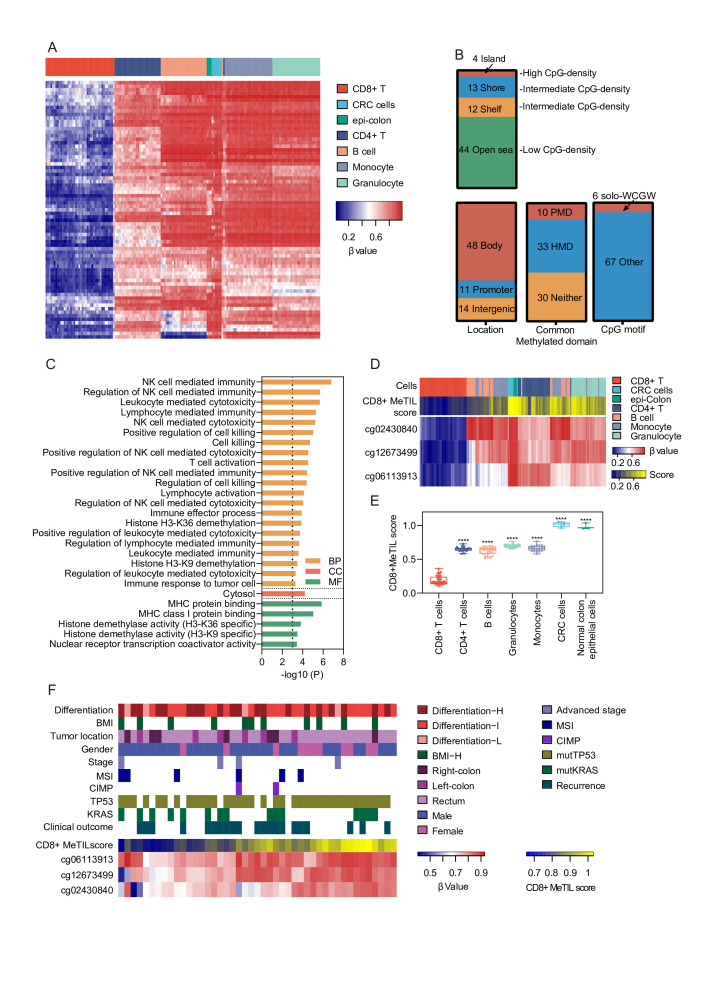
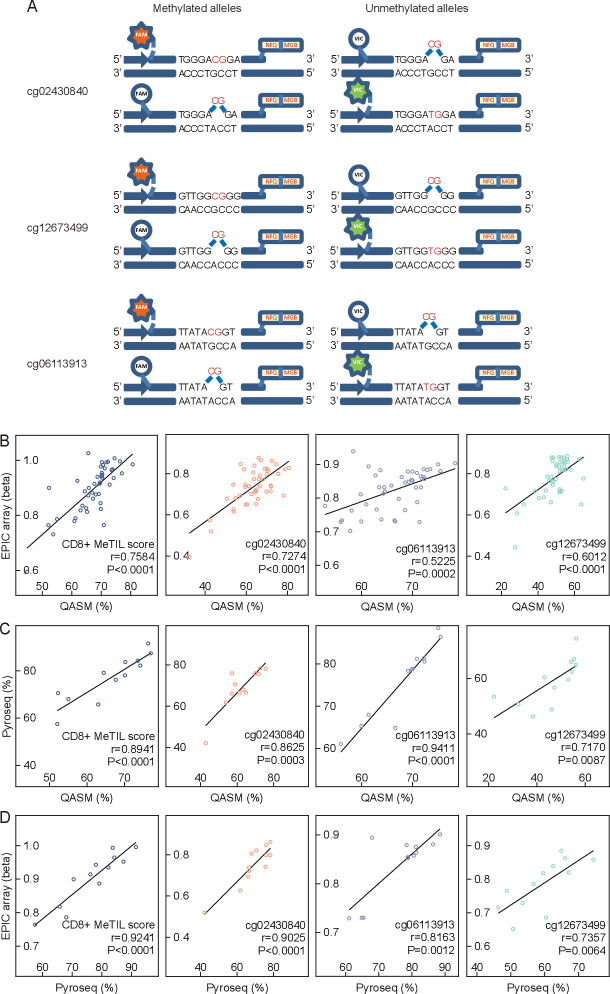
Three CD8+ T cell-specific DMPs were identified to construct the CD8+ MeTIL signature score, which showed a dramatic discriminability between CD8+ T cells and other cells. The QASM assay we developed for CD8+ MeTIL markers could measure CD8+ TILs distributions in a fully quantitative, accurate, and simple manner. The CD8+ MeTIL score determined by QASM assay showed a strong association with histopathology-based CD8+ TIL counts and a gene expression-based immune marker. Furthermore, the low CD8+ MeTIL score (enriched CD8+ TILs) was associated with MSI-H tumors and predicted better survival in CRC cohorts.
This study developed a quantitative DNA methylation-based signature that was reliable to evaluate CD8+ TILs and prognosis in CRC. This approach has the potential to be a tool for investigations on CD8+ TILs and a biomarker for therapeutic approaches, including immunotherapy.
肿瘤浸润淋巴细胞(TILs),尤其是 CD8+TILs,可用于预测免疫治疗反应和生存结果。然而,目前 CD8+TILs 的评估依赖于具有高度变异性的组织病理学方法。因此,我们旨在开发一种用于评估结直肠癌(CRC)免疫反应和预后的 CD8+T 细胞特异性 DNA 甲基化标志物(CD8+MeTIL)。
使用从 Illumina EPIC 甲基化阵列中鉴定出的 CD8+T 细胞特异性差异甲基化位置(DMP)构建 CD8+MeTIL 特征评分。使用免疫细胞、结肠上皮细胞和两个 CRC 队列(n=282 和 335),开发一种基于 PCR 的定量分析单碱基分辨率 DNA 甲基化(QASM)的检测方法,以确定 CD8+MeTIL 特征评分。
确定了三个 CD8+T 细胞特异性 DMP 来构建 CD8+MeTIL 特征评分,该评分在 CD8+T 细胞和其他细胞之间具有显著的区分能力。我们开发的用于 CD8+MeTIL 标志物的 QASM 检测方法可以以完全定量、准确和简单的方式测量 CD8+TIL 的分布。QASM 检测法确定的 CD8+MeTIL 评分与基于组织病理学的 CD8+TIL 计数和基于基因表达的免疫标志物具有强烈的相关性。此外,低 CD8+MeTIL 评分(富含 CD8+TIL)与 MSI-H 肿瘤相关,并预测 CRC 队列的生存更好。
本研究开发了一种可靠的定量 DNA 甲基化标志物,用于评估 CRC 中的 CD8+TIL 和预后。这种方法有可能成为研究 CD8+TIL 的工具和治疗方法的生物标志物,包括免疫治疗。