Kwok Man Ki, Schooling Catherine Mary
School of Public Health, Li Ka Shing, Faculty of Medicine, The University of Hong Kong, 1/F, Patrick Manson Building (North Wing), 7 Sassoon Road, Pok Fu Lam, Hong Kong Special Administrative Region, China.
City University of New York Graduate School of Public Health and Health Policy, New York, USA.
Sci Rep. 2021 Sep 21;11(1):18682. doi: 10.1038/s41598-021-98058-w.
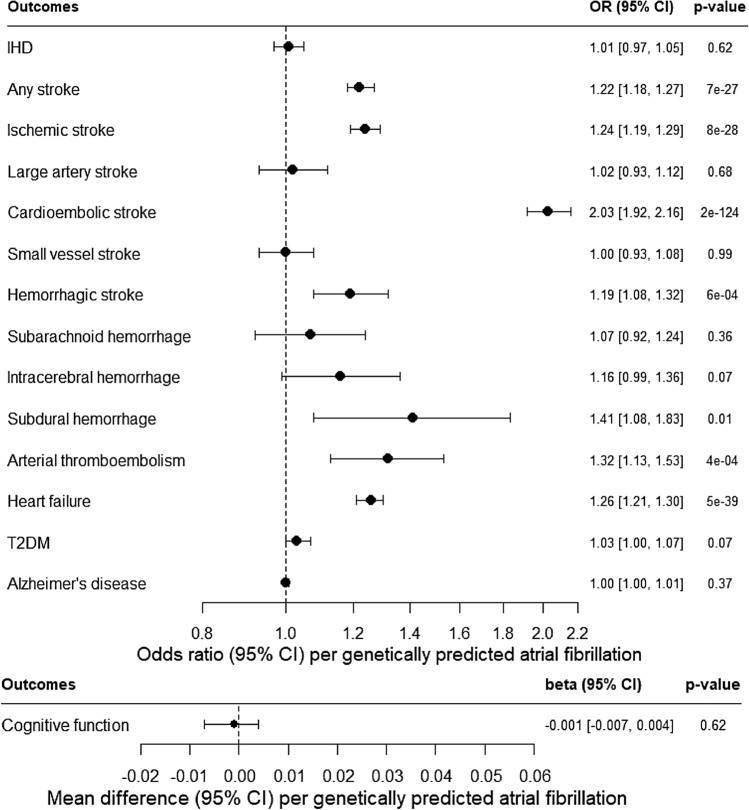
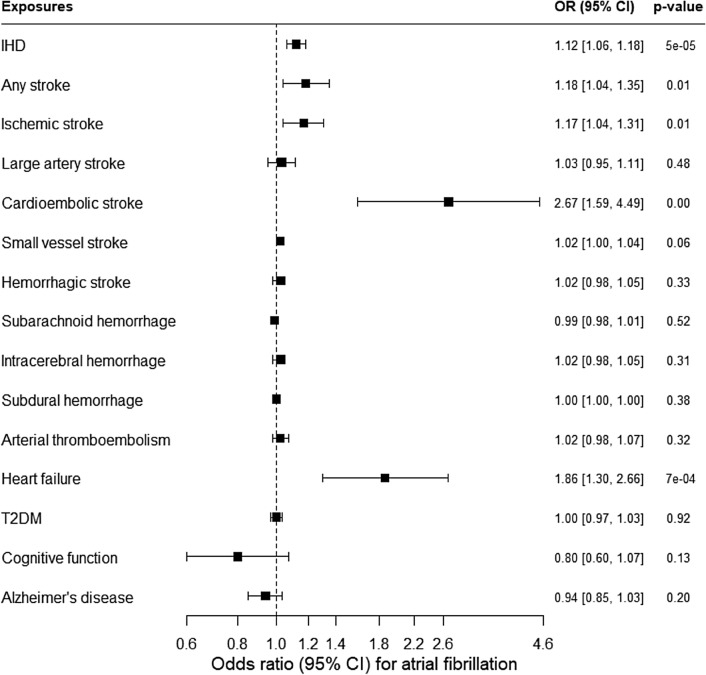
Atrial fibrillation (AF) has been associated with numerous diseases. However, whether AF is a cause or consequence of these diseases is uncertain. To clarify, we assessed the causal role of AF on ischemic heart disease (IHD), stroke, other cardiovascular disease (CVD) subtypes, type 2 diabetes mellitus (T2DM), and late-onset AD using bi-directional two-sample Mendelian randomization (MR) among people primarily of European descent. Genetically predicted log odds of AF was associated with any stroke (odds ratio (OR) 1.22, 95% CI 1.18 to 1.27), particularly cardioembolic stroke and possibly subdural hemorrhage, with sensitivity analyses showing similar positive findings. Genetically predicted AF was also associated with arterial thromboembolism (1.32, 1.13 to 1.53), and heart failure (1.26, 1.21 to 1.30). No association of genetically predicted AF with IHD, T2DM, cognitive function, or late-onset AD was found. Conversely, genetically predicted IHD, heart failure and possibly ischemic stroke, particularly cardioembolic stroke, were positively associated with AF. Atrial fibrillation plays a role in any stroke, arterial thromboembolism, and heart failure, corroborating current clinical guidelines on the importance of preventing these complications by effective AF management. In addition, patients with IHD, heart failure or possibly ischemic stroke might be predisposed to developing AF, with implications for management.
心房颤动(AF)与多种疾病相关。然而,AF是这些疾病的原因还是结果尚不确定。为了阐明这一点,我们在主要为欧洲血统的人群中,使用双向双样本孟德尔随机化(MR)方法评估了AF对缺血性心脏病(IHD)、中风、其他心血管疾病(CVD)亚型、2型糖尿病(T2DM)和晚发性阿尔茨海默病(AD)的因果作用。遗传预测的AF对数优势与任何中风相关(优势比(OR)1.22,95%可信区间1.18至1.27),尤其是心源性栓塞性中风,可能还有硬膜下出血,敏感性分析显示了类似的阳性结果。遗传预测的AF也与动脉血栓栓塞(1.32,1.13至1.53)和心力衰竭(1.26,1.21至1.30)相关。未发现遗传预测的AF与IHD、T2DM、认知功能或晚发性AD之间存在关联。相反,遗传预测的IHD、心力衰竭以及可能的缺血性中风,尤其是心源性栓塞性中风,与AF呈正相关。心房颤动在任何中风、动脉血栓栓塞和心力衰竭中都起作用,这证实了当前临床指南中关于通过有效管理AF来预防这些并发症的重要性。此外,患有IHD、心力衰竭或可能患有缺血性中风的患者可能易患AF,这对治疗具有启示意义。