Department of Epidemiology and Biostatistics, School of Public Health, Imperial College London, London, United Kingdom; Department of Cardiology, Royal North Shore Hospital, Sydney, New South Wales, Australia; Faculty of Medicine and Health, The University of Sydney, Sydney, New South Wales, Australia.
Medical Research Council Laboratory of Molecular Biology, Cambridge, United Kingdom; Department of Physiology, Development and Neuroscience, University of Cambridge, Cambridge, United Kingdom; School of Mathematics and Statistics, University of New South Wales, Sydney, New South Wales, Australia.
Am J Cardiol. 2023 Oct 15;205:329-337. doi: 10.1016/j.amjcard.2023.08.007. Epub 2023 Aug 24.
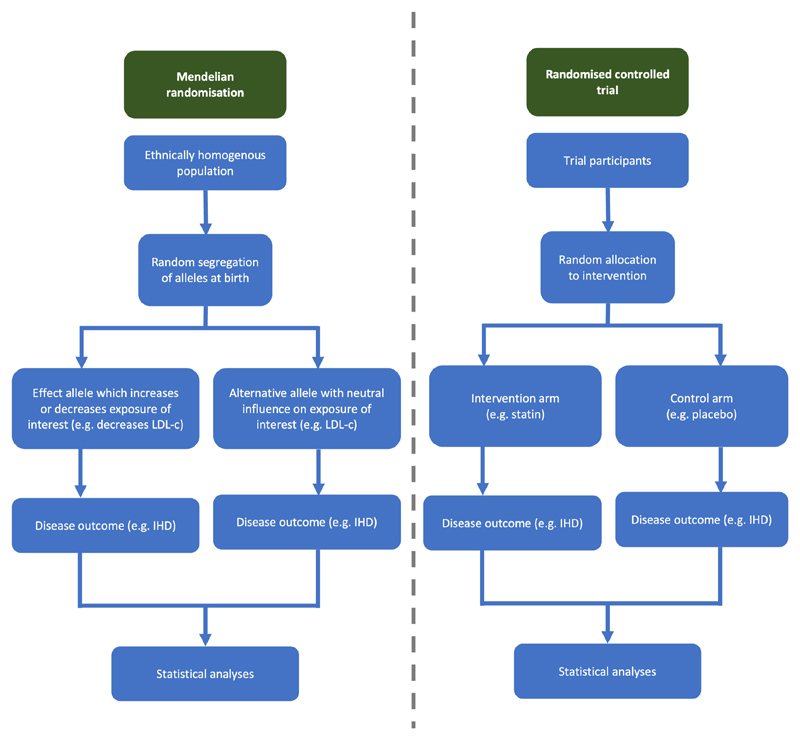
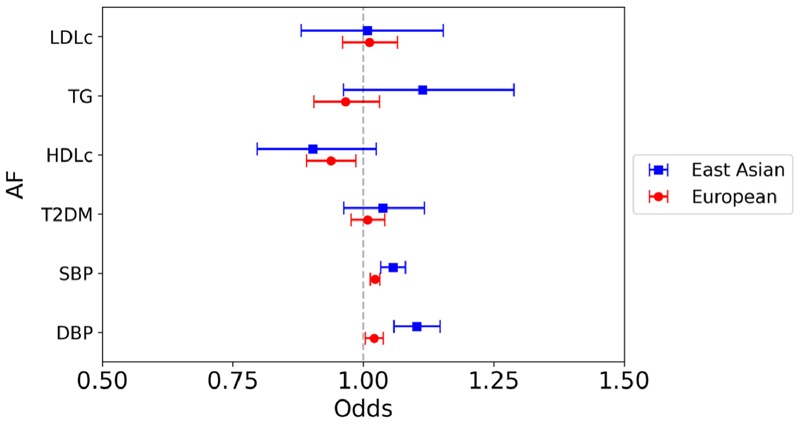
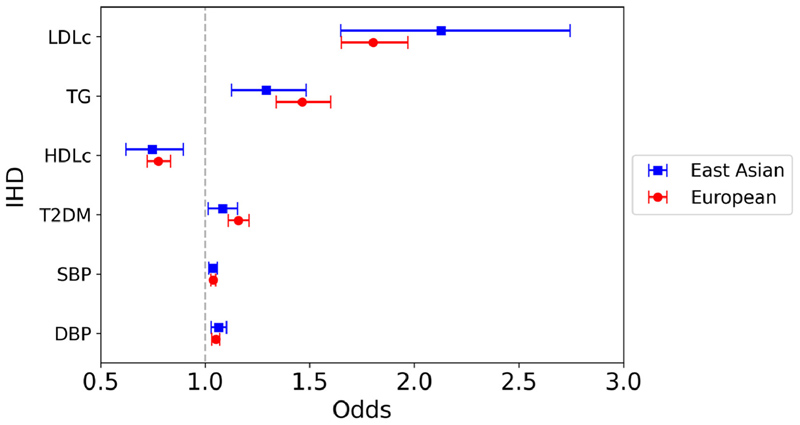
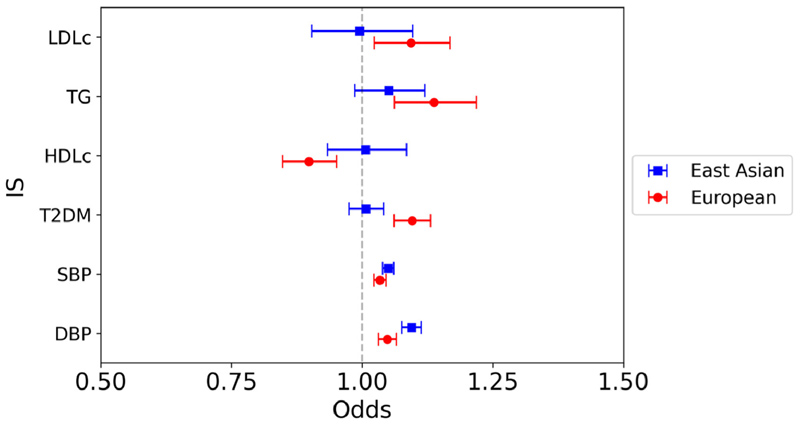
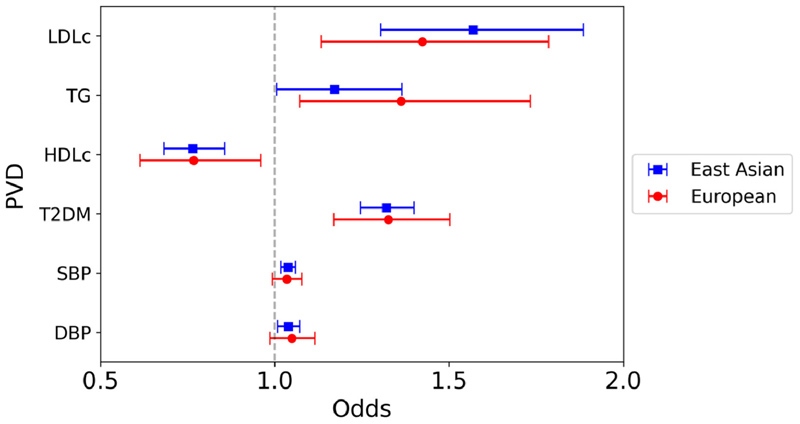
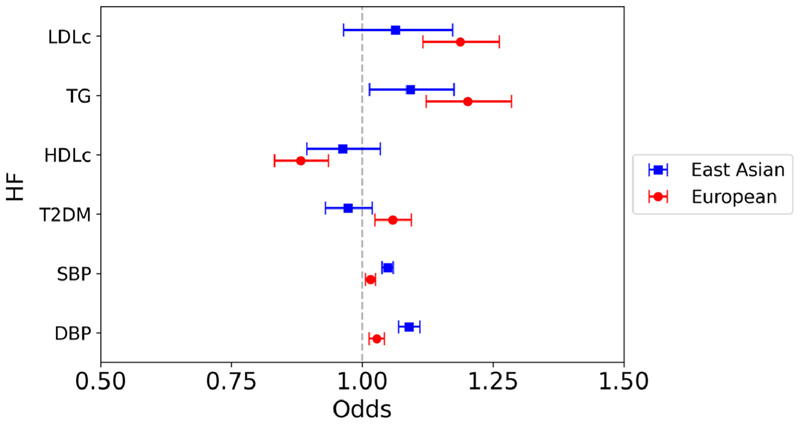
Elevated blood pressure, dyslipidemia, and impaired glycemic control are well-established cardiovascular risk factors in Europeans, but there are comparatively few studies focused on East Asian populations. This study evaluated the potential causal relations between traditional cardiovascular risk factors and disease risk in East Asians through a 2-sample Mendelian randomization approach. We collected summary statistics for blood pressure parameters, lipid subsets, and type 2 diabetes mellitus liability from large genome-wide association study meta-analyses conducted in East Asians and Europeans. These were paired with summary statistics for ischemic heart disease (IHD), ischemic stroke (IS), peripheral vascular disease, heart failure (HF) and atrial fibrillation (AF). We performed univariable Mendelian randomization analyses for each exposure-outcome pair, followed by multivariable analyses for the available lipid subsets. The genetically predicted risk factors associated with IHD and AF were similar between East Asians and Europeans. However, in East Asians only genetically predicted elevated blood pressure was significantly associated with IS (odds ratio 1.05, 95% confidence interval 1.04 to 1.06, p <0.0001) and HF (odds ratio 1.05, 95% confidence interval 1.04 to 1.06, p <0.0001), whereas nearly all genetically predicted risk factors were significantly associated with IS and HF in Europeans. In conclusion, this study provides supportive evidence for similar causal relations between traditional cardiovascular risk factors and IHD and AF in both East Asian and European ancestry populations. However, the identified risk factors for IS and HF differed between East Asians and Europeans, potentially highlighting distinct disease etiologies between these populations.
高血压、血脂异常和血糖控制受损是欧洲人群中公认的心血管危险因素,但针对东亚人群的研究相对较少。本研究通过两样本 Mendelian 随机化方法评估了传统心血管危险因素与东亚人群疾病风险之间的潜在因果关系。我们从东亚和欧洲进行的大型全基因组关联研究荟萃分析中收集了血压参数、血脂亚类和 2 型糖尿病易感性的汇总统计数据。这些数据与缺血性心脏病(IHD)、缺血性中风(IS)、外周血管疾病、心力衰竭(HF)和心房颤动(AF)的汇总统计数据相配对。我们对每个暴露-结局对进行了单变量 Mendelian 随机化分析,然后对可用的血脂亚类进行了多变量分析。在东亚人和欧洲人中,与 IHD 和 AF 相关的遗传预测风险因素相似。然而,在东亚人中,只有遗传预测的血压升高与 IS(比值比 1.05,95%置信区间 1.04 至 1.06,p<0.0001)和 HF(比值比 1.05,95%置信区间 1.04 至 1.06,p<0.0001)显著相关,而在欧洲人中,几乎所有遗传预测的风险因素都与 IS 和 HF 显著相关。总之,本研究为东亚和欧洲血统人群中传统心血管危险因素与 IHD 和 AF 之间的相似因果关系提供了支持性证据。然而,IS 和 HF 的确定风险因素在东亚人和欧洲人之间存在差异,这可能突出了这些人群之间不同的疾病病因。