Department of Cardiology, Amsterdam UMC, Vrije Universiteit Amsterdam, Amsterdam, Netherlands.
Department of Epidemiology and Biostatistics, Amsterdam UMC, Vrije Universiteit Amsterdam, Amsterdam, Netherlands.
J Interv Cardiol. 2021 Aug 31;2021:4339451. doi: 10.1155/2021/4339451. eCollection 2021.
Quantitative flow ratio (QFR) computes fractional flow reserve (FFR) based on invasive coronary angiography (ICA). Residual QFR estimates post-percutaneous coronary intervention (PCI) FFR. This study sought to assess the relationship of residual QFR with post-PCI FFR.
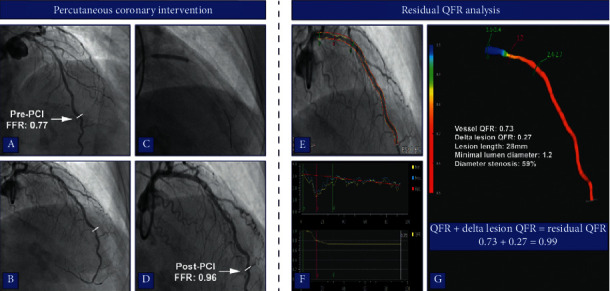
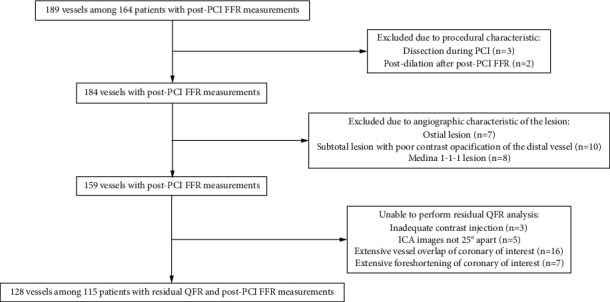
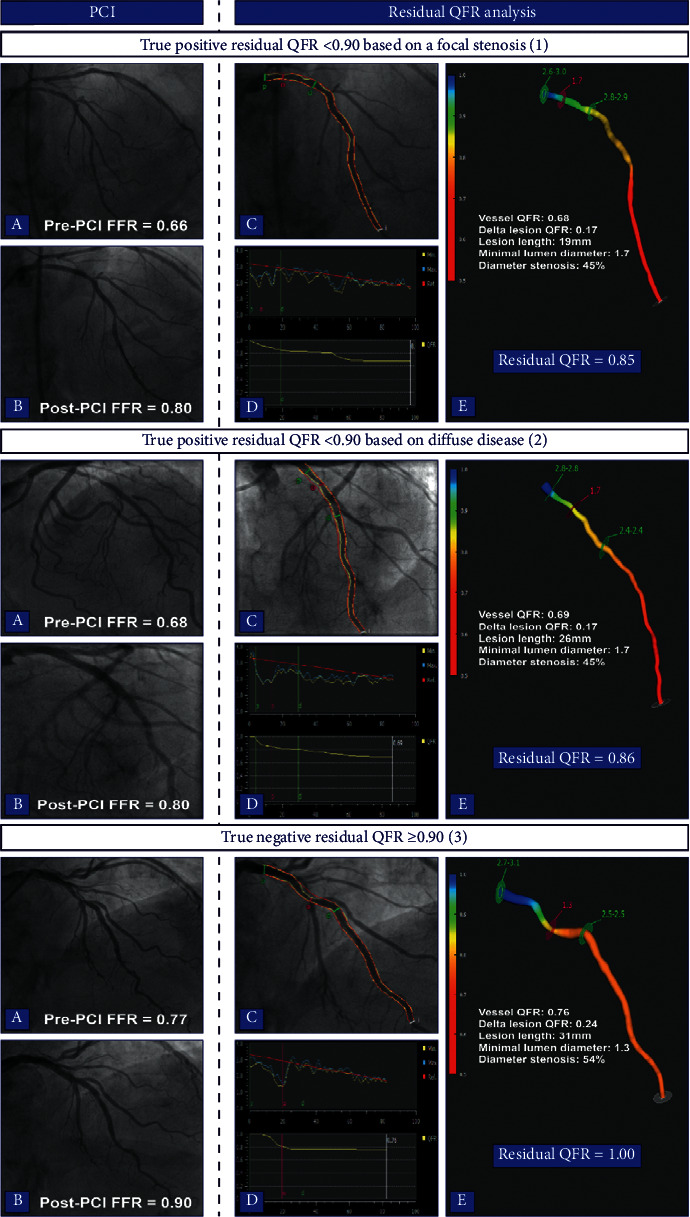
Residual QFR analysis, using pre-PCI ICA, was attempted in 159 vessels with post-PCI FFR. QFR lesion location was matched with the PCI location to simulate the performed intervention and allow computation of residual QFR. A post-PCI FFR < 0.90 was used to define a suboptimal PCI result.
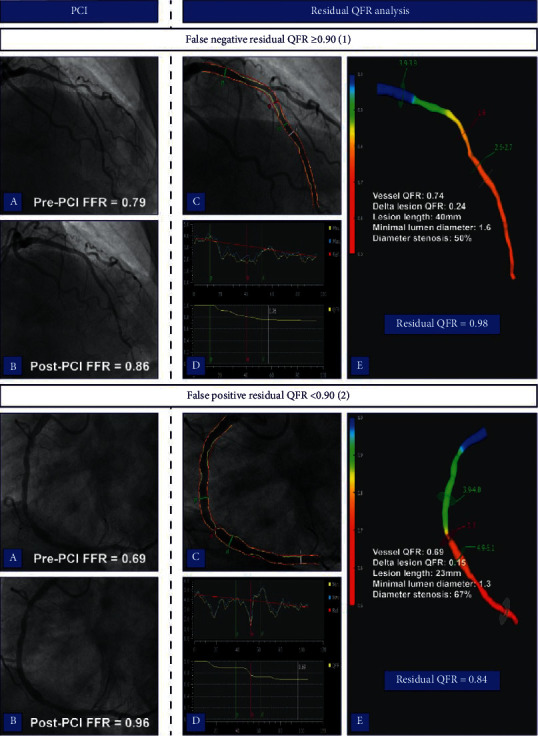
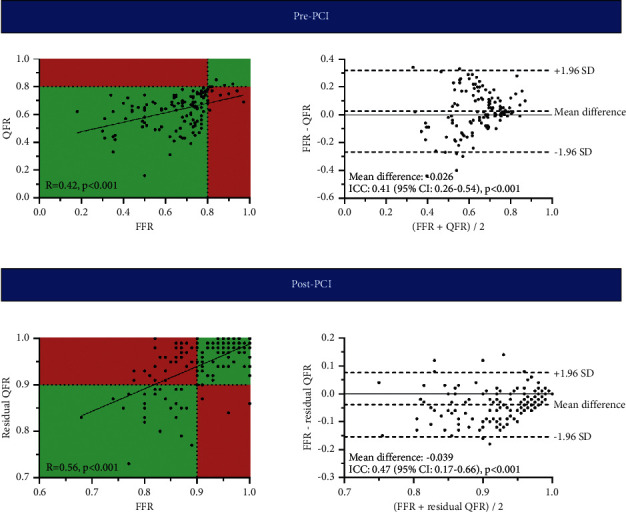
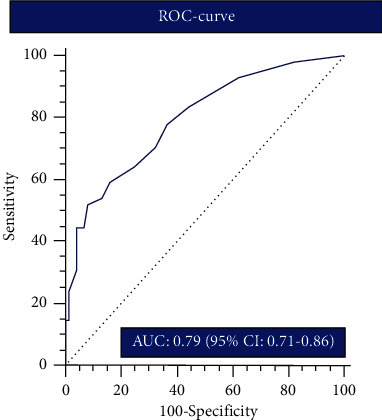
Residual QFR computation was successful in 128 (81%) vessels. Median residual QFR was higher than post-PCI FFR (0.96 Q1-Q3: 0.91-0.99 vs. 0.91 Q1-Q3: 0.86-0.96, < 0.001). A significant correlation and agreement were observed between residual QFR and post-PCI FFR ( = 0.56 and intraclass correlation coefficient = 0.47, < 0.001 for both). Following PCI, an FFR < 0.90 was observed in 54 (42%) vessels. Specificity, positive predictive value, sensitivity, and negative predictive value of residual QFR for assessment of the PCI result were 96% (95% confidence interval (CI): 87-99%), 89% (95% CI: 72-96%), 44% (95% CI: 31-59%), and 70% (95% CI: 65-75%), respectively. Residual QFR had an accuracy of 74% (95% CI: 66-82%) and an area under the receiver operating characteristic curve of 0.79 (95% CI: 0.71-0.86).
A significant correlation and agreement between residual QFR and post-PCI FFR were observed. Residual QFR ≥ 0.90 did not necessarily commensurate with a satisfactory PCI (post-PCI FFR ≥ 0.90). In contrast, residual QFR exhibited a high specificity for prediction of a suboptimal PCI result.
定量血流比(QFR)基于有创冠状动脉造影(ICA)计算血流储备分数(FFR)。残余 QFR 估计经皮冠状动脉介入治疗(PCI)后的 FFR。本研究旨在评估残余 QFR 与 PCI 后 FFR 的关系。
对 159 个有 PCI 后 FFR 的血管进行残余 QFR 分析,使用 PCI 前 ICA。将 QFR 病变位置与 PCI 位置匹配,模拟进行的干预,允许计算残余 QFR。将 PCI 后 FFR<0.90 定义为 PCI 结果不理想。
128 个(81%)血管成功进行了残余 QFR 计算。中位残余 QFR 高于 PCI 后 FFR(0.96 Q1-Q3:0.91-0.99 比 0.91 Q1-Q3:0.86-0.96,<0.001)。残余 QFR 与 PCI 后 FFR 之间存在显著相关性和一致性(=0.56 和组内相关系数=0.47,均<0.001)。PCI 后,54 个(42%)血管的 FFR<0.90。残余 QFR 评估 PCI 结果的特异性、阳性预测值、敏感性和阴性预测值分别为 96%(95%CI:87-99%)、89%(95%CI:72-96%)、44%(95%CI:31-59%)和 70%(95%CI:65-75%)。残余 QFR 的准确性为 74%(95%CI:66-82%),受试者工作特征曲线下面积为 0.79(95%CI:0.71-0.86)。
残余 QFR 与 PCI 后 FFR 之间存在显著相关性和一致性。残余 QFR≥0.90 并不一定等同于满意的 PCI(PCI 后 FFR≥0.90)。相反,残余 QFR 对预测不理想的 PCI 结果具有很高的特异性。