School of Computer Science and Information Security, Guilin University of Electronic Technology, Guilin 541004, China.
Infection and Immunity Program, Biomedicine Discovery Institute and Department of Microbiology, Monash University, VIC 3800, Australia.
Nucleic Acids Res. 2022 Jan 7;50(D1):D848-D857. doi: 10.1093/nar/gkab814.
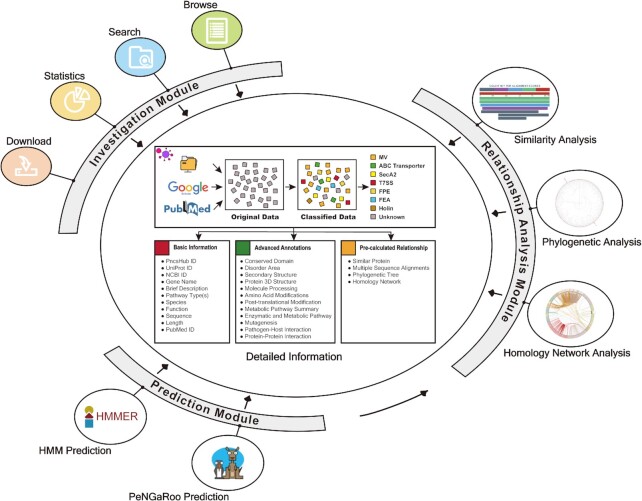
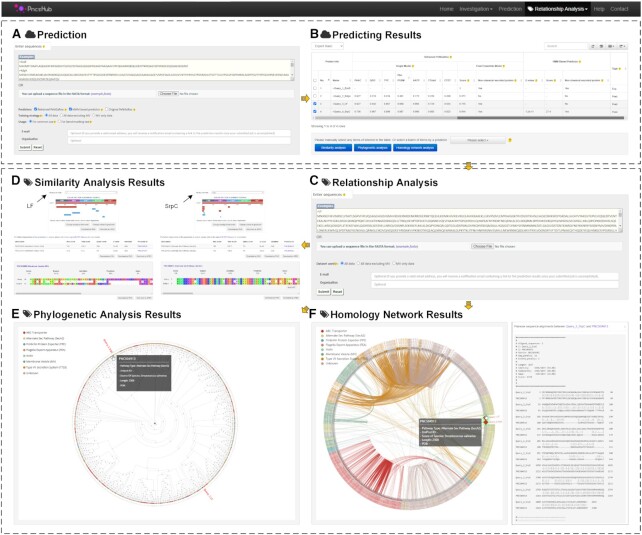
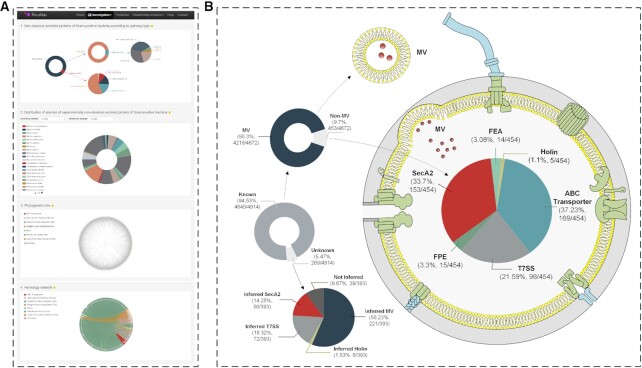
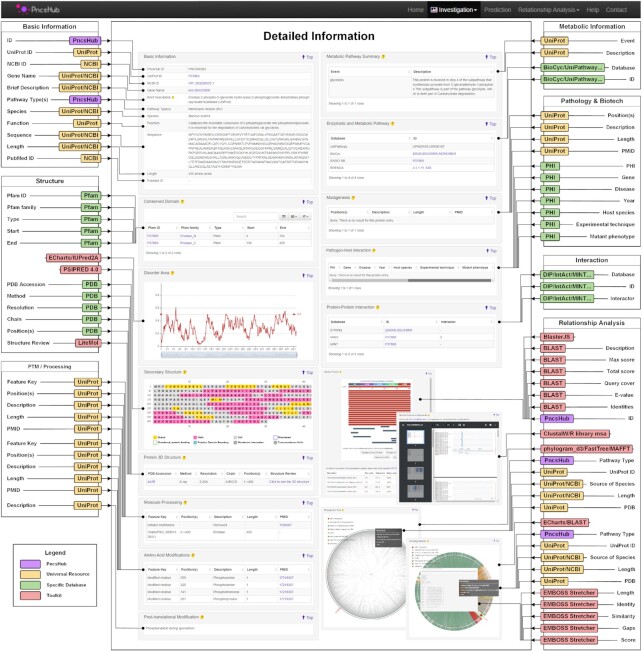
From industry to food to health, bacteria play an important role in all facets of life. Some of the most important bacteria have been purposely engineered to produce commercial quantities of antibiotics and therapeutics, and non-classical secretion systems are at the forefront of these technologies. Unlike the classical Sec or Tat pathways, non-classically secreted proteins share few common characteristics and use much more diverse secretion pathways for protein transport. Systematically categorizing and investigating the non-classically secreted proteins will enable a deeper understanding of their associated secretion mechanisms and provide a landscape of the Gram-positive secretion pathway distribution. We therefore developed PncsHub (https://pncshub.erc.monash.edu/), the first universal platform for comprehensively annotating and analyzing Gram-positive bacterial non-classically secreted proteins. PncsHub catalogs 4,914 non-classically secreted proteins, which are delicately categorized into 8 subtypes (including the 'unknown' subtype) and annotated with data compiled from up to 26 resources and visualisation tools. It incorporates state-of-the-art predictors to identify new and homologous non-classically secreted proteins and includes three analytical modules to visualise the relationships between known and putative non-classically secreted proteins. As such, PncsHub aims to provide integrated services for investigating, predicting and identifying non-classically secreted proteins to promote hypothesis-driven laboratory-based experiments.
从工业到食品再到健康,细菌在生活的各个方面都发挥着重要作用。一些最重要的细菌已被专门设计用来生产商业数量的抗生素和治疗药物,而非经典分泌系统是这些技术的前沿。与经典的 Sec 或 Tat 途径不同,非经典分泌的蛋白质几乎没有共同的特征,并且使用更多样化的分泌途径来运输蛋白质。系统地对非经典分泌蛋白进行分类和研究,将使我们能够更深入地了解它们相关的分泌机制,并提供革兰氏阳性菌分泌途径分布的全景图。因此,我们开发了 PncsHub(https://pncshub.erc.monash.edu/),这是第一个用于全面注释和分析革兰氏阳性细菌非经典分泌蛋白的通用平台。PncsHub 编目了 4914 种非经典分泌蛋白,这些蛋白被精细地分为 8 种亚型(包括“未知”亚型),并使用多达 26 种资源和可视化工具编译的数据进行注释。它集成了最先进的预测器来识别新的和同源的非经典分泌蛋白,并包括三个分析模块,用于可视化已知和推定的非经典分泌蛋白之间的关系。因此,PncsHub 的目标是提供综合服务,用于研究、预测和识别非经典分泌蛋白,以促进基于实验室的假设驱动实验。