Department of Pulmonary Medicine, Fukushima Medical University, Fukushima, Japan.
Department of Respiratory Medicine, National Hospital Organization Hokkaido Cancer Center, Sapporo, Japan.
Oncoimmunology. 2021 Sep 18;10(1):1971430. doi: 10.1080/2162402X.2021.1971430. eCollection 2021.
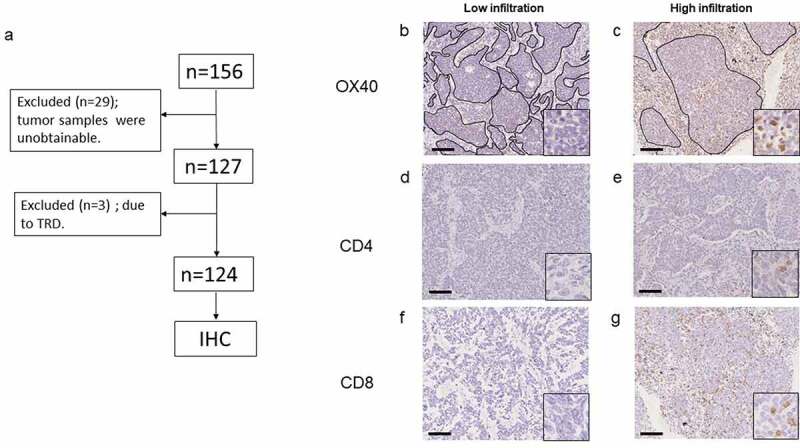
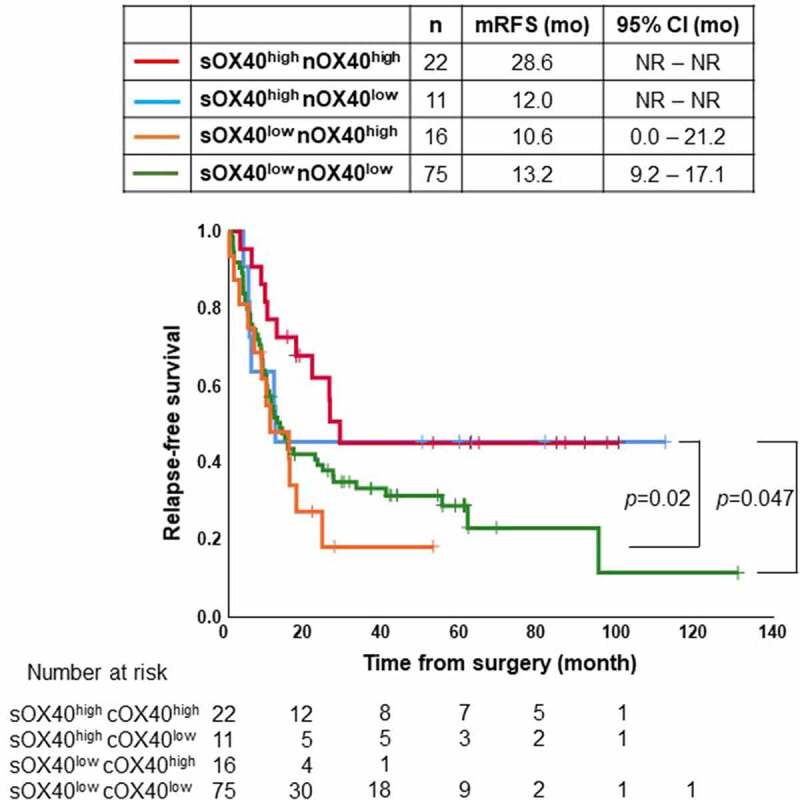
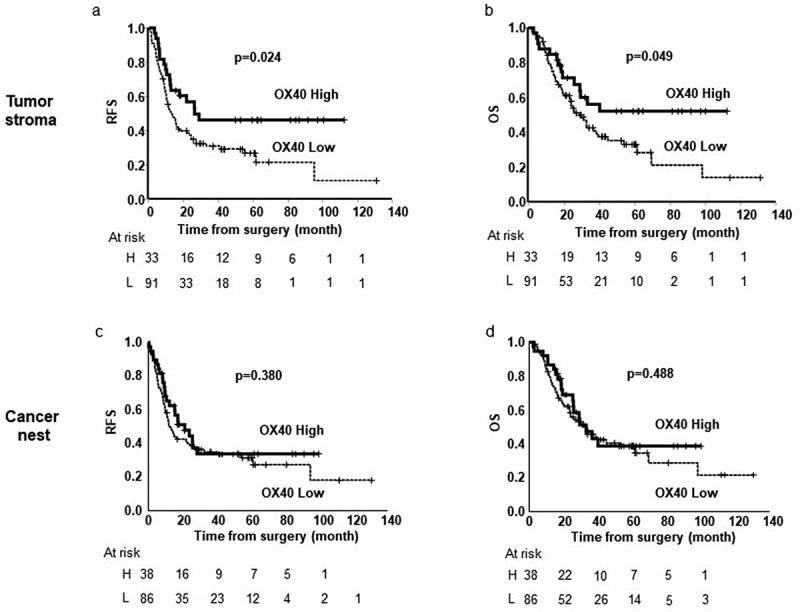
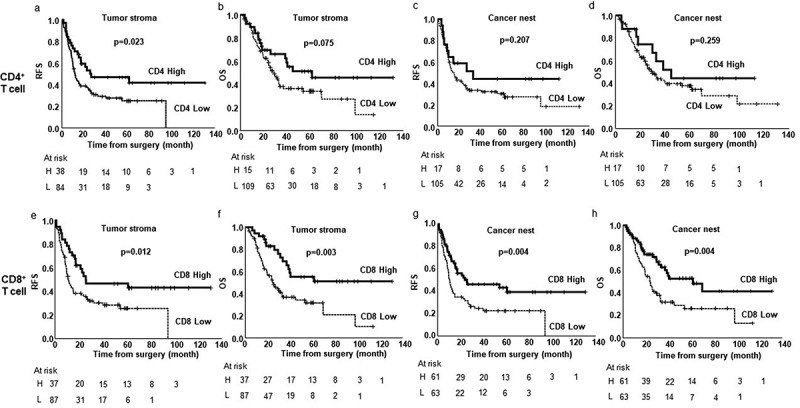
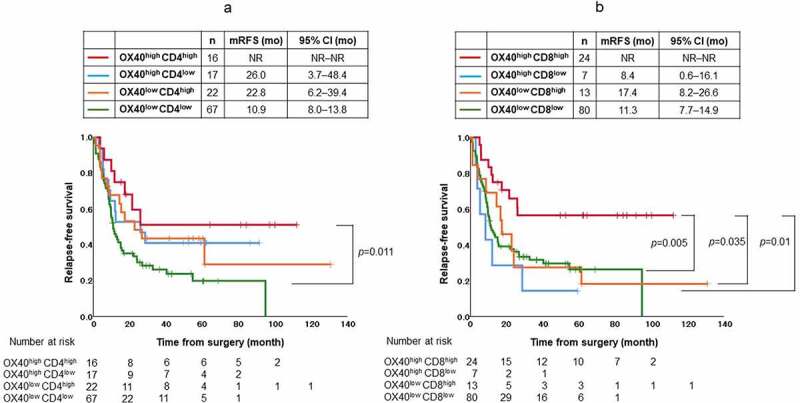
OX40 (CD134) is a co-stimulatory molecule mostly expressed on activated T lymphocytes. Previous reports have shown that OX40 can be an immuno-oncology target and a clinical biomarker for cancers of various organs. In this study, we collected formalin-fixed paraffin-embedded tumor samples from 124 patients with small-cell lung cancer (SCLC) who had undergone surgery. We analyzed the expression profiles of OX40 and other relevant molecules, such as CD4, CD8, and Foxp3, in tumor stroma and cancer nest using immunohistochemistry and investigated their association with survival. High infiltration of OX40 lymphocytes (OX40) in tumor stroma was positively associated with relapse-free survival (RFS) and overall survival (OS) compared with low infiltration of OX40 lymphocytes (OX40) (RFS, median, 26.0 months [95% confidence interval (CI), not reached (NR)-NR] vs 13.2 months [9.1-17.2], = .024; OS, NR [95% CI, NR-NR] vs 29.8 months [21.3-38.2], = .049). Multivariate analysis revealed that OX40 in tumor stroma was an independent indicator of prolonged RFS. Moreover, RFS of patients with OX40/CD4 in tumor stroma was significantly longer than that of patients with OX40/CD4. The RFS of patients with tumor stroma with OX40/CD8 was significantly longer than that of patients with tumor stroma with OX40/CD8, OX40/CD8, or OX40/CD8. These findings suggest that OX40 lymphocytes in tumor stroma play a complementary role in regulating the relapse of early-stage SCLC. Reinforcing immunity by coordinating the recruitment of OX40 lymphocytes with CD4 and CD8 T cells in tumor stroma may constitute a potential immunotherapeutic strategy for patients with SCLC.
OX40(CD134)是一种主要在激活的 T 淋巴细胞上表达的共刺激分子。先前的报告表明,OX40 可以作为免疫肿瘤学的靶点和各种器官癌症的临床生物标志物。在这项研究中,我们收集了 124 名接受手术的小细胞肺癌(SCLC)患者的福尔马林固定石蜡包埋肿瘤样本。我们使用免疫组织化学分析了肿瘤基质和癌巢中 OX40 和其他相关分子(如 CD4、CD8 和 Foxp3)的表达谱,并研究了它们与生存的关联。与 OX40 淋巴细胞浸润低相比,肿瘤基质中 OX40 淋巴细胞浸润高与无复发生存(RFS)和总生存(OS)呈正相关(RFS,中位数,26.0 个月[95%置信区间(CI),未达到(NR)-NR] vs 13.2 个月[9.1-17.2], = 0.024;OS,NR[95%CI,NR-NR] vs 29.8 个月[21.3-38.2], = 0.049)。多变量分析显示,肿瘤基质中的 OX40 是 RFS 延长的独立指标。此外,肿瘤基质中 OX40/CD4 的患者的 RFS 明显长于 OX40/CD4 的患者。肿瘤基质中 OX40/CD8 的患者的 RFS 明显长于肿瘤基质中 OX40/CD8、OX40/CD8 或 OX40/CD8 的患者。这些发现表明,肿瘤基质中的 OX40 淋巴细胞在调节早期 SCLC 的复发中发挥互补作用。通过协调 OX40 淋巴细胞与肿瘤基质中 CD4 和 CD8 T 细胞的募集来增强免疫可能构成 SCLC 患者潜在的免疫治疗策略。