Wong Ker Rui, Sgro Marissa, Yamakawa Glenn R, Li Crystal, McDonald Stuart J, Sun Mujun, Shultz Sandy R, Brady Rhys D, Mychasiuk Richelle
Department of Neuroscience, Central Clinical School, Monash University, Melbourne, VIC, Australia.
Department of Physiology, Anatomy and Microbiology, School of Life Sciences, La Trobe University, Bundoora, VIC, Australia.
Bone Rep. 2021 Sep 8;15:101123. doi: 10.1016/j.bonr.2021.101123. eCollection 2021 Dec.
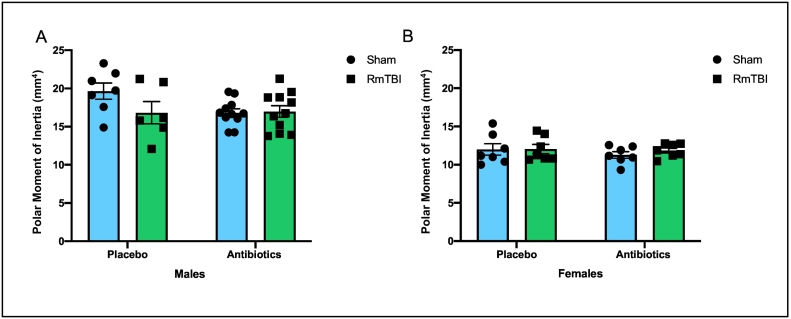
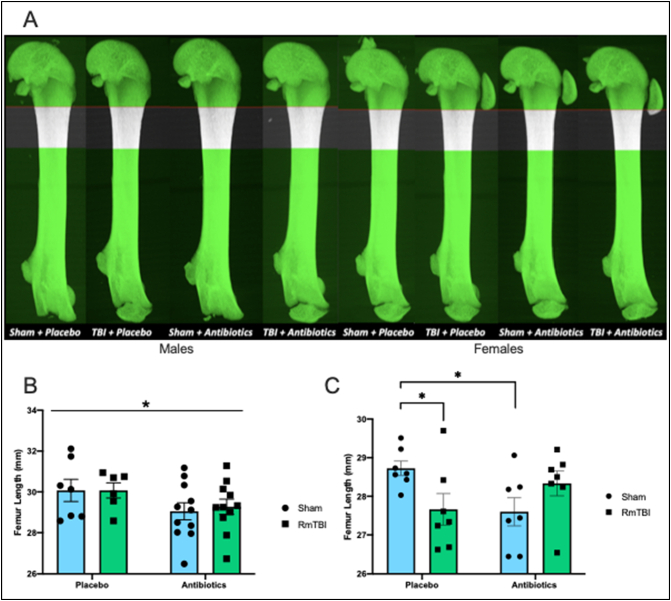
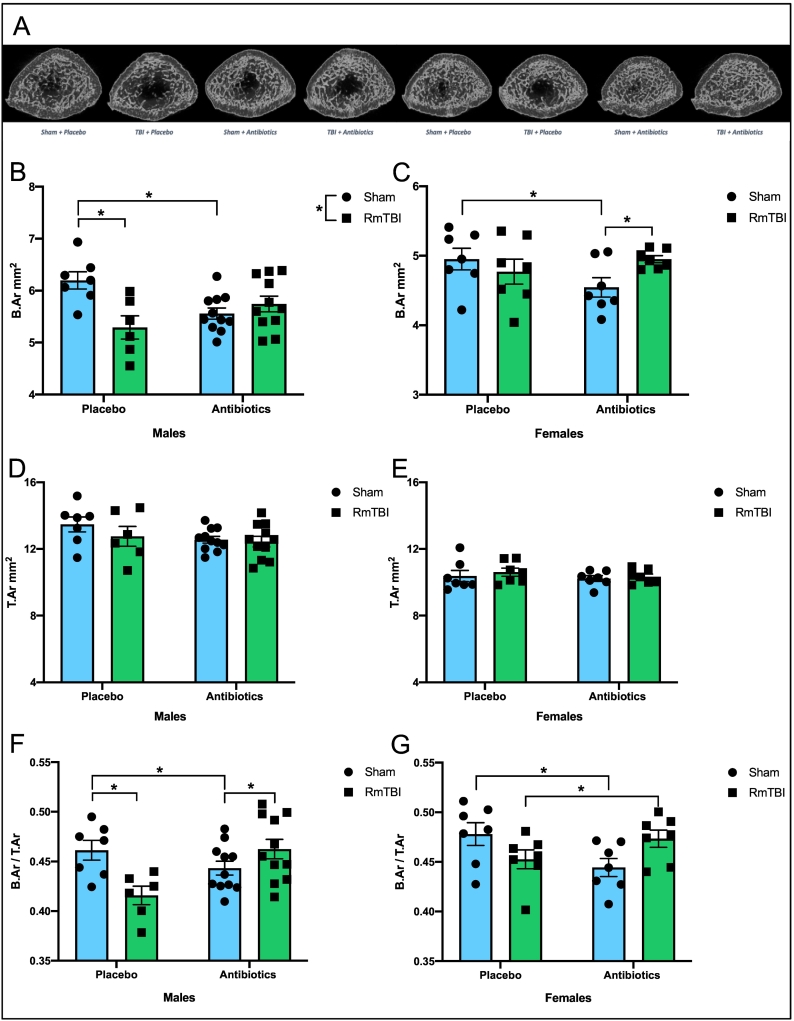
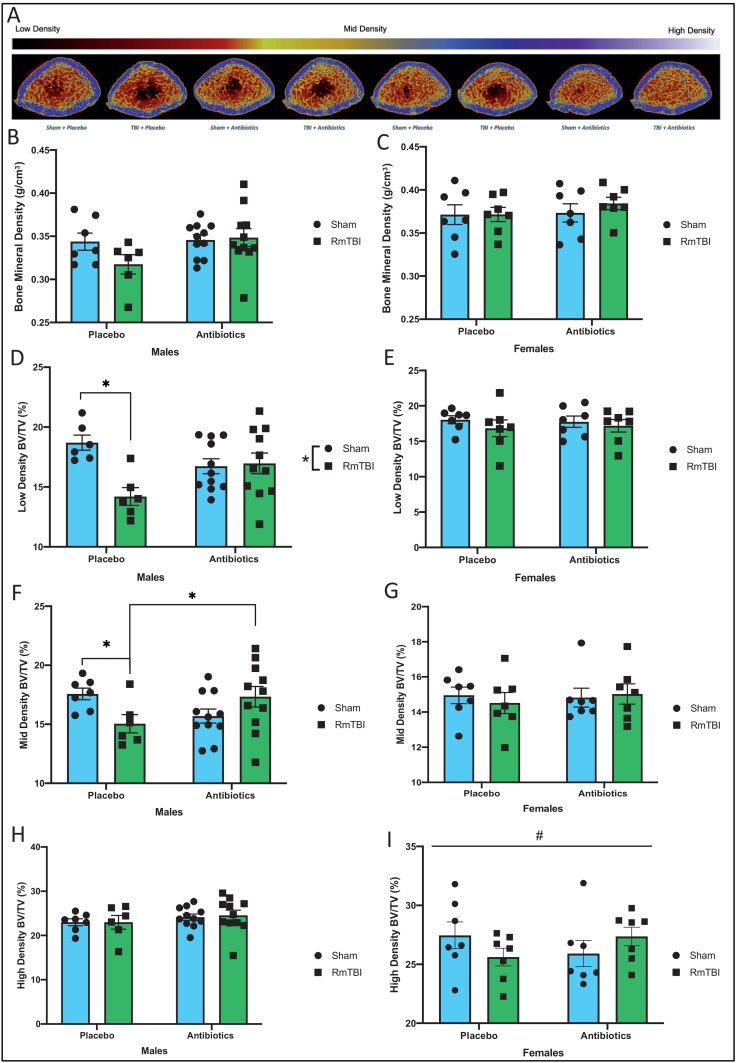
Dysregulation of the gut microbiome has been shown to disrupt both bone formation and bone resorption in several preclinical and clinical models. However, the role of microbiome in adolescent bone development remains poorly understood. This effect of disrupted bone development may be more pronounced during adolescence, when bone development is vulnerable to environmental stimuli and external insults (e.g., antibiotic treatment and traumatic brain injury), as this is a critical window of development. Therefore, in this study, we sought to investigate the effect of repetitive mild traumatic brain injury (RmTBI) and gut microbiome depletion by antibiotic treatment on femur length and bone density in male and female adolescent Sprague Dawley rats. Rats were randomly assigned to receive standard or antibiotic autoclaved drinking water and to receive sham or RmTBIs injuries. Using micro-computed tomography (μCT), we found sexually dimorphic changes in adolescent bone development in response to microbiome depletion and RmTBI. Specifically, gut microbiome depletion stunted femur growth in males and altered cross sectional bone area (CSA), bone area fraction, and the bone volume of low and mid density bone in the distal metaphyseal region of the femur. Conversely, RmTBI and antibiotic treatment individually disrupted bone growth, bone area fraction, and bone volume of high-density bone within the distal metaphyseal region of the femur in females, but not when combined. Therefore, findings from this study indicate that gut microbiome and RmTBI may alter bone development in a sex-dependent manner during adolescence.
在多个临床前和临床模型中,肠道微生物群失调已被证明会破坏骨形成和骨吸收。然而,微生物群在青少年骨骼发育中的作用仍知之甚少。在青春期,当骨骼发育容易受到环境刺激和外部损伤(如抗生素治疗和创伤性脑损伤)影响时,这种骨骼发育紊乱的影响可能会更加明显,因为这是一个关键的发育窗口。因此,在本研究中,我们试图研究重复性轻度创伤性脑损伤(RmTBI)和抗生素治疗导致的肠道微生物群耗竭对雄性和雌性青少年Sprague Dawley大鼠股骨长度和骨密度的影响。将大鼠随机分为接受标准或抗生素高压灭菌饮用水组,并接受假手术或RmTBI损伤。使用微计算机断层扫描(μCT),我们发现青少年骨骼发育中存在性别差异,这是对微生物群耗竭和RmTBI的反应。具体而言,肠道微生物群耗竭阻碍了雄性大鼠的股骨生长,并改变了股骨远端干骺端区域的横截面骨面积(CSA)、骨面积分数以及低密度和中密度骨的骨体积。相反,RmTBI和抗生素治疗单独破坏了雌性大鼠股骨远端干骺端区域高密度骨的骨生长、骨面积分数和骨体积,但联合使用时则没有。因此,本研究结果表明,肠道微生物群和RmTBI可能在青春期以性别依赖的方式改变骨骼发育。