Vogsen Marianne, Jensen Jeanette Dupont, Gerke Oke, Jylling Anne Marie Bak, Asmussen Jon Thor, Christensen Ivar Yannick, Braad Poul-Erik, Thye-Rønn Peter, Søe Katrine Lydolph, Ewertz Marianne, Hildebrandt Malene Grubbe
Department of Oncology, Odense University Hospital, 5000, Odense C, Denmark.
Department of Nuclear Medicine, Odense University Hospital, Odense, Denmark.
EJNMMI Res. 2021 Sep 22;11(1):93. doi: 10.1186/s13550-021-00833-3.
[F]-fluorodeoxyglucose-positron emission tomography/computed tomography ([F]FDG-PET/CT) has been implemented sporadically in hospital settings as the standard of care examination for recurrent breast cancer. We aimed to explore the clinical impact of implementing [F]FDG-PET/CT for patients with clinically suspected recurrent breast cancer and validate the diagnostic accuracy.
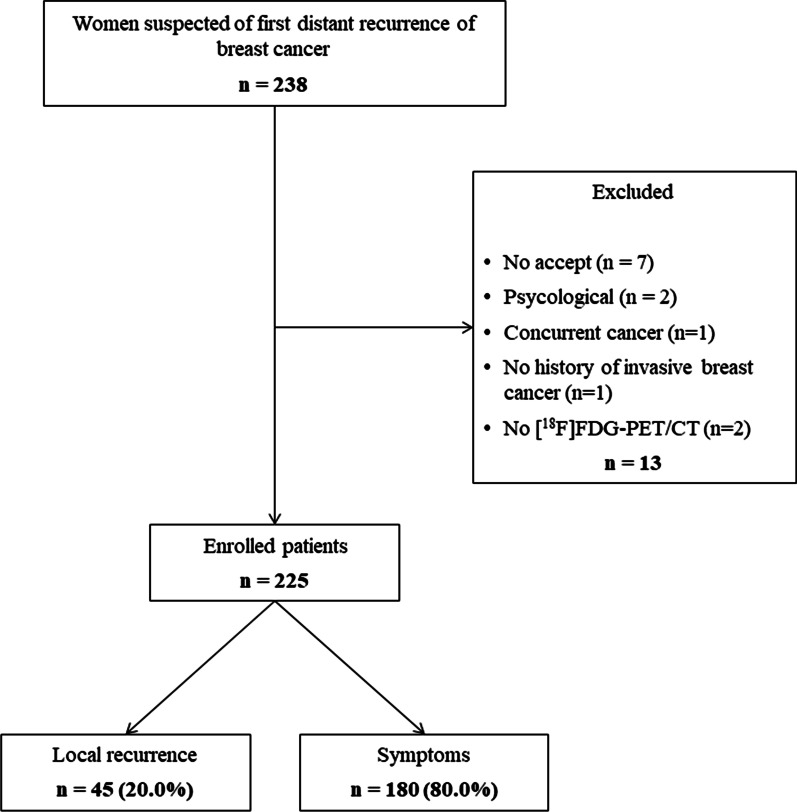
Women with suspected distant recurrent breast cancer were prospectively enrolled in the study between September 2017 and August 2019. [F]FDG-PET/CT was performed, and the appearance of incidental benign and malignant findings was registered. Additional examinations, complications, and the final diagnosis were registered to reflect the clinical consequence of such findings. The diagnostic accuracy of [F]FDG-PET/CT as a stand-alone examination was analyzed. Biopsy and follow-up were used as a reference standard.
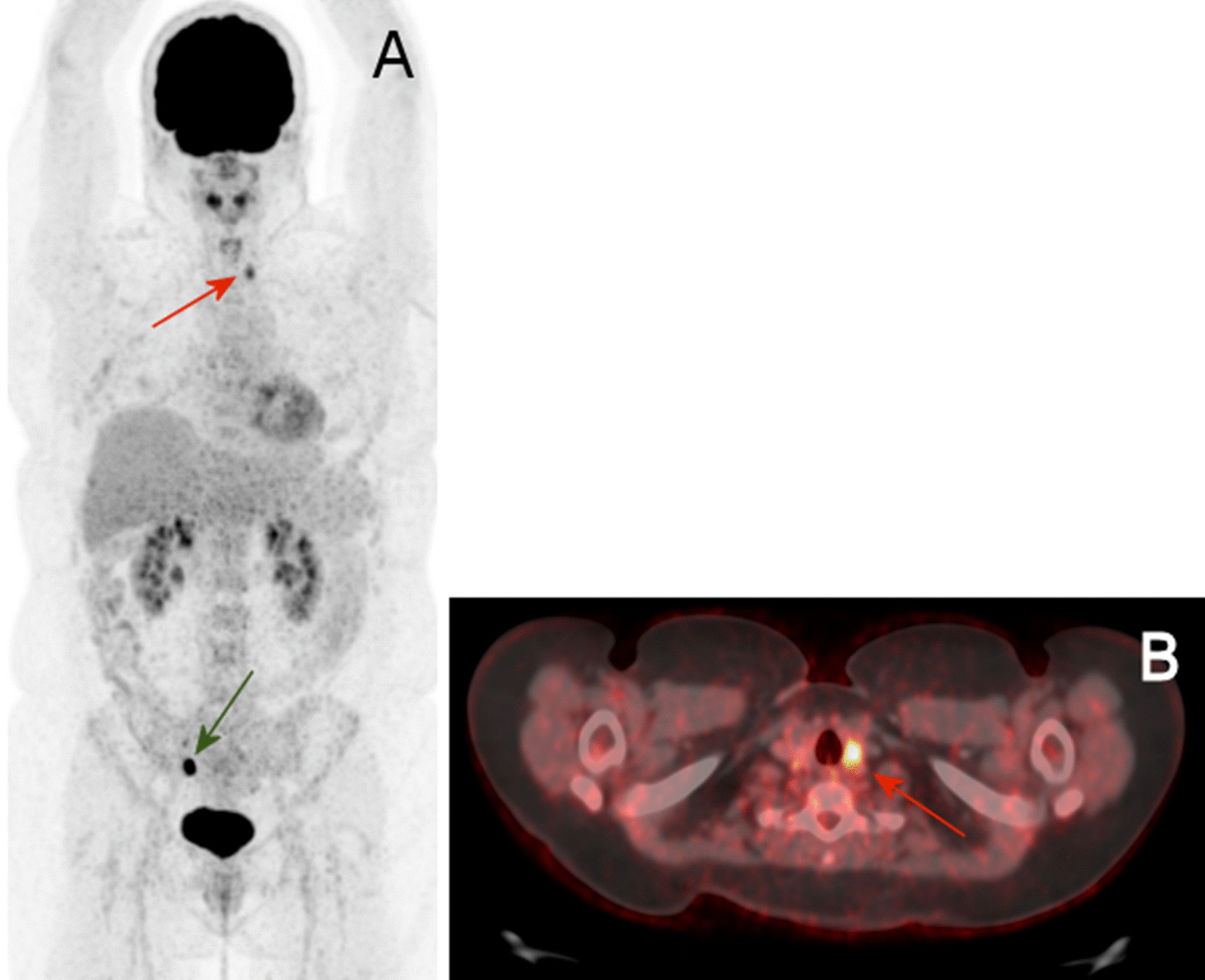
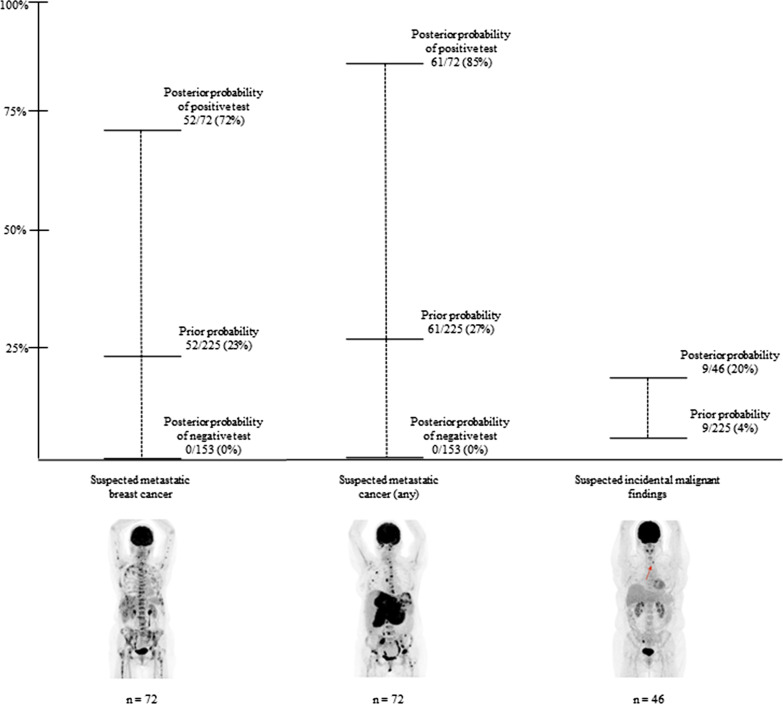
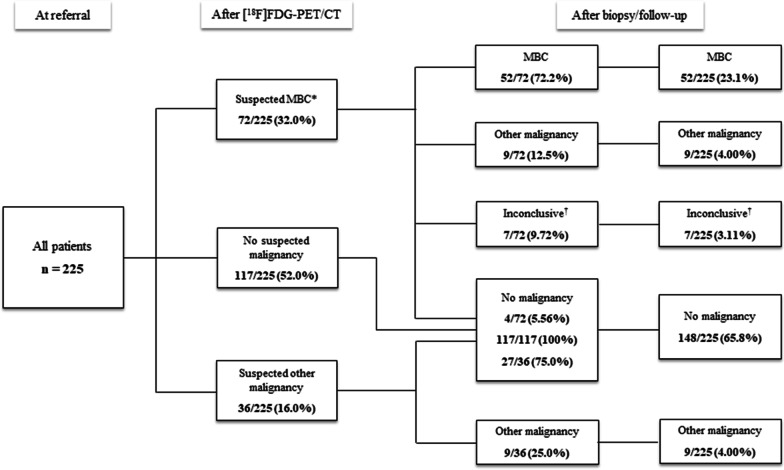
[F]FDG-PET/CT reported breast cancer metastases in 72 of 225 women (32.0%), and metastases were verified by biopsy in 52 (52/225, 23.1%). Prior probability and posterior probability of a positive test for suspected metastatic cancer and incidental malignancies were 27%/85% and 4%/20%, respectively. Suspected malignant incidental findings were reported in 46 patients (46/225, 20.4%), leading to further examinations and final detection of nine synchronous cancers (9/225, 4.0%). These cancers originated from the lung, thyroid, skin, pancreas, peritoneum, breast, kidney, one was malignant melanoma, and one was hematological cancer. False-positive incidental malignant findings were examined in 37/225 patients (16.4%), mainly in the colon (n = 12) and thyroid gland (n = 12). Ten incidental findings suspicious for benign disease were suggested by [F]FDG-PET/CT, and further examinations resulted in the detection of three benign conditions requiring treatment. Sensitivity, specificity, and AUC-ROC for diagnosing distant metastases were 1.00 (0.93-1.0), 0.88 (0.82-0.92), and 0.98 (95% CI 0.97-0.99), respectively.
[F]FDG-PET/CT provided a high posterior probability of positive test, and a negative test was able to rule out distant metastases in women with clinically suspected recurrent breast cancer. One-fifth of patients examined for incidental findings detected on [F]FDG-PET/CT were diagnosed with clinically relevant conditions. Further examinations of false-positive incidental findings in one of six women should be weighed against the high accuracy for diagnosing metastatic breast cancer. Trial registration Clinical.Trials.gov. NCT03358589. Registered 30 November 2017-Retrospectively registered, http://www.ClinicalTrials.gov.
[F]氟脱氧葡萄糖正电子发射断层扫描/计算机断层扫描([F]FDG-PET/CT)已在医院环境中偶尔用作复发性乳腺癌的标准护理检查。我们旨在探讨对临床怀疑为复发性乳腺癌的患者实施[F]FDG-PET/CT的临床影响,并验证其诊断准确性。
2017年9月至2019年8月期间,前瞻性纳入疑似远处复发性乳腺癌的女性患者。进行[F]FDG-PET/CT检查,并记录偶然发现的良性和恶性病变的情况。记录额外的检查、并发症及最终诊断,以反映这些发现的临床后果。分析[F]FDG-PET/CT作为独立检查的诊断准确性。活检和随访用作参考标准。
225名女性中,[F]FDG-PET/CT报告有乳腺癌转移的有72例(32.0%),其中52例(52/225,23.1%)经活检证实有转移。疑似转移性癌症和偶然恶性肿瘤的阳性检测的先验概率和后验概率分别为27%/85%和4%/20%。46例患者(46/225,20.4%)报告有疑似恶性偶然发现,导致进一步检查并最终检测出9例同步性癌症(9/225,4.0%)。这些癌症起源于肺、甲状腺、皮肤、胰腺、腹膜、乳腺、肾脏,1例为恶性黑色素瘤,1例为血液系统癌症。37/225例患者(16.4%)有假阳性偶然恶性发现,主要在结肠(n = 12)和甲状腺(n = 12)。[F]FDG-PET/CT提示10例偶然发现疑似良性疾病,进一步检查发现3例需要治疗的良性疾病。诊断远处转移的敏感性、特异性和AUC-ROC分别为1.00(0.93 - 1.0)、0.88(0.82 - 0.92)和0.98(95%CI 0.97 - 0.99)。
[F]FDG-PET/CT提供了较高的阳性检测后验概率,阴性检测能够排除临床怀疑为复发性乳腺癌女性的远处转移。在因[F]FDG-PET/CT上的偶然发现而接受检查的患者中,五分之一被诊断为有临床相关疾病。对于六分之一女性中的假阳性偶然发现进行进一步检查时,应权衡其对诊断转移性乳腺癌的高准确性。试验注册Clinical.Trials.gov。NCT03358589。2017年11月30日注册 - 追溯注册,http://www.ClinicalTrials.gov。