Department for Orthopedics and Traumatology, Kepler University Hospital GmbH, Krankenhausstrasse 9, 4020, Linz, Austria.
Johannes Kepler University Linz, Altenberger Strasse 69, 4040, Linz, Austria.
Arch Orthop Trauma Surg. 2022 Oct;142(10):2935-2944. doi: 10.1007/s00402-021-04176-5. Epub 2021 Sep 23.
Short stems are increasingly used in in total hip arthroplasty (THA) because of advantages in bone and soft tissue preservation and reconstruction of hip geometry. Short stems can be inserted in a more varus position compared to conventional straight stems. This poses the risk of final varus misplacement of the femoral component, which is not intended in all femoral short stems.
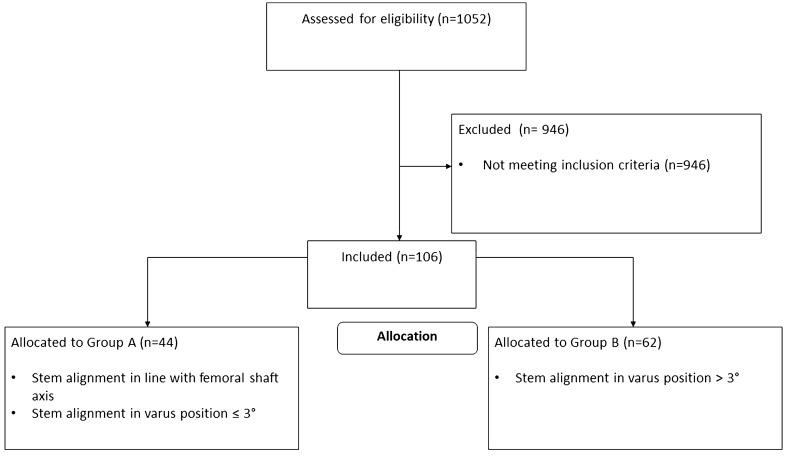
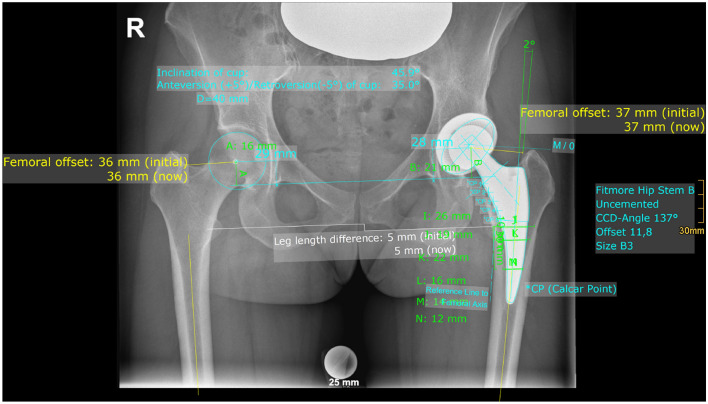
We wanted to evaluate the effect of a high varus stem positioning in MIS THA on hip offset, leg length and femoral canal fill index. A series of 1052 consecutive THAs with a singular cementless femoral short stem and press-fit cup was retrospectively screened for inclusion. One hundred six patients with unilateral THA and a contralateral healthy hip met the inclusion criteria. Measurements were carried out on preoperative and 3 months anterior-posterior postoperative radiographs. Patients were divided into Group A (varus stem alignment ≤ 3°) and Group B (varus stem alignment > 3°).
Hip offset (HO) increased significantly in Group B by 4 mm (p = 0.013). No influence on leg length difference was detected in both groups. Preoperative CCD angle was significantly lower in Group B (p < 0.001). Canal Fill Indices (CFI) were significantly lower in Group B (CFI I: p < 0.001; CFI II p = 0.003; CF III p = 0.002).
High varus stem alignment > 3° leads to a statistically significant but minor increase in HO and poses the risk of stem undersizing. A preoperatively low genuine CCD angle pose a risk for varus stem positioning.
在全髋关节置换术(THA)中,越来越多地使用短柄,因为其具有保留骨和软组织以及重建髋关节几何形状的优势。与传统的直柄相比,短柄可以插入更内翻的位置。这会导致股骨部件最终出现内翻错位的风险,但并非所有股骨短柄都希望出现这种情况。
我们想评估在微创 THA 中高内翻的股骨柄定位对髋关节中心边缘距(Hip offset)、下肢长度和股骨通道填充指数的影响。回顾性筛选了 1052 例连续的、使用单一非骨水泥股骨短柄和压配杯的 THA 病例,以纳入研究。106 例单侧 THA 且对侧髋关节健康的患者符合纳入标准。术前和术后 3 个月的前后位 X 线片进行了测量。患者被分为 A 组(内翻的股骨柄 alignment≤3°)和 B 组(内翻的股骨柄 alignment>3°)。
B 组的髋关节中心边缘距(Hip offset)显著增加了 4 毫米(p=0.013)。两组的下肢长度差异均无影响。B 组术前的中心性髋臼角(CCD angle)明显较低(p<0.001)。B 组的通道填充指数(CFI)明显较低(CFI I:p<0.001;CFI II p=0.003;CF III p=0.002)。
高内翻的股骨柄 alignment>3°会导致髋关节中心边缘距(Hip offset)出现统计学上但较小的增加,并增加股骨柄尺寸选择不当的风险。术前真实的中心性髋臼角较低会增加股骨柄内翻定位的风险。