Laboratory of Biomechanics, Justus-Liebig-University Giessen, Klinikstrasse 29, 35392, Giessen, Germany.
Department of Orthopaedics and Orthopaedic Surgery, University Hospital Giessen and Marburg (UKGM), Klinikstrasse 33, 35392, Giessen, Germany.
Arch Orthop Trauma Surg. 2023 Nov;143(11):6589-6597. doi: 10.1007/s00402-023-04977-w. Epub 2023 Jul 7.
Self-monitoring is crucial to work progressively with a high-quality standard. A retrospective analysis is a valuable tool for studying the postoperative outcome of a prosthesis and for evaluating the learning process for the surgeon.
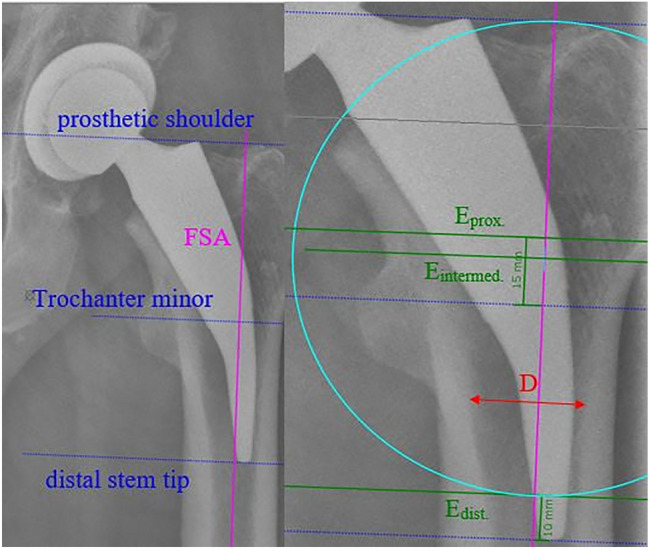
The learning process of one surgeon was analysed in 133 cases of hip arthroplasty. These were divided into seven groups representing the surgical years 2008-2014. Over the course of 3 postoperative years, a total of 655 radiographs were analysed at regarding three radiological quality parameters (centrum-collum-diaphyseal angle (CCD angle), intramedullary fit&fill ratio (FFR), and migration) and ancillary outcome parameters (Harris Hip Score (HHS), blood loss, operating time, and complications). This period was divided into five times: 1st-day post-op, 6 M, 12 M, 24 M, and 36 M. Bivariate Spearman's correlation analysis and pairwise comparisons were performed.
The total collective achieved a proximal FFR of over 0.8. The distal prosthesis tip migrated and was located on the lateral cortex within the first months. The CCD angle initially showed a variation with a subsequent constant course. The HHS showed a significant increase (p < 0.001) to over 90 points postoperatively. Over time, the operating time and blood loss decreased. Intraoperative complications existed only at the beginning of the learning phase. A learning curve effect can be determined for almost all parameters by comparing the subject groups.
Operative expertise was shown to gain through a learning curve, whereby postoperative results corresponded to the system philosophy of the short hip stem prosthesis. The distal FFR and the distal lateral distance could represent the principle of the prosthesis, which overall could be an interesting approach for verification of a new parameter.
自我监测对于以高质量标准逐步推进工作至关重要。回顾性分析是研究假体术后结果和评估外科医生学习过程的宝贵工具。
对一位外科医生的学习过程进行了分析,共涉及 133 例髋关节置换病例。这些病例分为七个组,代表 2008-2014 年的手术年份。在 3 年的术后期间,对 655 张 X 光片进行了分析,涉及三个影像学质量参数(中心-干骺端-骨干角(CCD 角)、髓内适配和填充比(FFR)以及迁移)和辅助结果参数(Harris 髋关节评分(HHS)、失血量、手术时间和并发症)。该时间段分为五个时间点:术后第 1 天、6 个月、12 个月、24 个月和 36 个月。进行了双变量 Spearman 相关分析和两两比较。
总体而言,近端 FFR 超过 0.8。远侧假体尖端在最初几个月内向外侧皮质迁移。CCD 角最初表现出变化,随后呈持续趋势。HHS 术后显著增加(p<0.001),超过 90 分。随着时间的推移,手术时间和失血量减少。术中并发症仅在学习阶段开始时存在。通过比较主题组,可以确定几乎所有参数的学习曲线效应。
通过学习曲线可以证明手术技术的提高,术后结果符合短髋骨柄假体的系统哲学。远端 FFR 和远端外侧距离可以代表假体的原则,这可能是验证新参数的有趣方法。